We are sleepwalking into a new nuclear arms race. More complex, more unpredictable, and even more dangerous. New technologies and new domains of conflict have erased the margin for error. From cyberspace to outer space, from hypersonic missiles to deep sea drones, the risks of escalation and miscalculation are multiplying. This is not just a crisis of weapons. It is a crisis of memory, responsibility and courage.
Developments and trends, 2025
Nuclear risks continued to intensify in 2025, as deepening geopolitical tensions and hardening divisions among major powers further diminished prospects for progress on nuclear disarmament and non‑proliferation while threatening decades of hard-won gains. References to a possible “nuclear tipping point”, once largely framed as a warning, became a recurring feature of international discourse, reflecting a climate of mistrust and concern over the erosion of long‑standing norms, commitments and guardrails.
The ongoing war in Ukraine continued to weigh heavily on relations among the five nuclear-weapon States recognized by the Treaty on the Non-Proliferation of Nuclear Weapons (NPT), including on efforts to bring them together to discuss their unique responsibilities under the Treaty. For another year, no ministerial-level meeting took place under the P5 Process, although working-level meetings continued.
Concerns also grew over regional proliferation pressures, the prospect of renewed nuclear explosive testing and the impending expiration of the Treaty on Measures for the Further Reduction and Limitation of Strategic Offensive Arms (New START Treaty) in February 2026 representing the effective end of strategic nuclear arms control. In an environment marked by nuclear competition and eroding arms control arrangements, the risks of accident, miscalculation and unintended escalation remained acute.
The possibility of a renewed nuclear arms race moved to the forefront of international discussions. Amid ongoing calls for greater transparency and accountability regarding China’s nuclear arsenal, the United States highlighted its own ongoing efforts to modernize its nuclear triad, as well as its nuclear command, control and communications architecture. In the Russian Federation, following the 2024 decree on the “Fundamentals of the State Policy of the Russian Federation in the field of Nuclear Deterrence”, President Vladimir Putin reiterated, at an expanded meeting of the Ministry of Defence Board, that improving the country’s strategic nuclear forces remained a priority.
Regional proliferation challenges, particularly regarding the nuclear programme of the Islamic Republic of Iran, reached a critical point in 2025. Israeli and United States military strikes against Iranian military installations and nuclear facilities in June led the International Atomic Energy Agency (IAEA) to halt all in‑field verification activities in the country. While discussions continued on modalities for the return of IAEA inspectors, France, Germany and the United Kingdom notified the Security Council on 28 August of what they described as the Islamic Republic of Iran’s “significant non‑performance” of its nuclear commitments under the Joint Comprehensive Plan of Action (JCPOA), thereby activating the “snapback” mechanism under Security Council resolution 2231 (2015). After two draft resolutions aimed at extending the termination of prior sanctions failed to obtain the required number of votes, the Secretary‑General announced on 28 September that, consistent with resolution 2231 (2015), all pre‑2015 Security Council sanctions on Iran had been reapplied. The Islamic Republic of Iran, along with China and the Russian Federation, rejected the reinstated measures.
Throughout the year, the IAEA continued to report to its Board of Governors and the Security Council on the implementation by the Islamic Republic of Iran of its nuclear-related commitments under the JCPOA, as well as on verification and monitoring in the country in view of Security Council resolution 2231 (2015). The Agency also continued its quarterly reporting on the implementation of the country’s NPT safeguards agreement. On 31 May, the Agency concluded that several locations had formed part of an undeclared structured nuclear programme until the early 2000s, involving the use of undeclared nuclear material, while also stating that it had no credible indications of an ongoing undeclared programme. It further stated that the Islamic Republic of Iran’s cooperation in addressing long-standing safeguards questions had been less than satisfactory, even as the country continued to cooperate with the IAEA on matters of routine safeguards implementation.
The Democratic People’s Republic of Korea continued to advance its nuclear and missile programmes in 2025, conducting ballistic‑missile launches of various ranges on six occasions in violation of relevant Security Council resolutions. Although the exact number of missiles fired in several incidents could not be determined, the overall frequency of launches was lower than in 2023 and 2024. Notably, 2025 included the launch on 6 January of an intermediate‑range ballistic missile and, in October, the unveiling of a new solid‑fuel intercontinental ballistic missile. Those activities occurred as the country entered the final year of its five‑year military development plan announced in 2021.
Those dynamics negatively affected multilateral and treaty processes. At the third session of the Preparatory Committee for the 2026 NPT Review Conference, which took place from 28 April to 9 May, divisions were evident over the lack of progress on nuclear disarmament, the future of strategic arms control, the Islamic Republic of Iran, the Democratic People’s Republic of Korea, export controls and restrictions on access to the peaceful uses of nuclear energy, naval nuclear propulsion, transparency and the relationship between nuclear weapons and emerging technologies, in particular artificial intelligence. Conflicts in Ukraine and Gaza, nuclear threats and broader tensions in the Middle East also remained major points of contention, weakening prospects for consensus in multilateral bodies, particularly in the NPT review process.
Nonetheless, the session demonstrated continued commitment among States parties to the Treaty and to improving its review process. There was broad agreement that the 2026 Review Conference, through a subsidiary body or otherwise, should consider detailed modalities for strengthened reporting. However, nuclear sharing and extended deterrence re-emerged as significant obstacles to agreement.
The NPT continued to expand its membership, with Ghana ratifying the Treaty and Kyrgyzstan signing it. The Treaty’s intersessional process continued through the work of informal working groups and facilitators before and after the third Meeting of States Parties, held from 3 to 7 March. The Scientific Advisory Group continued to provide independent technical expertise, submitting both its annual report and an updated assessment of nuclear weapon-related developments. The third Meeting of States Parties established a new consultative process to review and potentially renew the Group’s mandate before the first Review Conference, appointing Mexico as coordinator.
Membership of the Comprehensive Nuclear-Test-Ban Treaty did not change in 2025, remaining at 187 signatories and 178 ratifications. However, during the annual commemoration of the International Day against Nuclear Tests on 29 August, States made clear the growing priority over preserving the international norm against nuclear testing.
Recent mandates of the General Assembly in the field of nuclear disarmament and non-proliferation also advanced in 2025. The independent Scientific Panel on the Effects of Nuclear War, established pursuant to resolution 79/238, began its work in the second half of the year, with its Chair providing an update to the First Committee. The Panel was expected to continue its work throughout 2026 and report to the General Assembly at its eighty-second session, in 2027. In addition, the qualified group of experts mandated by resolution 79/241 to prepare a study on nuclear-weapon-free zones — the first such study in nearly 50 years — was constituted and began meeting in 2025. It aimed to submit the study to the General Assembly at its eighty-first session in 2026.
Following the work of the Group of Governmental Experts on Nuclear Disarmament Verification, the Secretary-General was requested to submit a report containing possible options for establishing a group of scientific and technical experts on nuclear disarmament verification within the United Nations, taking into account the views submitted by Member States in writing and through three informal in-person meetings. After those meetings were held and views received, the Secretary-General submitted his report (A/80/93). The General Assembly subsequently requested, by resolution 80/53, the Secretary-General to establish a group of scientific and technical experts on nuclear disarmament verification within the United Nations, consisting of 21 members. participating in their personal capacity and without prejudice to national positions in future negotiations. The Group’s report was due to be submitted to the General Assembly in 2029, reflecting continued commitment of States to making progress in nuclear disarmament and non-proliferation, despite the broader deterioration in the international environment.
Meanwhile, at the sixth session of the Conference on the Establishment of a Middle East Zone Free of Nuclear Weapons and Other Weapons of Mass Destruction, participating States engaged in substantive deliberations on key aspects of a future treaty, including negative security assurances, cooperation, consultation and clarification, dispute settlement and cooperation between existing nuclear-weapon-free zones and the Conference.
Figure 1. Early participation in selected nuclear disarmament and non-proliferation treaties
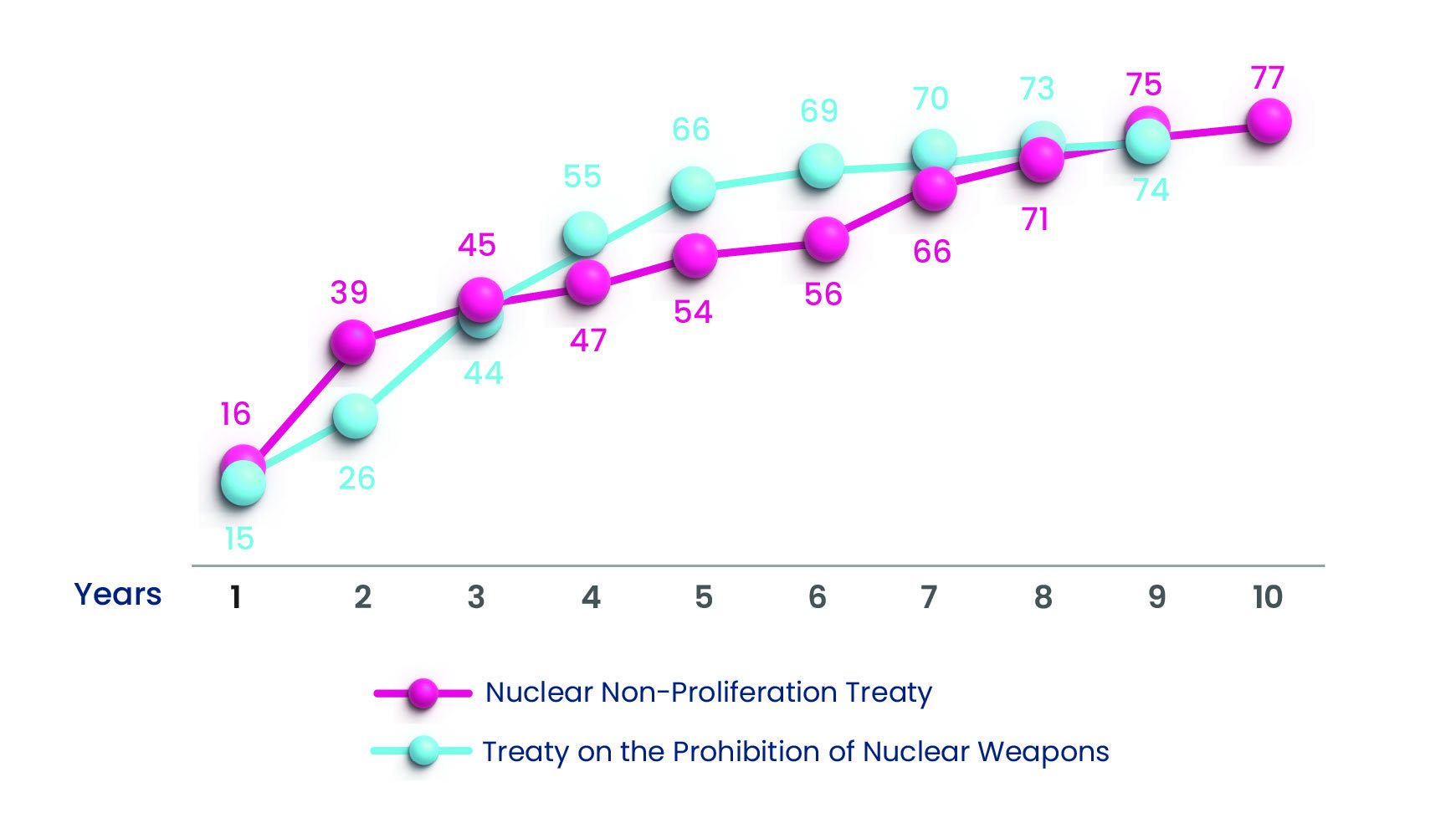
This chart shows the cumulative number of States parties during the first ten years following the opening for signature of the Treaty on the Non-Proliferation of Nuclear Weapons (NPT) in 1968 and the Treaty on the Prohibition of Nuclear Weapons (TPNW) in 2017.

On 9 August in Nagasaki, High Representative for Disarmament Affairs Izumi Nakamitsu participated in the commemoration of the eightieth anniversary of the atomic bombing, delivering a statement on behalf of the Secretary-General and laying flowers in remembrance of victims and the enduring legacy of the survivors, the hibakusha.
Issues related to the Treaty on the Non-Proliferation of Nuclear Weapons
The Treaty on the Non-Proliferation of Nuclear Weapons (NPT) is a landmark international treaty whose objectives are to prevent the spread of nuclear weapons and weapons technology, promote cooperation in the peaceful uses of nuclear energy, and further the goal of nuclear disarmament and general and complete disarmament.
Third session of the Preparatory Committee for the 2026 Review Conference of the Parties to the Treaty on the Non-Proliferation of Nuclear Weapons
The Preparatory Committee for the 2026 NPT Review Conference held its third session in New York from 28 April to 9 May, with Harold Adlai Agyeman (Ghana) serving as Chair. Representatives from 145 States parties, nine international organizations and 80 non-governmental organizations participated in the session (for the list of participants, see NPT/ CONF.2026/PC.III/INF/6). The Committee then adopted a final report (NPT/CONF.2026/1).
The High Representative for Disarmament Affairs, Izumi Nakamitsu, in her opening statement to the Preparatory Committee, expressed her continued concern about the current international environment and the erosion of the disarmament and non-proliferation architecture. She identified several priority issues for States parties’ consideration: (a) accelerated implementation of existing commitments; (b) recommitment to article VI; (c) ways to prevent nuclear war or any use of a nuclear weapon, including through avoiding nuclear threats, and seeking out transparency and confidence-building measures; (d) supporting the viability of the non-proliferation regime through support to the IAEA; (e) and reinforcing the inalienable right to develop research, production and use of nuclear energy for peaceful purposes, as well as the link between the NPT and development.
The Preparatory Committee set aside five meetings for a general debate on issues related to all aspects of its work. It heard 108 statements by States parties and 21 statements by non-governmental organizations.
States parties reaffirmed that the Treaty remained the foundation of the global nuclear non‑proliferation regime and a key contributor to international peace, security and stability. They also underscored the need for balanced implementation of its three pillars, stressing that each strengthened and supported the others.
National positions under the Treaty’s three “pillars” — disarmament, non-proliferation and peaceful uses of nuclear energy — continued to reflect long-standing divisions among States parties. Throughout 2025, frustration further intensified over what many States saw as an imbalance in the implementation of Treaty commitments, particularly concerning nuclear disarmament and the 1995 resolution on the Middle East. Statements highlighted the slow progress of implementation of decisions 1 and 2 of the 1995 Review and Extension Conference and the resolution on the Middle East adopted at that meeting (NPT/CONF.1995/32 (Part I), annex); the final document of the 2000 Review Conference (NPT/CONF.2000/28 (Parts I and II)); and the conclusions and recommendations for follow-on actions adopted at the 2010 Review Conference (NPT/CONF.2010/50 (Vol. I)).
As at the first and second sessions of the Preparatory Committee, nuclear sharing and extended deterrence featured as prominent issues, alongside the nuclear programme of the Islamic Republic of Iran and the wars in Ukraine and Gaza.
Following the general exchange of views, the Committee organized its work into three clusters, allocating equal time to each of the Treaty’s three pillars: (a) non-proliferation of nuclear weapons, disarmament and international peace and security; (b) non-proliferation of nuclear weapons, safeguards and nuclear-weapon-free zones; and (c) the inalienable right of all NPT States parties to develop research, production and use of nuclear energy for peaceful purposes, without discrimination and in conformity with articles I and II of the Treaty. The clusters addressed, respectively: (a) nuclear disarmament and security assurances; (b) regional issues, including with respect to the Middle East and the implementation of the 1995 resolution on the Middle East; and (c) peaceful uses of nuclear energy and other provisions of the Treaty. The Committee also considered ways to improve the effectiveness of the strengthened review process.
Cluster 1
States parties reaffirmed their commitment to the full and effective implementation of article VI of the Treaty, stressing that such implementation was essential to the Treaty’s credibility and to advancing nuclear disarmament. They recalled the outcomes of the 1995, 2000 and 2010 Review Conferences and emphasized that all past commitments remained valid until fulfilled. States parties also reiterated the unequivocal undertaking made by the nuclear‑weapon States in 2000, and reaffirmed in 2010, to eliminate their nuclear arsenals.
Many States parties expressed deep concern over the lack of progress in implementing nuclear disarmament obligations and commitments. They highlighted the need for sustained unilateral, bilateral, regional and multilateral efforts to reduce and ultimately eliminate both deployed and non‑deployed nuclear weapons in a transparent, irreversible and verifiable manner, urging the States with the largest arsenals to lead those efforts.
Delegations also addressed the worsening international security environment. Many emphasized that worsening security conditions should not delay disarmament and that disarmament itself could help reverse negative trends. Serious concern was expressed over the growing role of nuclear weapons in military doctrines, the modernization and expansion of arsenals, and the implications of such developments for arms racing and long‑term nuclear possession. States parties also highlighted the rise in nuclear rhetoric and threats of use, recalling the prohibition in the Charter of the United Nations regarding the threat or use of force. Additional concerns were raised regarding nuclear‑sharing arrangements, extended deterrence and the stationing of nuclear weapons on the territories of non‑nuclear‑weapon States.
The Committee continued to examine the risks of nuclear-weapon use, whether intentional or resulting from miscalculation, miscommunication, misperception or accident. Nuclear‑weapon States, in cooperation with non‑nuclear‑weapon States, were called upon to take concrete steps to prevent any use of nuclear weapons, including by strengthening crisis communication channels, reducing operational readiness, increasing transparency and restraint, providing negative security assurances and engaging in arms control and disarmament negotiations. Delegations emphasized, however, that risk‑reduction measures complemented but could not substitute for genuine disarmament progress.
Many States parties voiced deep concern about the catastrophic humanitarian consequences of any use of nuclear weapons and reaffirmed that all States must comply with international law, including international humanitarian law. Several delegations stressed that those humanitarian considerations should guide nuclear disarmament efforts, and many highlighted the importance of assisting victims and addressing environmental damage resulting from past nuclear use and testing. Such support, they noted, could involve sharing technical expertise, scientific information and financial resources with affected States parties.
As the expiration of the New START Treaty approached, States parties continued to call on the United States and the Russian Federation to fully implement the Treaty and to begin negotiating a successor agreement or new arms control framework aimed at further reducing their nuclear arsenals, including non‑strategic weapons. Other nuclear‑weapon States were encouraged to join such efforts. Delegations also expressed frustration at the continued inability of the Conference on Disarmament to begin negotiations on a fissile material cut‑off treaty or legally binding negative security assurances. Many reiterated the urgent need for the Comprehensive Nuclear‑Test‑Ban Treaty to enter into force. States parties to the Treaty on the Prohibition of Nuclear Weapons highlighted its 2021 entry into force and emphasized its complementarity with the NPT.
Cluster 2
During consideration of cluster 2 issues, States parties emphasized that IAEA safeguards remained a cornerstone of the global nuclear non‑proliferation regime that was essential to enabling peaceful nuclear trade and cooperation and to creating the conditions necessary for safe nuclear development and international collaboration in the peaceful uses of nuclear energy. States parties highlighted the IAEA’s role as the competent authority for verifying and ensuring compliance with safeguards agreements, stressing that its authority and independence must be fully protected.
States parties underscored the importance of full compliance with the Treaty’s non‑proliferation obligations. They stressed the need to resolve all cases of safeguards non‑compliance promptly and in accordance with the IAEA Statute and relevant legal commitments. Many delegations voiced concern about ongoing non‑compliance and emphasized the need for States to remain in or swiftly return to full compliance. In that context, they recalled the roles of the Security Council and the General Assembly in upholding safeguards obligations.
States parties stressed the importance of implementing IAEA safeguards through comprehensive safeguards agreements based on INFCIRC/153 (Corrected), welcoming the fact that 182 States parties had such agreements in force. States that had not yet concluded such agreements were encouraged to do so without delay. While comprehensive safeguards agreements provide assurances regarding declared nuclear material, they offer only limited confidence regarding the absence of undeclared material and activities. Many States parties therefore stressed that the combination of a comprehensive safeguards agreement and an additional protocol (INFCIRC/540 (Corrected)) constituted an enhanced verification standard, noting that the additional protocol gave the IAEA broader access and information. The Committee noted that 141 States parties had brought additional protocols into force, while recognizing that adopting one remained a sovereign decision.
It was recalled, during cluster 2 discussions, that States with comprehensive safeguards agreements accompanied by operative small quantities protocols based on the original standard text significantly limited the Agency’s ability to draw credible annual safeguards conclusions. States that had not yet amended or rescinded their original small quantities protocols were urged to do so as a matter of urgency.
Many States parties expressed deep concern about military activities near or at nuclear power plants and other safeguarded facilities, warning of their negative impact on nuclear safety, security and safeguards, and of the risks posed when competent authorities lose control over such sites. The Committee also continued its discussion on naval nuclear propulsion and its implications for safeguards and the integrity of the non‑proliferation regime, with several States noting ongoing deliberations in the IAEA Board of Governors.
The Committee reaffirmed that each State bore full responsibility for nuclear security within its territory. It emphasized that strong nuclear security measures — including physical protection of nuclear material and facilities, prevention of unauthorized access or removal, protection against sabotage and robust computer security — supported the objectives of the Treaty. States parties also reiterated concern about the evolving threat of terrorism, including the possibility that non‑State actors could acquire nuclear weapons or delivery systems. They recalled the central role of relevant Security Council resolutions, particularly resolution 1540 (2004), and the obligation of all States to implement their binding provisions.
States parties stressed the need to ensure that exports of nuclear‑related dual‑use items did not contribute to the proliferation of nuclear weapons or other nuclear explosive devices. At the same time, they reaffirmed the legitimate right of all States parties, especially developing countries, to access nuclear material, equipment and technology for peaceful purposes. Delegations highlighted the importance of facilitating nuclear technology transfer and international cooperation in line with the Treaty, while eliminating undue restrictions inconsistent with its provisions.
The Committee reaffirmed that internationally recognized nuclear‑weapon‑free zones, established through arrangements freely agreed by regional States, enhanced international and regional peace and security, strengthened the non‑proliferation regime and advanced nuclear disarmament objectives. States parties acknowledged the contributions of the Antarctic Treaty, the Treaty of Tlatelolco, the Rarotonga Treaty, the Bangkok Treaty, the Pelindaba Treaty, the Treaty on a Nuclear-Weapon-Free Zone in Central Asia and Mongolia’s nuclear‑weapon‑free status. They urged further progress towards ratification by nuclear‑weapon States of the relevant protocols to those treaties, including those containing negative security assurances. In that regard, they welcomed renewed readiness by Association of Southeast Asian Nations member States and nuclear‑weapon States to engage in constructive consultations on outstanding issues related to the Protocol to the Bangkok Treaty. Nuclear‑weapon States were also encouraged to review reservations or interpretative statements attached to their ratifications and to engage in dialogue with zone members.
The Committee discussed the need to advance full implementation of the 1995 resolution on the Middle East, stressing that it remained valid until its objectives were achieved and recalling its central role in the decision to extend the NPT indefinitely. States also took note of progress made during the first five sessions of the Conference on the Establishment of a Middle East Zone Free of Nuclear Weapons and Other Weapons of Mass Destruction, held in 2019, 2021, 2022, 2023 and 2024.
Delegations underscored the importance of the JCPOA, endorsed by Security Council resolution 2231 (2015), and urged all parties to return to its full implementation. The Committee also expressed concern about the lack of progress in resolving long‑standing safeguards issues related to the Syrian Arab Republic, emphasizing the need for the country’s effective cooperation with the IAEA.
The complete, verifiable and irreversible denuclearization of the Korean Peninsula continued to command support from a large group of States. Those States voiced grave concern over the continued development of nuclear and ballistic missile programmes by the Democratic People’s Republic of Korea, condemned that country’s six nuclear tests and stressed that it must not conduct further tests. They emphasized that the Democratic People’s Republic of Korea could not be recognized as a nuclear‑weapon State under the NPT and called on it to return immediately to the Treaty as a non-nuclear-weapon State and to full IAEA safeguards.
Cluster 3
The Committee reaffirmed that nothing in the NPT diminished the inalienable right of all States parties to develop research, production and use of nuclear energy for peaceful purposes, without discrimination and in conformity with the Treaty. States parties also reiterated that all parties had both the right and the responsibility to facilitate the fullest possible exchange of equipment, materials and scientific and technological information for peaceful nuclear applications, consistent with all Treaty provisions.
Delegations emphasized that each State party retained the sovereign right to determine its national energy strategy. For those choosing to pursue nuclear power, a range of nuclear technologies, including advanced reactors, small modular reactors, large‑capacity power reactors and fast‑neutron systems, were recognized as potential contributors to energy security, decarbonization and the transition to a low‑carbon economy. States parties in a position to do so were encouraged to support the further development of peaceful nuclear applications, particularly in non‑nuclear‑weapon States and with special attention to the needs of developing regions.
States parties underscored that nuclear safety and nuclear security were indispensable to the peaceful uses of nuclear energy. They stressed that any expansion of nuclear energy, including nuclear power, must be accompanied by full implementation of IAEA safeguards and robust, effective safety and security measures consistent with national legislation and international obligations. Delegations highlighted the need to ensure high standards of safety and security in the deployment of emerging nuclear technologies and emphasized that advanced reactors and small modular reactors must be developed and operated in a safe, secure and fully safeguarded manner.
The Committee exchanged views on how regional and cooperative arrangements, particularly those supported by the IAEA, could facilitate the transfer of nuclear technology and expertise. States parties also discussed the importance of transporting radioactive materials in line with international safety, security and environmental standards. They encouraged continued efforts to strengthen communication between shipping and coastal States to build confidence and address concerns related to transport safety, security and emergency preparedness.
Many States parties stressed the importance of ensuring nuclear safety and security at peaceful nuclear facilities under all circumstances, including in situations of armed conflict. They noted the IAEA Director General’s seven indispensable pillars for nuclear safety and security during conflict and expressed strong support for the Agency’s five concrete principles to protect the Zaporizhzhia nuclear power plant.
Delegations highlighted the contribution of nuclear science and technology to addressing global challenges and advancing socioeconomic development. They emphasized the relationship between nuclear applications and development and the importance of assistance through capacity‑building, equipment provision, strengthened regional networks and cooperation frameworks, as well as through North‑South, South‑South and triangular cooperation. They stressed the essential role of the IAEA, particularly its technical cooperation programme, in helping States build human and institutional capacities, including regulatory capabilities, for the safe, secure and peaceful use of nuclear science and technology. These activities were noted as contributing to energy supply, human and animal health, poverty reduction, environmental protection, agricultural development, water resource management, industrial optimization and cultural heritage preservation.
The Committee also reviewed the IAEA’s broader technical cooperation efforts, including nuclear knowledge‑sharing and technology transfer to developing and least developed countries. States parties emphasized the importance of ensuring that the Agency had the resources and support necessary to meet Member State requests for assistance. They welcomed the continued role of the IAEA Peaceful Uses Initiative in mobilizing extrabudgetary contributions to advance those goals.
Strengthened review process
In general, States parties favourably recalled the July 2023 working group on further strengthening the review process of the Treaty on the Non-Proliferation of Nuclear Weapons, welcoming initiatives to improve implementation of the Treaty. Although the working group did not reach consensus on recommendations to the Preparatory Committee, many States parties viewed it as an opportunity to deepen discussions on measures to improve the review process.
At the 2025 session of the Preparatory Committee, the Chair tabled a draft decision on the strengthened review process. The initiative sought to respond to the interest expressed by the vast majority of States Parties in enhancing transparency and accountability for implementation of existing commitments, including through strengthened, interactive reporting.
Although the draft decision did not command consensus, there was broad agreement that the 2026 Review Conference, through a subsidiary body or otherwise, should consider detailed modalities for reporting. Support was also expressed for measures to improve the efficiency and effectiveness of the review process itself, including more effective use of time and avoidance of duplicative or overlapping discussions.
Issues related to the Comprehensive Nuclear-Test-Ban Treaty
The Comprehensive Nuclear‑Test‑Ban Treaty prohibits all nuclear weapon test explosions and any other nuclear explosions. The Treaty opened for signature on 24 September 1996 and will enter into force once all 44 States listed in its annex 2 have ratified it.[1]
Challenges to the international norm against nuclear testing
On 30 October, the President of the United States announced that he had ordered his Government to resume nuclear testing, stating that, “because of other countries’ testing programmes”, the United States would begin testing its nuclear weapons “on an equal basis”. The announcement followed United States allegations that China and the Russian Federation had been conducting low‑yield nuclear tests in violation of the zero‑yield standard expected under the Comprehensive Nuclear‑Test‑Ban Treaty. It did not specify whether explosive tests were envisaged or whether the activities under consideration would instead involve “non-critical explosions”.
The announcement nevertheless raised concerns regarding the future of global moratoriums on nuclear testing. In response, the Russian Federation recalled that it had not conducted any nuclear weapon tests and reiterated its long-standing position that it would conduct a nuclear test only if another State did so first, stating that it would “respond in kind”. China’s Ministry of Foreign Affairs urged the United States to respect its moratorium on nuclear testing and to maintain strategic stability.
Progress towards universalization and verification
There were no ratifications or signatures of the Comprehensive Nuclear-Test-Ban Treaty in 2025, During the 2023–2025 period, the total number of participating States had increased to 187 signatories and 178 ratifications.[2] At the fourteenth Conference on Facilitating the Entry into Force of the Treaty (Article XIV Conference), held on 26 September at United Nations Headquarters, States noted with regret the lack of progress towards ratification among the annex 2 States, including the nuclear-weapon States, since the 2023 Conference.
Despite limited progress in universalization, the Treaty’s verification system continued to expand. The International Monitoring System and the International Data Centre together constitute a global network of seismic, hydroacoustic, infrasound and radionuclide monitoring stations. In 2025, the network comprised 307 certified facilities in operation worldwide. The Provisional Technical Secretariat of the Preparatory Commission for the Comprehensive Nuclear-Test-Ban Treaty Organization also continued activities to strengthen on-site inspection capabilities, including through exercises and training.
International Day against Nuclear Tests
On 3 and 4 September, the General Assembly held its annual high-level plenary meeting to commemorate and promote the International Day against Nuclear Tests (29 August). Many delegations reaffirmed that the Comprehensive Nuclear-Test-Ban Treaty remained central to preventing the resumption of nuclear testing and to advancing nuclear disarmament. Speakers widely called on the remaining annex 2 States to sign and ratify the Treaty without delay and emphasized that voluntary moratoriums, while important, could not substitute for a legally binding prohibition. Delegations also underscored the importance of preserving and strengthening the global norm against nuclear testing amid geopolitical tensions. Participants further highlighted the devastating and long-lasting humanitarian, environmental and health consequences of past nuclear testing, while stressing the need for continued attention to victim assistance and environmental remediation.
In her statement, the High Representative for Disarmament Affairs underscored that the prohibition of nuclear explosive testing was a moral and strategic necessity and that only a legally binding ban through the entry into force of the Comprehensive Nuclear-Test-Ban Treaty could definitively abolish nuclear tests. She stressed that nuclear testing could never be justified, “not as a tool of deterrence, not as a display of political influence, not under the guise of science”.
Fourteenth Conference on Facilitating the Entry into Force of the Comprehensive Nuclear-Test-Ban Treaty
The fourteenth Conference on Facilitating the Entry into Force of the Comprehensive Nuclear-Test-Ban Treaty (Article XIV Conference) was held at United Nations Headquarters on 26 September, under the co-presidency of the Philippines and Sweden. Ratifying and signatory States adopted a final declaration reviewing progress since the previous Conference and setting out priorities for advancing the Treaty’s entry into force (CTBT-Art.XIV/2025/CRP.1). Participants took note of the current status of signatures and ratifications and expressed concern over the absence of further progress among the remaining annex 2 States during the reporting period, as well as over actions that could weaken confidence in the Treaty framework. The declaration also reaffirmed States’ intention to continue using the Article XIV process as a forum to sustain efforts in support of the Treaty pending its entry into force.
Addressing the Conference, the High Representative for Disarmament Affairs underscored that the Treaty was an integral part of the global disarmament and non-proliferation architecture and that its near-universal support reflected a shared international conviction that nuclear testing must never be allowed. While highlighting the strength and sophistication of the Treaty’s verification regime, she emphasized that technical progress must be matched by binding legal commitments, noting with concern that nearly three decades after its adoption the Treaty had yet to enter into force. She recalled the catastrophic and enduring humanitarian and environmental consequences of nuclear testing and called on all States, particularly the remaining annex 2 States, to sign and ratify the Treaty without conditions, while emphasizing the need to maintain and strengthen the global moratorium on nuclear testing in the interim.
Treaty on the Prohibition of Nuclear Weapons
The Treaty on the Prohibition of Nuclear Weapons, adopted in 2017, includes a comprehensive set of prohibitions on participating in any nuclear-weapon activity. It entered into force on 22 January 2021, following the deposit of the fiftieth instrument of ratification or accession with the Secretary-General on 24 October 2020.
Signature and ratification
Membership in the Treaty continued to expand in 2025. On 26 September, during a high-level ceremony at the United Nations held on the margins of the eightieth session of the General Assembly, Kyrgyzstan signed and Ghana ratified the Treaty. That brought the number of States that have signed, ratified or acceded to the Treaty into the global majority. With 74 States parties and 25 signatory States, the development demonstrates a growing international commitment to the Treaty’s objectives and the broader goal of nuclear disarmament.
Intersessional process
The intersessional process, initiated by the first Meeting of States Parties in 2022, continued, in accordance with decision 1 of the second Meeting of States Parties in 2023 (TPNW/MSP/2023/14, annex II). The Co-Chairs of the informal working groups, informal facilitators and gender focal point submitted reports to the third Meeting of States Parties detailing progress achieved.[3] In addition, the Coordination Committee held a virtual meeting to finalize the remaining preparatory details and key decisions for the third Meeting of States Parties. The Coordination Committee comprised the Presidents of the first, second and third Meeting of States Parties, the working group Co-Chairs, the informal facilitators of work to promote complementarity, and the gender focal point. It also conducted its work with the participation of the International Committee of the Red Cross, the International Campaign to Abolish Nuclear Weapons and the Co-Chairs of the Scientific Advisory Group.[4] In accordance with rule 45 of the rules of procedure, States parties adopted intersessional decisions in the period between second and third Meetings (TPNW/MSP/2025/11/Rev.1, annex III).
Scientific Advisory Group
The Scientific Advisory Group continued to fulfil its mandate of providing independent technical expertise to support the Treaty’s implementation and inform decision-making. Established by the first Meeting of States Parties in 2022, with its membership appointed by the President of the second Meeting of States Parties in 2023, the Group was tasked with assessing developments relevant to nuclear disarmament and humanitarian impacts, support capacity-building among States parties and facilitate engagement with scientists, academia and civil society to strengthen the Treaty’s objectives (TPNW/MSP/2022/6, annex III, decision 2).
The Group submitted to the third Meeting of States Parties a report on its annual activities (TPNW/MSP/2025/8) and a working paper entitled “Update to the 2023 report of the Scientific Advisory Group on the status and developments regarding nuclear weapons, nuclear weapon risks, the humanitarian consequences of nuclear weapons, nuclear disarmament and related issues” (TPNW/MSP/2025/WP.5).
The third Meeting of States Parties decided to establish an intersessional consultative process between the third Meeting and the first Review Conference, among States parties and signatories, with the involvement of the Scientific Advisory Group and other relevant stakeholders and experts, to consult and submit a report to the first Review Conference on the renewal of the mandate and terms of reference of the Scientific Advisory Group and recommendations thereto. Mexico was appointed as coordinator for this consultative process (TPNW/MSP/2025/11/Rev.1, annex II, decision 4).
Third Meeting of States Parties
The third Meeting of States Parties to the Treaty on the Prohibition of Nuclear Weapons was held at United Nations Headquarters from 3 to 7 March. On 7 March, the Meeting adopted its report (TPNW/MSP/2025/11/Rev.1) and a declaration entitled “Strengthening our commitment to a world free of nuclear weapons amid the rising global instability” (annex I).
Akan Rakhmetullin (Kazakhstan) served as President of the Meeting. Its opening plenary included an address delivered by the High Representative for Disarmament Affairs, as well as statements by high-level officials. The Meeting was attended by 59 States parties and 31 observer States. In accordance with rule 1 (2) of the rules of procedure, representatives of various organizations[5] attended the Meeting, as did representatives of 163 relevant non-governmental organizations, who attended the Meeting under rule 1 (3).
At its second and third plenary meetings, on 3 and 4 March, the Meeting conducted a thematic debate on the risks to humanity of a nuclear conflict and its devastating humanitarian consequences, during which delegations made statements and asked questions of the panellists.[6]
A general exchange of views took place at its fourth, fifth and sixth plenary meetings. In total, 75 speakers took the floor during the high-level opening segment and the general exchange of views, comprising 48 States parties, 11 observer States, four international organizations, 11 civil society organizations and one representative of affected communities.
At its sixth to ninth plenary meetings, from 5 to 7 March, the Meeting considered the Treaty’s status and operation and other matters important for achieving its objectives and purpose. The President, Co-Chairs of the informal working groups, co-facilitators, gender focal point and coordinator presented reports and working papers and briefed participants on intersessional work.
In the declaration, States parties highlighted the heightened geopolitical tensions, the further expansion and modernization of nuclear arsenals, the increasing salience of nuclear weapons in military and security doctrines, including through security guarantees, and the growing dangers of nuclear proliferation and potentially devastating nuclear arms races. The authors noted that those circumstances demanded immediate and decisive action from the international community. States parties underscored the need to work to unite and mobilize the international community around the imperative and urgency of eliminating the existential threat posed by nuclear weapons and ensuring that the Treaty remained a vital element in advancing nuclear disarmament.
The Meeting adopted decisions extending the intersessional structure established by the first Meeting of States Parties to the period between the third Meeting and the first Review Conference (decision 1) and on the arrangements for the first Review Conference (decision 2). It also decided to hold focused discussions in its informal working group on victim assistance, environmental remediation, and cooperation and assistance regarding an international trust fund for victim assistance and environmental remediation (decision 3).
Preparations for the first Review Conference
The third Meeting of States Parties decided to hold the first conference to review the operation of the Treaty and the progress in achieving its purposes from 30 November to 4 December 2026 at United Nations Headquarters. It decided to elect South Africa as President of the first Review Conference, on the understanding that the designated representative would be communicated to States parties in due course.
States parties also decided to defer consideration of all other organizational matters related to the first Review Conference to the intersessional period. The extended intersessional structure leading to the first Review Conference would include Austria, New Zealand and Uruguay as Co-Chairs of the informal working group on universalization; Kazakhstan and Kiribati as Co-Chairs of the informal working group on victim assistance, environmental remediation, international cooperation and assistance; Malaysia and the Philippines as Co-Chairs of the informal working group on the implementation of article 4; Malta as gender focal point; and Ireland and Thailand as informal facilitators on complementarity (TPNW/MSP/2025/11/Rev.1, annex II, decision 1).
Bilateral agreements and other issues
Implementation of the New START Treaty
Under the New START Treaty, the United States and the Russian Federation must possess no more than 700 deployed intercontinental ballistic missiles, submarine-launched ballistic missiles and heavy bombers, and no more than 1,550 warheads associated with those deployed launchers. With the expiration of the Treaty on 5 February 2026, no bilateral arms control agreements would be in force between the two countries for the first time in more than 50 years. During the eightieth session of the First Committee General Assembly , Austria and other States circulated a joint statement calling for “the urgent commencement of negotiations for a successor agreement”.
This followed two years of rising uncertainty over a successor framework and the future of bilateral arms control. In an address to the Russian Federal Assembly on 21 February 2023, the President of the Russian Federation, Vladimir Putin, announced that the country was “suspending its participation” in the Treaty. In a subsequent statement, the Ministry of Foreign Affairs stated that the Russian Federation intended to strictly comply with the quantitative restrictions on strategic offensive arms within the Treaty’s life cycle.
On 27 June 2024, Russian Foreign Deputy Minister Sergey Ryabkov said that there was no certainty that the United States was adhering to the New START Treaty ceilings. Meanwhile, in its 2024 Report to Congress on Implementation of the New START Treaty, the United States asserted that it could not certify Russian compliance with the terms of the Treaty. It further assessed with high confidence that, while the Russian Federation had not engaged in any large-scale activity above the Treaty limits, it had probably remained close to the deployed warhead limit during much of the year and may have slightly exceeded that limit in some instances.
On 22 September 2025, President Putin suggested that the Russian Federation would observe the central limits of New START Treaty for one additional year if the United States “acts in a similar spirit”. While President Donald Trump later declared that President Putin’s proposal “sounds like a good idea”, the United States issued no formal response.
As in 2024, the parties convened no meetings of the Bilateral Consultative Commission in 2025. In November, Alexander Darchiev, Russian Ambassador to the United States, linked the resumption of strategic stability dialogue to “positive change in Washington’s policy” towards the Russian Federation. In the absence of an agreement to maintain existing limits, nuclear arsenals on both sides could quickly increase following the February 2026 expiration.
Joint Comprehensive Plan of Action and Security Council resolution 2231 (2015)
Two major developments in 2025 had significant implications for the Joint Comprehensive Plan of Action (JCPOA). From 13 to 24 June, Israel and the United States conducted military attacks against military installations and nuclear facilities in the Islamic Republic of Iran. As a result, the IAEA ceased all in-field verification and monitoring activities in the country. Separately, while the IAEA and the Islamic Republic of Iran engaged in dialogue on modalities for the return of IAEA inspectors, France, Germany and the United Kingdom notified the Security Council on 28 August of the Islamic Republic of Iran’s “significant non-performance” of its nuclear commitments under the JCPOA, thereby activating the “snapback” procedure under resolution 2231 (2015).
After two draft resolutions seeking to extend the termination of previous sanctions failed to obtain the required number of votes for adoption, on 28 September, the Secretary-General issued a Note to Correspondents stating that, effective 27 September at 8 p.m. Eastern Daylight Time, all provisions of resolutions 1696 (2006), 1737 (2006), 1747 (2007), 1803 (2008), 1835 (2008) and 1929 (2010) had been reapplied in the same manner as they applied before the adoption of resolution 2231 (2015) on 20 July 2015. The Islamic Republic of Iran, China and the Russian Federation objected to the reinstatement of those provisions, as well as to subsequent reports by the Secretary-General and the IAEA on the matter and the convening of meetings to discuss them.
Nuclear activities by the Islamic Republic of Iran: verification and monitoring
Throughout 2025, the IAEA continued to report to its Board of Governors and the Security Council on implementation by the Islamic Republic of Iran of nuclear-related commitments under the JCPOA, as well as on verification and monitoring in the country in view of Security Council resolution 2231 (2015). On 3 September, the IAEA reported (GOV/2025/50) that, as of 13 June, the Islamic Republic of Iran had stockpiled an estimated total of 9,040.5 kg of uranium in the form of uranium hexafluoride enriched to various levels, including 440.9 kg of uranium enriched to 60 per cent U-235. Under the JCPOA, the Islamic Republic of Iran had committed not to accumulate more than 202.8 kg of uranium enriched to 3.67 per cent U-235.
The IAEA also reported the continued expansion of the country’s uranium enrichment activities. By June, compared with November 2024, the Islamic Republic of Iran was operating five more cascades of IR-6 centrifuges at the Fordow fuel enrichment plant. At Natanz, 16 more cascades of IR-2m centrifuges were in operation, while two more cascades of IR-2m centrifuges and 11 cascades of IR-4 centrifuges had been installed in the fuel enrichment plant. At the pilot fuel enrichment plant, one new cascade of IR-2 centrifuges and two additional cascades of IR-6 centrifuges were in operation, while one further cascade of IR-2 centrifuges and three additional cascades of IR-6 centrifuges were being installed. The Islamic Republic of Iran also informed the IAEA of plans to install IR-2m, IR-4 and/or IR-6 centrifuges in 15 research and development production lines at the pilot fuel enrichment plant.
On 12 June, the Islamic Republic of Iran informed the IAEA of its intention to establish a new enrichment facility, the Isfahan fuel enrichment plant, at the Nuclear Reactors Fuel Company site. The IAEA planned to conduct a design information examination and design information verification on 13 June, but those activities were cancelled due to the military attacks that began that day.
Implementation of Nuclear Non-Proliferation Treaty safeguards
Throughout 2025, the IAEA continued its quarterly reporting on the implementation of its 1974 agreement with the Islamic Republic of Iran on the application of safeguards in connection with the NPT and the additional protocol provisionally applied by the Government pending its entry into force.[7]
On 31 May, the IAEA issued a report (GOV/2025/25) containing “a comprehensive and updated assessment on the possible presence or use of undeclared nuclear material in connection with past and present outstanding issues regarding the Islamic Republic of Iran’s nuclear programme, including a full account of the Islamic Republic of Iran’s cooperation with the IAEA on these issues”, as requested by the Agency’s Board of Governors in its resolution GOV/2024/68 of 21 November 2024.
Based on all available safeguards-relevant information and its exchanges with the Islamic Republic of Iran, the IAEA concluded in its report that Lavisan-Shian, Varamin and Marivan, and other possible related locations, had formed part of an undeclared structured nuclear programme carried out by the Islamic Republic of Iran until the early 2000s and that some activities had used undeclared nuclear material. The report also noted that the IAEA had “no credible indications of an ongoing, undeclared structured nuclear programme”. Regarding cooperation, the IAEA indicated that the Islamic Republic of Iran’s engagement had been less than satisfactory in several respects, particularly in clarifying IAEA questions related to past outstanding safeguards issues, while noting that the country continued to cooperate on routine safeguards implementation.
On 12 June, the IAEA Board of Governors adopted a resolution on the Islamic Republic of Iran (GOV/2025/38) with a vote of 19 in favour, three against and 11 abstentions.[8] In the text, the Board noted the Director General’s conclusion’s in GOV/2025/25 and found that the many failures by the Islamic Republic of Iran since 2019 to uphold its obligations to provide full and timely cooperation regarding undeclared nuclear material and activities at multiple undeclared locations constituted non-compliance with its obligations under its safeguards agreement with the IAEA in the context of article XII.C of the IAEA Statute. The Board requested the Director General to continue his efforts to implement that resolution and previous texts and to report again. The Board also stated its intention to address the timing and content of the report required under article XII.C of the IAEA Statute and provided for in article 19 of the country’s comprehensive safeguards agreement, as well as the notification required under article III.B.4 of the IAEA Statute.
In adopting its resolution GOV/2025/38, the Board of Governors left room for continued diplomatic discussion of Iranian nuclear issues before any referral of the matter to the Security Council pursuant to article III.B.4 of the IAEA Statute.
Military attacks in June
Shortly after the 13 June adoption of resolution GOV/2025/38, Israel launched attacks against military installations and nuclear facilities in the Islamic Republic of Iran. The Director General reported to the IAEA Board of Governors and to the Security Council on the attacks that same day, recalling relevant General Conference resolutions on military attacks against nuclear facilities and reiterating that nuclear facilities must never be attacked, regardless of the context or circumstances, given the resulting harm to people and the environment. He also noted that such attacks had serious implications for nuclear safety, security and safeguards, as well as regional and international peace and security.
As a result of the military attacks, the IAEA ceased all in-field verification and monitoring activities in the Islamic Republic of Iran. By the end of June, the Agency had decided to withdraw all inspectors from the country for safety reasons. The Minister for Foreign Affairs of the Islamic Republic of Iran notified the Director General that the country would “adopt special measures to protect our nuclear equipment and materials”. In response, the Director General recalled that any transfers of nuclear material from a safeguarded facility to another location in the Islamic Republic of Iran must be declared to the Agency, as required under the country’s comprehensive safeguards agreement.
On 2 July, the Islamic Republic of Iran enacted a law suspending cooperation with the IAEA. Under that law, such cooperation was suspended pending a determination by the country’s Supreme National Security Council that certain conditions had been met.
On 3 September, the Director General reported that,[9] based on commercially available satellite imagery, the Fordow fuel enrichment plant was expected to have suffered very significant damage as a result of the military attacks from 13 to 24 June. At Natanz, the fuel enrichment plant showed likely extensive damage, including indications of direct impacts on the underground enrichment halls. The underground part of the pilot fuel enrichment plant had been extensively damaged, with indications of direct impacts, while the above-ground part was destroyed (GOV/2025/50).
Following the attacks, the IAEA was able to conduct inspections and design information verification only at certain nuclear facilities unaffected by the attacks, despite having notified Iran of inspections and design information verification at several other unaffected nuclear facilities. Concerning nuclear facilities affected by the attacks, the IAEA required special reports by the Islamic Republic of Iran regarding the status of those facilities and the nuclear material contained therein, as set out in its NPT safeguards agreement. The Agency stated that these reports had not been provided.
On 9 September, the IAEA and the Islamic Republic of Iran signed in Cairo the “Practical Modalities for the Implementation of Safeguards in Iran”. The Director General stated that “this technical document provides for a clear understanding of the procedures for inspection, notifications, and implementation” of the Islamic Republic of Iran’s safeguards agreement with the IAEA.
In November, the IAEA issued a report summarizing developments between 14 July 2015 and 18 October 2025. The report, the first issued after the “snapback” of previous Security Council resolutions on the Islamic Republic of Iran, was issued as an information document (GOV/INF/2025/14) pursuant to a request by the IAEA Board of Governors by its resolution GOV/2015/72. The report did not contain an updated estimate of the Islamic Republic of Iran’s enriched uranium stockpile.
On 20 November, the IAEA Board of Governors adopted a resolution on the Islamic Republic of Iran (GOV/2025/71) by a vote of 19 in favour, 3 against and 12 abstentions.[10] In the resolution, the Board urged the country to “extend full and prompt cooperation to the IAEA, including by providing such information and access that the Agency requests to this effect”. It also called on the Director General to report at every quarterly Board meeting on implementation of the country’s NPT safeguards agreement, the provisions of all relevant Security Council resolutions reinstated on 27 September, the Islamic Republic of Iran’s uranium stockpile, and inventories of centrifuges and related equipment. It further stated that those reports should be shared with the Security Council. The provisions clarified the IAEA’s reporting obligations, which had remained unclear and disputed following the re-establishment of previous Security Council resolutions on 27 September.
Following the adoption of resolution GOV/2025/71, the Islamic Republic of Iran announced on 21 November that it was formally terminating the Practical Modalities for the Implementation of Safeguards in the Islamic Republic of Iran, signed in Cairo on 9 September.
Implementation of Security Council resolution 2231 (2015) and the snapback procedure
By resolution 2231 (2015) on the JCPOA, the Security Council requested the Secretary-General to report every six months on implementation of the resolution. In his nineteenth report (S/2025/397), issued on 19 June, the Secretary-General stated that the regional context surrounding the JCPOA had evolved and reiterated his call for immediate de-escalation. He also underlined the need for a diplomatic solution to address the outstanding challenges and divisions that had delayed implementation of resolution 2231 (2015).
On 28 August, the Security Council received a joint letter (S/2025/538) from France, Germany and the United Kingdom notifying the Council of the Islamic Republic of Iran's “significant non-performance” of its nuclear commitments under the JCPOA. The notification activated the “snapback” procedure under resolution 2231 (2015), which gives the Council 30 days to vote on a resolution extending the termination of previous sanctions. On 19 September, the Security Council voted on a draft resolution (S/2025/561) submitted by the President of the Council (Republic of Korea), as required by paragraph 11 of resolution 2231 (2015). The draft failed to obtain the required number of votes and was not adopted.[11] On 28 September, the Security Council voted on the draft resolution submitted by China and the Russian Federation (S/2025/539), which also failed to obtain the required number of votes and was not adopted, with the same voting pattern as the 19 September vote.
On the same day, the Secretary-General issued a Note to Correspondents entitled “Re-application of resolutions 1696 (2006), 1737 (2006), 1747 (2007), 1803 (2008), 1835 (2008) and 1929 (2010) concerning the Islamic Republic of Iran”. The Note stated that, pursuant to paragraphs 11 and 12 of resolution 2231 (2015), all provisions of those resolutions had been reapplied, effective on 27 September at 8 p.m. Eastern Daylight Time, in the same manner as before the adoption of resolution 2231 (2015). It further stated that the sanctions list maintained by the Security Council Committee established pursuant to resolution 1737 (2006) had been re-established and included 43 individuals and 78 entities listed before the adoption of resolution 2231 (2015).
From 21 July to 2 September, China, France, Germany, the Islamic Republic of Iran, the Russian Federation and the United Kingdom sent several letters to the Secretary-General setting out their respective views for and against the stated intention of France, Germany and the United Kingdom to invoke the “snapback” procedure.[12] After the Secretary-General issued the Note to Correspondents on 28 September, those States submitted additional letters, both individually and in groups, expressing support for, or opposition to, the actions described in the Note.[13]
In his December report (S/2025/814), the Secretary-General noted that diplomatic efforts involving JCPOA participants had resumed and intensified in August and September but that these engagements had not succeeded in identifying a way forward satisfactory to all parties involved.
Democratic People’s Republic of Korea
The Democratic People’s Republic of Korea continued its nuclear and ballistic missile programmes in 2025. The country conducted ballistic missile launches of various ranges on six occasions in contravention of relevant Security Council resolutions. The exact number of ballistic missiles launched could not be determined because some of the launches, including those on 14 January, 10 March and 8 May, were described by military sources and media reports only as involving “several” or “multiple” missiles. The frequency of launches declined compared to 2024 and 2023, when the country launched ballistic missiles of various ranges on 15 and 18 occasions, respectively. However, 2025 included the launch of an intermediate-range ballistic missile on 6 January and the unveiling in October of a new solid-fuel intercontinental ballistic missile. The country also continued to develop new weapons systems as it entered the final year of the five-year military development plan announced at the eighth Congress of the Workers’ Party of Korea in January 2021.
Ballistic missile launches
On 6 January, the Democratic People’s Republic of Korea launched what it described as a “new-type intermediate-range hypersonic ballistic missile” loaded with a hypersonic glide vehicle. Hypersonic glide vehicles travel at, and can maintain, speeds of more than five times the speed of sound and can make evasive manoeuvres, complicating defensive measures. According to an official statement by the country, the missile flew at a speed amounting to 12 times the speed of sound and could “deal a serious military strike to a rival by effectively breaking any of its dense defensive barriers”. The country had first tested a hypersonic glide vehicle in April 2024, mounted on a Hwasong-16B intermediate-range ballistic missile. It had also tested a similar system in January 2024, describing it as a “hypersonic manoeuvrable controlled warhead”.[14]
On 22 October, the Democratic People’s Republic of Korea claimed to have successfully conducted a test launch of “two hypersonic projectiles” as “part of the defence capability development programme to enhance the sustainability and effectiveness of strategic deterrence against potential enemies”.[15] It also unveiled a new Hwasong-11E short-range ballistic missile equipped with a hypersonic glide vehicle at the “Military Hardware Exhibition Defence Development-2025” in Pyongyang in October. Some experts assessed that the missile launched could have been the Hwasong-11C, previously launched in September 2024.
On 1 September, Kim Jong Un, General Secretary of the Worker’s Party of Korea, visited a factory producing nuclear missile materials. The Korean Central News Agency, the official State news agency, reported that a new type of solid-fuel engine using composite carbon fibre with much higher maximum thrust would be used in the Hwasong-19 intercontinental ballistic missile and in the next-generation Hwasong-20. On 10 October, during a military parade commemorating the eightieth anniversary of the founding of the Workers’ Party of Korea, the Hwasong-20 was displayed along with other new and existing weapon systems. The Korean Central News Agency described the Hwasong-20 as the “most powerful nuclear strategic weapon system”. The new missile had not yet been tested but would be the country’s third solid-fuel intercontinental ballistic missile. It appeared similar in size to the Hwasong-19, which the Democratic People’s Republic of Korea tested in 2024, but featured a blunter, wider nose cone.
The Democratic People’s Republic of Korea conducted multiple short-range ballistic missile launches on 14 January, 10 March and 8 May, as well as several cruise-missile launches. The Korean Central News Agency stated that, on 25 January, the country tested “sea (underwater)-to-surface strategic cruise guided weapons”, which struck their target after flying for more than two hours in “elliptical and 8-shaped flight orbits”. On 28 April, the country conducted a test launch of nuclear-capable “supersonic cruise missiles [and] strategic cruise missiles” from a new Choe Hyon-class destroyer unveiled three days earlier. Similar sea-to-surface strategic cruise missiles were test-fired from a ship on 28 October, while two strategic cruise missiles were tested from a ground site on 26 February.
The Korean Central News Agency reported on 25 December that Kim Jong Un had inspected an “8,700-ton nuclear-powered strategic guided missile submarine”. The report included photographs of the vessel but did not provide details on its naval reactor or a timeline for completion.[16] Kim Jong Un framed the vessel’s development as necessary in response to the Republic of Korea’s announcement of plans to build a nuclear-powered submarine with assistance from the United States. The same report described the development of a strategic nuclear attack submarine as “one of the five-point major tasks for developing the defence capabilities set forth at the eighth Congress [of the Workers’ Party of Korea]”. During the inspection, Kim Jong Un was also reported to have reviewed research on “new underwater secret weapons under development”.
Nuclear activity
On 29 January, the Democratic People’s Republic of Korea released photographs of Kim Jong Un visiting “the nuclear material production base and the Nuclear Weapons Institute”. The location likely referred to the Yongbyon uranium enrichment plant; if so, it would mark the first publicized visit by Kim Jong Un to that plant. He had previously visited an undeclared enrichment facility at the Kangson complex in September 2024.
In June, the IAEA reported that it was monitoring construction of a new building at Yongbyon with dimensions and features similar to the uranium enrichment plant in Kangson. Satellite images obtained by a civil society organization indicated that construction preparations for the building had begun in late 2024. The IAEA expressed serious concern over undeclared enrichment facilities at both Kangson and Yongbyon, together with Kim Jong Un’s call for “overfulfilling the plan for producing weapons-grade nuclear materials”.
At Yongbyon, the IAEA observed that the 5MW(e) reactor likely continued to operate in its seventh cycle, which had begun in late 2024. A core load of irradiated fuel from the reactor’s sixth operating cycle was likely reprocessed at the radiochemical laboratory between January and September. The Agency also observed indications that the light water reactor at Yongbyon operated until early August and had likely been shut down since then. Warm water outflows from the reactor’s cooling water system, observed since October 2023, remained consistent with a commissioning process for a new reactor. In June, the IAEA reported that additions to support infrastructure adjacent to the light water reactor had been completed.
There were no indications of significant changes at the Punggye-ri nuclear test site, which remained prepared to support a nuclear test.
Political developments
After the Panel of Experts mandated to monitor implementation of Security Council resolution 1718 (2006) ceased its work in April 2024, 11 States announced the establishment of the Multilateral Sanctions Monitoring Team in October 2024. The Team was tasked with monitoring and reporting violations and evasions of sanctions measures set out in relevant Security Council resolutions and publishing information based on inquiries into sanctions violations and evasion attempts. It issued its initial report on 29 May, entitled “Unlawful Military Cooperation including Arms Transfers between North Korea and Russia” (MSMT/2025/1), which was circulated as a document of the Security Council (S/2025/340). On 22 October, it issued a second report, entitled “The DPRK’s Violation and Evasion of UN Sanctions through Cyber and Information Technology Worker Activities”, which was brought to the attention of the President of the Security Council (S/2025/705).
Following the June 2024 visit to Pyongyang by President Vladimir Putin and the signing of the Treaty on Comprehensive Strategic Partnership between the Democratic People’s Republic of Korea and the Russian Federation, bilateral ties continued to deepen in 2025. On 12 July, the Minister of Foreign Affairs of the Russian Federation, Sergei Lavrov, visited Wonsan, Democratic People’s Republic of Korea, and met with Kim Jong Un and the country’s Minister of Foreign Affairs, Choe Son Hui. The Ministry of Foreign Affairs of the Russian Federation quoted Sergei Lavrov as saying that the visit represented the continuation of the “strategic dialogue” inaugurated by President Putin’s 2024 visit to Pyongyang.[17] On 3 September, Kim Jong Un met President Putin in Beijing, during the Victory Day parade commemorating the eightieth anniversary of the end of the Second World War. On 27 October, Choe Son Hui visited Moscow and held meetings with President Putin and Sergei Lavrov, reportedly discussing strengthening relations.
The Security Council met twice in 2025 in response to the launch of an intermediate-range ballistic missile by the Democratic People’s Republic of Korea and to discuss continued violations of Security Council resolutions by the country (see S/PV.9833 and S/PV.9912). The Council remained divided, with many members strongly condemning the country’s actions, while China and the Russian Federation attributed rising tensions to the United States and its allies. As it had done since July 2023, the Democratic People’s Republic of Korea attended the meetings and defended its ballistic missile launches as legitimate exercises of self-defence.
Role of verification in advancing nuclear disarmament
In 2025, pursuant to General Assembly resolution 79/240, the Secretary-General submitted a report (A/80/93) containing options for establishing a group of scientific and technical experts, taking into account the views submitted by Member States in writing and expressed during three informal in-person meetings held on 12 March in Geneva and on 28 May and 20 June in New York. Member States were encouraged to focus their views on the possible merits, objectives, mandate and modalities of such a group.
The Secretary-General’s report identified possible objectives for the group, including consideration of technical aspects of nuclear disarmament verification, promotion of capacity-building, and review and dissemination of knowledge based on past and current verification initiatives and experience. It also outlined possible mandate options, including deliberations that would not be legally binding, identification of verification challenges associated with maintaining a world without nuclear weapons, consideration of areas including those proposed by some members of the Group of Governmental Experts to Further Consider Nuclear Disarmament Verification Issues (A/78/120) and contribution to the work of existing frameworks. Regarding modalities, the report set out options concerning establishment and working methods, size and composition, duration, meeting locations, institutional support and participation by external stakeholders.
In the report, the Secretary-General concluded that the United Nations and its forums should remain central to multilateral discussions on nuclear disarmament verification, including on the establishment of a group of scientific and technical experts.
On 1 December, the General Assembly adopted resolution 80/53, establishing the Group of Scientific and Technical Experts on Nuclear Disarmament Verification within the United Nations. The Assembly requested the Secretary-General to select 21 experts to participate in their personal capacities based on their technical expertise and on as wide a geographical basis as possible and giving due regard to gender balance.
The Group was requested to (a) identify and consider technical challenges in and possible approaches to nuclear disarmament verification in terms of tools, techniques, processes and procedures; (b) appraise knowledge on nuclear disarmament verification derived from past and ongoing initiatives on nuclear disarmament verification or related areas; (c) enable States to participate in technical discussions on nuclear disarmament verification voluntarily; and (d) incorporate and preserve knowledge on nuclear disarmament verification within the United Nations system and provide assurances to the international community that States are focused on the matter.
Furthermore, the Group would consider indicative areas including (a) declarations, including initial and progress declarations; (b) removal of deployed nuclear warheads; (c) dismantlement and storage of warhead components; (d) conversion of nuclear material with classified characteristics; (e) elimination or irreversible conversion of all nuclear-weapon-related
facilities; (f) placement of nuclear material and facilities under international safeguards; (g) verification of the correctness and completeness of baseline declarations of nuclear material once a State declares that it no longer possesses nuclear weapons or nuclear explosive devices; and (h) means of delivery of nuclear weapons.
The Group would undertake its work through four two-week sessions in Geneva and Vienna from January 2027 to September 2029. It would submit a report on its work to the General Assembly at its eighty-fourth session, at which point the Assembly may decide on the possible extension of the Group’s activities. In addition, the report would be brought to the attention of all Member States, the First Committee of the General Assembly, the Disarmament Commission, the Conference on Disarmament and other relevant organizations.
International Atomic Energy Agency verification
Since its founding in 1957, the IAEA has served as the focal point for worldwide cooperation in the peaceful uses of nuclear technology, for promoting global nuclear security and safety and, through its verification activities, for providing assurances that States’ international undertakings to use nuclear material and facilities for peaceful purposes are being honoured. The following is a brief survey of the work of the IAEA in 2025 in the areas of nuclear verification, nuclear security, peaceful uses of nuclear energy and nuclear fuel assurances.
Nuclear verification
A major pillar of the IAEA’s programme involves the implementation of safeguards activities that enable the IAEA to provide assurances to the international community regarding the peaceful use of nuclear material and facilities. The IAEA’s verification programme thus remains at the core of multilateral efforts to prevent the proliferation of nuclear weapons by verifying that States are complying with their safeguards obligations.[18]
Safeguards conclusions
At the end of each year, the IAEA draws safeguards conclusions for each State with a safeguards agreement in force for which safeguards are applied, based upon the evaluation of all safeguards-related information available to it for that year. For a broader conclusion to be drawn that all nuclear material remained in peaceful activities, a State must have both a comprehensive safeguards agreement[19] and an additional protocol[20] in force. The IAEA must have been able to conduct all necessary verification and evaluation activities for the State and have found no indication that, in its judgment, would give rise to a safeguards concern. For States that have a comprehensive safeguards agreement but no additional protocol in force, the IAEA draws a safeguards conclusion regarding only the non-diversion of declared nuclear material, as the IAEA does not have sufficient tools to provide credible assurance of the absence of undeclared nuclear material and activities in such States.
For those States for which the broader conclusion has been drawn, the IAEA was able to implement integrated safeguards — an optimized combination of measures available under comprehensive safeguards agreements and additional protocols — based on the State-level safeguards approach[21] developed for that State.
In 2025, safeguards were applied for 190 States[22] , [23] with safeguards agreements in force with the IAEA. Of the 138 States that had both a comprehensive safeguards agreement and an additional protocol in force, the IAEA concluded that all nuclear material remained in peaceful activities in 75 States.[24] For 63 of those States, the IAEA concluded only that declared nuclear material remained in peaceful activities as the necessary evaluation regarding the absence of undeclared nuclear material and activities remained ongoing.
Forty-four States had comprehensive safeguards agreements in force, but no additional protocol in force. For 32 of these States, the IAEA concluded only that declared nuclear material remained in peaceful activities. For one State, the secretariat found no indication of the diversion of declared nuclear material and no indication of undeclared production or processing of nuclear material at declared facilities and locations outside facilities[25] not affected by the military attacks of June 2025.[26] On this basis, the Secretariat concluded that, for this State, declared nuclear material at these facilities and locations outside facilities remained in peaceful activities. This conclusion does not apply to nuclear material — previously declared by the State at certain facilities affected by the above-mentioned military attacks — which the Agency was unable to verify.[27] Therefore, the Agency could not draw any conclusion regarding this nuclear material. This gives rise to a proliferation concern as this nuclear material, which the Agency was not able to verify, includes a large amount of highly enriched uranium. Finally, for the other 11 States with a comprehensive safeguards agreement but no additional protocol in force that had an operative small quantities protocol based on the original standard text, the secretariat could not draw any safeguards conclusions.
Integrated safeguards were implemented for the whole of 2025 or part thereof for 74 States.[28]
For the three States for which the IAEA implemented safeguards pursuant to item-specific safeguards agreements,[29] the IAEA concluded that nuclear material, facilities or other items to which safeguards had been applied remained in peaceful activities.
Safeguards were also implemented with regard to nuclear material in selected facilities in the five nuclear-weapon States party to the NPT under their respective voluntary offer agreements. For these five States, the IAEA concluded that nuclear material in selected facilities to which safeguards had been applied remained in peaceful activities or had been withdrawn from safeguards as provided for in the agreements.
As at 31 December, three non-nuclear-weapon States parties to the NPT had yet to bring comprehensive safeguards agreements into force pursuant to article III of the Treaty. For these States parties, the IAEA could not draw any safeguards conclusions.
Safeguards agreements, additional protocols and small quantities protocols
Safeguards agreements and additional protocols are legal instruments that provide the basis for IAEA verification activities. The entry into force of such instruments therefore continues to be crucial to effective and efficient IAEA safeguards.
The Agency continued to implement the Plan of Action to Promote the Conclusion of Safeguards Agreements and Additional Protocols, which was last updated in September. During the year, the Agency hosted a visit by Somalia in November and participated in events organized by the International Nuclear Safeguards and Engagement Program of the United States Department of Energy, for Brunei Darussalam, the Federated States of Micronesia and the Solomon Islands. The Agency also engaged in consultations with representatives from several Member and non-Member States in Geneva, New York and Vienna at various times throughout the year. During these outreach activities, the Agency encouraged States to conclude comprehensive safeguards agreements and additional protocols and amend or rescind their small quantities protocols.
During 2025, an additional protocol entered into force for Saint Vincent and the Grenadines. A small quantities protocol was amended for Grenada, Kyrgyzstan, Saint Vincent and the Grenadines and Zambia. A comprehensive safeguards agreement with a small quantities protocol based on the revised text and an additional protocol was approved by the Board of Governors for Equatorial Guinea and Somalia. An additional protocol was signed for the Kingdom of the Netherlands in respect of its Caribbean part. At the end of 2025, 88 States had operative small quantities protocols in force based on the revised standard text.
Verification activities
Between 16 January 2016 (JCPOA Implementation Day) and 8 May 2019, the Agency, in light of Security Council resolution 2231 (2015), verified and monitored the Islamic Republic of Iran’s implementation of its nuclear-related commitments under the JCPOA. From 8 May 2019 onwards, however, the Islamic Republic of Iran reduced the implementation of those commitments on a step-by-step basis until, on 23 February 2021, it stopped implementing them altogether, including the additional protocol. This seriously affected the Agency’s JCPOA-related verification and monitoring activities, which was exacerbated in June 2022 by the Islamic Republic of Iran’s decision to remove all of the Agency’s JCPOA-related surveillance and monitoring equipment. Consequently, the Agency lost continuity of knowledge in relation to the production and current inventory of centrifuges, rotors and bellows, heavy water and uranium ore concentrate, which it will not be able to restore. Until June 2025, the Islamic Republic of Iran continued to accumulate enriched uranium well beyond the limits agreed under the JCPOA and continued expanding its enrichment capacity and production of both high- and low-enriched uranium at its declared enrichment facilities. Since the aforementioned June 2025 military attacks, the Agency has been unable to access declared nuclear facilities that had been affected by, or subjected to, those military attacks, including enrichment facilities, or to verify the associated nuclear material, including the Islamic Republic of Iran’s inventory of enriched uranium. As of 13 June 2025, the estimated uranium stockpile included 440.9 kg of uranium in the form of uranium hexafluoride enriched up to 60 per cent uranium-235. During 2025, the Director General submitted to the Board and in parallel to the Security Council four quarterly reports (GOV/2025/8, GOV/2025/24, GOV/2025/50 and GOV/INF/2025/14, entitled “Verification and monitoring in the Islamic Republic of Iran in light of United Nations Security Council resolution 2231 (2015)”.
In the first part of 2025, the Agency was able to conduct scheduled in-field verification activities at declared nuclear facilities in the Islamic Republic of Iran as planned. The Agency stopped conducting verification activities in the country at the commencement of the military attacks on several Iranian nuclear facilities in June and, by the end of the month, had decided to withdraw all of its inspectors for safety reasons. At the beginning of July, the Islamic Republic of Iran enacted a law suspending cooperation with the Agency. While the Agency was able to resume implementation of in-field verification activities at facilities unaffected by the military attacks beginning in August, inspections and design information verifications at these facilities were delayed by the Islamic Republic of Iran in some instances as a result of its internal procedures required under the above-mentioned law.
The Islamic Republic of Iran has not provided the required special reports on the status for safeguards purposes of facilities affected by the military attacks or, according to the country subjected to attacks, and the associated nuclear material, nor has the Agency been able to access these facilities to verify the inventories of nuclear material. The Islamic Republic of Iran did not allow the Agency to conduct design information examination of the Isfahan fuel enrichment plant, which was declared by the country before the attacks; as a result, as of the end of 2025, the Agency did not know the precise location of the Isfahan fuel enrichment plant or its status for safeguards purposes. The Director General has reiterated his readiness to engage on modalities for reporting and access related to affected facilities and associated nuclear material within the framework of the NPT safeguards agreement and to work constructively with the Islamic Republic of Iran without delay to facilitate access to all facilities and locations under safeguards in the country.
As requested by the Board of Governors in its resolution GOV/2024/68, adopted by a vote in May, the Director General provided to the Board for its consideration a “comprehensive and updated assessment on the possible presence or use of undeclared nuclear material in connection with past and present outstanding issues regarding Iran’s nuclear programme”. The report identified several unresolved safeguards issues related to the Government not declaring nuclear material and nuclear-related activities at undeclared locations; the possible presence of undeclared nuclear material in the Islamic Republic of Iran; and the country’s limited cooperation with the Agency to address outstanding safeguards issues. By the end of 2025, these issues remained outstanding.
The Islamic Republic of Iran continued not to implement modified Code 3.1 of the subsidiary arrangements to its NPT safeguards agreement, which remains a legal obligation for the Islamic Republic of Iran, or to act in accordance with the provisions of the additional protocol, as called upon to do in Board resolution GOV/2025/71.
During 2025, the Director General submitted four quarterly reports to the Board entitled “NPT Safeguards Agreement with the Islamic Republic of Iran” (GOV/2025/10, GOV/2025/25, GOV/2025/53 and GOV/2025/65).
On 4 June, at a meeting in Damascus between the Director General and the President of the Syrian Arab Republic, the new Syrian Government agreed to cooperate with the Agency to address past Syrian nuclear activities. Specifically, the Director General requested that the Government assist the Agency in returning to the Dayr al-Zawr site to conduct further analysis, access relevant documentation and talk to those involved in the country’s past nuclear activities.
In September, the Director General submitted a report to the Board of Governors entitled “Implementation of the NPT Safeguards Agreement in the Syrian Arab Republic” (GOV/2025/52) covering relevant developments since the previous report in August 2024 (GOV/2024/43). The Director General informed the Board of Governors that he welcomed the Syrian Arab Republic’s renewed engagement with the Agency related to the unresolved safeguards issues.[30] While taking into account the security situation in the region, the Agency continues to engage with the Syrian Arab Republic to gain access to the Dayr al-Zawr site, as part of its process of clarifying the pending safeguards issues related to the Syrian Arab Republic to exclude any proliferation concern and bring the matter to a close.
In August, the Director General submitted a report to the Board of Governors and General Conference entitled “Application of Safeguards in the Democratic People’s Republic of Korea” (GOV/2025/51-GC(69)/13), which included new information since the Director General’s report of August 2024 (GOV/2024/42-GC(68)/15).
Since 1994, the Agency has not been able to conduct all necessary safeguards activities provided for in the NPT safeguards agreement of the Democratic People’s Republic of Korea. From the end of 2002 until July 2007, the Agency was not able — and, since April 2009, has not been able — to implement any verification measures in the Democratic People’s Republic of Korea, and therefore the Agency could not draw any safeguards conclusion regarding the country.
In 2025, no verification activities were implemented in the field, but the Agency continued to monitor developments in the nuclear programme of the Democratic People’s Republic of Korea and to evaluate all safeguards-relevant information available to it, including open-source information and satellite imagery.
In 2025, the secretariat continued to maintain the Agency’s enhanced readiness to play its essential role in verifying the nuclear programme of the Democratic People’s Republic of Korea. The secretariat continued its collection and analysis of safeguards-relevant open-source information on the nuclear programme of the country, increased its collection and analysis of high-resolution commercial satellite imagery, maintained necessary equipment and supplies, prepared Agency inspectors for verification and monitoring activities in the country and continued to review and document the Agency’s knowledge of its nuclear programme. Once a political agreement has been reached among the countries concerned, the Agency is ready to promptly return to the Democratic People’s Republic of Korea, if requested by the country, subject to approval by the Board of Governors.
In 2025, in Ukraine, the Agency continued to undertake a vital verification role to reach independent conclusions that nuclear material under safeguards remained in peaceful use and that safeguarded facilities were not used for the undeclared production or processing of nuclear material. The Agency continued to implement safeguards, including in-field verification activities, in accordance with Ukraine’s comprehensive safeguards agreement and additional protocol. Based on the evaluation of all safeguards relevant information available to the Agency to date, the Agency found no indication that would give rise to a proliferation concern.
Application of International Atomic Energy Agency safeguards in the Middle East
As requested in operative paragraph 13 of resolution GC(68)/RES/14 on the application of IAEA safeguards in the Middle East adopted at the sixty-eighth regular session of the General Conference of the IAEA in 2024, the Director General submitted to the IAEA Board of Governors and to the General Conference at its sixty-ninth regular session a report on the implementation of that resolution (GOV/2025/48-GC(69)/9). The report on the application of IAEA safeguards in the Middle East described, inter alia, the steps undertaken by the Director General in his efforts to further the implementation of his mandates conferred by the IAEA General Conference in resolution GC(68)/RES/14 and in decision GC(44)/DEC/12.
In relation to this, in September 2013, following the discussions of the Board of Governors, the Director General provided to the Member States of the IAEA the background documentation prepared for the 2012 Conference on the Establishment of a Middle East Zone Free of Nuclear Weapons and all Other Weapons of Mass Destruction, which described the work the IAEA undertook and the experience it gained concerning modalities for a zone free of nuclear weapons in the Middle East region.[31] Furthermore, in response to a request conveyed to the IAEA by the High Representative for Disarmament Affairs on behalf of the Secretary-General, pursuant to the General Assembly decision 73/546, the IAEA secretariat provided background documentation in 2019 describing the work previously undertaken by the Agency on modalities of the application of safeguards in the Middle East and its role under nuclear-weapons free zone treaties and regional arrangements (A/CONF.236/3). The IAEA background documentation was updated in 2023 (A/CONF.236/2023/BD.2) and in 2025 (CONF.236/2025/BD.2) for the fourth and sixth sessions of the Conference, respectively. Upon invitation of the High Representative for Disarmament Affairs, on behalf of the Secretary-General, pursuant to General Assembly decision 73/546, the IAEA attended, as an observer, all six sessions of the Conference on the Establishment of a Middle East Zone Free of Nuclear Weapons and other Weapons of Mass Destruction, held at United Nations Headquarters from 2019 to 2025.
Assurances of supply of nuclear fuel
In December 2010, the Agency’s Board of Governors approved the establishment of the IAEA low-enriched uranium bank, a physical stock of standard commercial low-enriched uranium hexafluoride with enrichment levels of up to 4.95 per cent. During the bank’s establishment, the Agency decided to stock it with 60 30B-type cylinders containing 90 metric tons of low-enriched uranium hexafluoride with enrichment levels of 1.6 and 4.95 per cent. The low-enriched uranium bank serves as a supply mechanism of last resort if an eligible Member State’s supply of low-enriched uranium is disrupted and cannot be restored by commercial means.
The IAEA low-enriched uranium bank was established and became operational on 17 October 2019 with the receipt in the IAEA low-enriched uranium bank, located at and operated by the Ulba metallurgical plant in Kazakhstan[KK1] , of 32 30B cylinders filled with low-enriched uranium. The physical stock of low-enriched uranium in the IAEA low-enriched uranium bank was completed with the receipt of 28 additional 30B cylinders filled with low-enriched uranium on 10 December 2019.
IAEA contracts with KTZ Express, TENEX (Techsnabexport) and CNEIC (China Nuclear Energy Industry Corporation) to ensure possible shipments of the low-enriched uranium and equipment to and from the IAEA low-enriched uranium bank, either through China or the Russian Federation.
Priority activities in 2025 ensured that the IAEA low-enriched uranium bank was operated safely and securely and in accordance with all legal and contractual obligations, and that the IAEA low-enriched uranium bank remained ready to supply low-enriched uranium in accordance with GOV/2010/67. In 2025, the IAEA undertook a Comprehensive Safety and Security Review Mission of the IAEA low-enriched uranium bank at the Ulba metallurgical prlant, held in Oskemen, Kazakhstan, from 3 to 8 September.
Minimization of highly enriched uranium
The IAEA continued to support minimization of highly enriched uranium use in the civilian sector around the globe. The Agency facilitated conversion of research reactors through supporting development of low-enriched uranium fuels and improved analytic techniques. With major Mo-99 producers converted to using low-enriched uranium targets, the IAEA activities in that area were focused on effective management of related uranium residues and waste. Direct support of highly enriched uranium fuel removal efforts continued; in 2025, the Agency assisted Kazakhstan with the preparatory work for the down-blending and disposition of spent highly enriched uranium fuel from two research reactors. IAEA cooperated in the organization of the international training session on highly enriched uranium miniature neutron source reactor core discharge and packing, held in Ghana in 2025, and in preparing the fourth International Symposium on Highly Enriched Uranium Minimization, to be hosted by Norway in 2026.
Nuclear security
Nuclear security plan
In 2025, the IAEA continued to assist States, at their request, in making their national nuclear security regimes more robust, sustainable and effective and to play a central role in enhancing international cooperation in nuclear security. In implementing the Nuclear Security Plan 2022–2025 and contributing to global efforts to achieve effective nuclear security, the Agency established comprehensive nuclear security guidance and promoted its use through peer reviews and advisory services and capacity-building, including education and training. It also worked to assist in adherence to, and implementation of, relevant international legal instruments, as well as strengthening international cooperation and coordination of assistance.
International nuclear security framework
In 2025, progress continued towards universalization of the principal binding international instruments relevant to nuclear security, both adopted under IAEA auspices: the Convention on the Physical Protection of Nuclear Material and its 2005 Amendment. During the year, the number of States parties to the original Convention remained unchanged at 165, while the number of States parties to the Amendment increased from 137 to 138. The Amendment entered into force in May 2016, establishing a legal basis for a strengthened framework to protect nuclear facilities and nuclear material in domestic use, storage and transport.
The year marked the twentieth anniversary of adoption of the Amendment. Since it entered into force, and with active support from the Agency, 34 additional States have joined the Amendment, and 12 more countries have become parties to the Convention. Several States also sought Agency support to expedite the process of becoming Parties to those instruments. The IAEA continued to promote universal adherence to the Convention and its Amendment through outreach activities, including two regional workshops and three consultancy meetings with parliamentarians from different States.
Nuclear security guidance for Member States
The IAEA establishes and maintains its nuclear security guidance series as part of its central role in providing nuclear security-related international support and coordination. In 2025, the Agency began the limited-scope revision of the Nuclear Security Fundamentals (IAEA Nuclear Security Series No. 20) and the Nuclear Security Recommendations (IAEA Nuclear Security Series Nos. 13, 14 and 15, with No. 13 also published as INFCIRC/225/Rev.5). The revisions involved professionals with diverse expertise from a wide range of member States to ensure that the full scope of nuclear security domains is adequately addressed.
Incident and Trafficking Database
The IAEA Incident and Trafficking Database is a component of the information management systems supporting the implementation of the IAEA Nuclear Security Plan. Through the Database, States voluntarily report incidents of nuclear and other radioactive material out of regulatory control. In 2025, the Database continued to serve as a valuable tool of information exchange and marked the thirtieth anniversary of its establishment in 1995. Over those 30 years, States reported or otherwise confirmed a total of 4,616 incidents, some of which occurred before the Database was established and were reported retroactively. In 2025, 226 incidents were reported.
Nuclear security human resource development
The IAEA continued to provide comprehensive assistance to States on nuclear security human resource development, including through programme development, needs analysis, training events, instructor training, educational programmes and further development of nuclear security support centres. In 2025, the Agency conducted 140 nuclear security-related training events, providing training to 2,100 participants from 158 States. It also continued implementation of its e-learning programme, with more than 4,000 users from 154 States completing more than 6,400 e-learning modules.
The Agency continued to support the Marie Skłodowska-Curie Fellowship Programme through the organization of the annual International School on Nuclear Security exclusively for programme participants. The most recent school was held in Vienna in September and was attended in person or virtually by 41 fellows from 37 countries.
The Nuclear Security Training and Demonstration Centre at the Agency’s laboratories in Seibersdorf, Austria, continued operations in 2025. Equipped with state-of-the-art technical infrastructure and equipment, the Centre hosted 50 events with more than 700 participants and experts, as well as 33 visits with nearly 400 visitors. The Centre complements existing national and international capabilities in nuclear security and focuses on areas not commonly available among institutions in States. Its training programme incorporated 28 training courses and workshops at the end of 2025.
Nuclear security peer reviews and advisory service
The IAEA continued to implement peer reviews and advisory services to help States evaluate their nuclear security regimes, with a focus on national nuclear security regimes and practical security measures for nuclear and other radioactive material and associated facilities and activities.
In 2025, the Agency carried out expert missions and workshops to guide States in drafting regulatory principles, reviewing regulatory frameworks, and finalizing nuclear security regulations and associated administrative measures. It conducted two International Physical Protection Advisory Service missions, three International Nuclear Security Advisory Service missions, and four Regulatory Infrastructure for Radiation Safety and Nuclear Security missions. Since 1996, a total of 110 International Physical Protection Advisory Service missions had been conducted, upon request, in 72 member States.
The IAEA also continued to implement the Integrated Nuclear Security Sustainability Plan framework, a key mechanism for assisting countries, upon request, in establishing, strengthening and sustaining national nuclear security regimes based on the Agency’s nuclear security guidance. In 2025, the number of States with approved plans increased from 93 to 94.
Coordinated research projects
The Agency continued to coordinate with educational, nuclear security operational, and research and development institutions to implement coordinated research projects focused on various scientific and technical areas of nuclear security to address evolving threats and technologies, including the establishment and sustainability of national nuclear security regimes. In 2025, the IAEA initiated one new nuclear security-related project, “Enhancing Computer Security of Artificial Intelligence (AI) Applications for Nuclear Technologies”. The project was launched to develop methodologies and frameworks to support the enhancement of computer security within AI-enabled technologies intended for deployment within nuclear security regimes and strengthen existing computer security strategies and programmes supporting the adoption of AI-enabled technologies while protecting safety and security.
The Agency also continued coordinated research projects on computer security; nuclear detection technology; nuclear forensics; counterfeit, fraudulent and suspect items; radiation detection equipment; protection against insider threats; security of radioactive material throughout its life cycle; nuclear security for research reactors; and nuclear security implications of uncrewed, aerial, ground and maritime systems.
Risk reduction
The IAEA continued to advise States on formal threat characterization and assessment; the development, use and maintenance of design basis threats; the conduct and evaluation of exercises; methodologies for nuclear material accounting and control for security purposes; and the evaluation and inspection of physical protection systems. Additionally, the Agency continued to support member States in protecting radioactive material throughout its life cycle and in safely and securely managing high-activity disused sealed radioactive sources. In 2025, the IAEA held consultancy meetings and technical workshops to develop a framework for selecting safe and secure disposal options for disused sealed radioactive sources. A draft technical document was prepared describing the framework and its potential development into practical methodologies and tools and guidance on disposal solutions was initiated. The work contributed to broader efforts to reduce radiological risk globally by securing materials that could potentially be used for malicious purposes.
Export controls
Nuclear Suppliers Group
The Nuclear Suppliers Group is a group of 48 nuclear supplier countries that seeks to contribute to the non-proliferation of nuclear weapons by implementing two sets of guidelines for nuclear transfers and transfers of nuclear-related dual-use equipment, materials, software and related technology. The guidelines aim to ensure that nuclear trade for peaceful purposes does not contribute to the proliferation of nuclear weapons or other nuclear explosive devices and that international trade and cooperation in the nuclear field is not unjustly hindered in the process. The European Commission and the Chair of the Zangger Committee participate as observers.
In 2025, the Group held its thirty-fourth plenary meeting in Cape Town, South Africa, on 24 and 25 July. Chaired by Ambassador Xolisa Mabhongo of South Africa, the Group focused on technical issues important to implementing the Control Lists. Participants exchanged views and agreed on an update to the dual-use list. The amendment decreases the outlet temperature range of turboexpanders to reflect actual operational temperatures. Helium gas was also added. In line with Group practice, changes adopted during the last three plenary meetings, from 2023 to 2025, would be compiled and sent to the IAEA for official publication as part of the information circular series (INFCIRC/254, Part 1 and Part 2).
During the plenary meeting, the Group discussed national efforts to raise awareness and engage industry and research institutions in the nuclear field. Participating Governments continued their comprehensive review of good practices documents and completed updates to “Good Practices for Implementing Controls on Intangible Transfers of NSG-Controlled Technology (ITT)” and “Good Practices for Internal Compliance Programmes and Corporate Standards to Support the Efforts of the International Community in the Non-Proliferation of Weapons of Mass Destruction”. Both documents are available in the “Good Practices” section of the Group’s website. The Group also released the first video in a new series of explanatory videos on technologies controlled by the Group, entitled “NSG 101: The NSG Part 1 Guidelines”. During the plenary week, South Africa organized a collective interactive outreach seminar with African States in Cape Town on 22 July. The Group further exchanged information on all aspects of the 2008 Statement on Civil Nuclear Cooperation with India.
The South African chairmanship concluded at the end of the 2025 plenary meeting. In December, Argentina assumed the chairmanship of the Group, with Gustavo Zlauvinen serving as Chair. Argentina was scheduled to chair the Group until the end of 2026.
Missile Technology Control Regime
In 2025, the Missile Technology Control Regime was unable to elect a new Chair and did not hold its usual plenary meeting. However, meetings normally convened during the plenary, including the reinforced points of contact meeting and the technical experts meeting, were held. As of the end of 2025, consultations on identifying a new Chair were ongoing.
Missile-related issues
Hague Code of Conduct against Ballistic Missile Proliferation
The twenty-fourth annual regular meeting of subscribing States to the Hague Code of Conduct against Ballistic Missile Proliferation was held in Vienna on 4 and 5 June, chaired by Uruguay. As had been the case since 2022, subscribing States were unable to agree on issuing a press release reflecting the meeting’s outcome.
Political declarations and other initiatives
Reaffirmations that a nuclear war cannot be won and must never be fought
Following the joint statement of January 2022 of the leaders of the five nuclear-weapon States recognized by the NPT, in which they reaffirmed that “a nuclear war cannot be won and must never be fought”, references to the assertion continued to appear throughout 2025 in various forums, including during the third session of the NPT Preparatory Committee. In November, G7 Foreign Ministers and the High Representative of the European Union released a statement in which they urged the Islamic Republic of Iran to fulfil its obligations under the NPT and expressed concern over the “rapid increase of nuclear weapons arsenal” in China.
Declarations calling for a world free of nuclear weapons
In 2025, this commitment was reaffirmed during a high-level plenary meeting at the eightieth session of the General Assembly to commemorate the International Day for the Total Elimination of Nuclear Weapons. In addition, in the Rio de Janeiro Declaration of 6 July, leaders called “for invigorating the system of disarmament, arms control and non-proliferation and for preserving its integrity and effectiveness to achieve global stability and international peace and security”. They also expressed concern “about the growing risks of nuclear danger and conflict”.
P5 Process
Owing to the ongoing war in Ukraine, no ministerial-level meeting took place under the P5 Process in 2025, although the P5 continued to meet at the working level, with the United Kingdom taking up the role of Chair in June. The P5 did not deliver any joint statements and did not submit any working papers to the third session of the Preparatory Committee for the 2026 NPT Review Conference.
Stockholm Initiative for Nuclear Disarmament
The Stockholm Initiative for Nuclear Disarmament[32] was launched in 2019 by NPT States parties. It aims to strengthen disarmament diplomacy within the context of the NPT, as well as building bridges between nuclear-weapon States and non-nuclear-weapon States.
Members of the Stockholm Initiative submitted two working papers on its behalf to the third session of the Preparatory Committee for the 2026 NPT Review Conference. The first working paper (NPT/CONF.2026/PC.III/WP.35), entitled “Navigating the potential impact of emerging technologies on nuclear disarmament, arms control, non-proliferation and peaceful uses of nuclear energy and technology”, called for NPT States parties to increase awareness of risks and opportunities linked to new technologies in the nuclear field. The second working paper (NPT/CONF.2026/PC.III/WP.42), entitled “Steps to strengthen negative security assurances to non-nuclear-weapon States”, outlined recommendations for nuclear-weapon States, including “exploring effective international arrangements to strengthen and formalize negative security assurances”.
Non-Proliferation and Disarmament Initiative
Founded in 2010, the Non-Proliferation and Disarmament Initiative[33] is a ministerial-level group of NPT States parties focused on practical steps that would promote the consensus outcomes of the 2010 Review Conference. Members of the Non-Proliferation and Disarmament Initiative submitted a working paper (NPT/CONF.2026/PC.III/WP.32) to the third session of the Preparatory Committee for the 2026 NPT Review Conference on “Disarmament and non-proliferation education”. The authors called for the consideration by NPT States parties of, among other aspects in the domain, “cooperation and collaboration among actors”, emerging technologies, and youth participation.
Footnotes
-
[1]
The remaining nine annex 2 States are China, Democratic People’s Republic of Korea, Egypt, India, Islamic Republic of Iran, Israel, Pakistan, Russian Federation and United States.
↩ -
[2]
Sri Lanka ratified the Treaty in 2023, and Papua New Guinea ratified it in 2024. Somalia signed the Treaty in 2023.
↩ -
[3]
Report of the Co-Chairs of the informal working group on the implementation of article 4 (Mexico and New Zealand) (TPNW/MSP/2025/2 ); Report of the Co-Chairs of the informal working group on universalization (South Africa and Uruguay) (TPNW/MSP/2025/3 ); Report of the Co-Chairs of the informal working group on victim assistance, environmental remediation, international cooperation and assistance (Kazakhstan and Kiribati) (TPNW/MSP/2025/4 ); Report of the gender focal point (Mexico) (TPNW/MSP/2025/5); and Report of the informal facilitators to further explore and articulate the possible areas of tangible cooperation between the Treaty on the Prohibition of Nuclear Weapons and the Treaty on the Non-Proliferation of Nuclear Weapons, and other relevant nuclear disarmament and non-proliferation instruments (Ireland and Thailand) (TPNW/MSP/2025/6).
↩ -
[4]
For more information about the Coordination Committee, see TPNW/MSP/2022/6 (annex III, decision 4).
↩ -
[5]
The United Nations, the United Nations Institute for Disarmament Research, the Food and Agriculture Organization of the United Nations, the International Atomic Energy Agency, the Provisional Technical Secretariat of the Preparatory Commission for the Comprehensive Nuclear-Test-Ban Treaty Organization, the International Committee of the Red Cross, the Agency for the Prohibition of Nuclear Weapons in Latin America and the Caribbean, the African Commission on Nuclear Energy, the States Parties to the Treaty on a Nuclear-Weapon Free Zone in Central Asia and the International Campaign to Abolish Nuclear Weapons.
↩ -
[6]
At the second plenary meeting, the panel comprised Eirini Giorgou, legal adviser for the International Committee of the Red Cross; Gaukhar Mukhatzhanova, Japan Chair for a World without Nuclear Weapons of the Vienna Center for Disarmament and Non-Proliferation; John Burroughs, Senior Analyst of the Lawyers Committee on Nuclear Policy; Charles Moxley, attorney and adjunct professor at the Fordham Law School; and Danielle McLaughlin, senior legal analyst of Horizon 2045. At its third plenary meeting, the panel composed of Nick Ritchie, Senior Lecturer at the University of York; Annie Jacobsen, journalist and author; Edwick Madzimure, Founding Director of Women’s International League for Peace and Freedom, in Zimbabwe; Zia Mian, Co-Chair of the Scientific Advisory Group of the Treaty on the Prohibition of Nuclear Weapons and Co-Director of Princeton University’s Program on Science and Global Security; and Melissa Parke, Executive Director of the International Campaign to Abolish Nuclear Weapons.
↩ -
[7]
The reports outline the efforts by the IAEA since 2019 to obtain clarifications from the Islamic Republic of Iran with respect to information related to anthropogenic uranium particles and possible undeclared nuclear material and nuclear-related activities at four locations that had not been declared. Those issues are believed to be connected to the Islamic Republic of Iran’s nuclear-related activities dating back to the early 2000s.
↩ -
[8]
Voted in favour: Argentina, Australia, Belgium, Canada, Colombia, Ecuador, France, Georgia, Germany, Italy, Japan, Luxembourg, Morocco, Kingdom of the Netherlands, Republic of Korea, Spain, Ukraine, United Kingdom and United States; against: Burkina Faso, China, Russian Federation; abstentions: Algeria, Armenia, Bangladesh, Brazil, Egypt, Ghana, India, Indonesia, Pakistan, South Africa, Thailand; not voting due to arrears: Paraguay, Bolivarian Republic of Venezuela.
↩ -
[9]
GOV/2025/50.
↩ -
[10]
Voted in favour: Argentina, Australia, Belgium, Canada, Chile, France, Georgia, Germany, Italy, Japan, Lithuania, Luxembourg, Morocco, Kingdom of the Netherlands, Peru, Portugal, Romania, United Kingdom and United States; against: China, Niger and Russian Federation; abstentions: Brazil, Colombia, Egypt, Ghana, India, Jordan, Pakistan, Philippines, Saudi Arabia, South Africa, Thailand and Togo; not voting due to arrears: Bolivarian Republic of Venezuela.
↩ -
[11]
Voted in favour: Algeria, China, Pakistan and Russian Federation; against: Denmark, France, Greece, Panama, Sierra Leone, Slovenia, United Kingdom and United States; abstentions: Guyana and Republic of Korea.
↩ -
[12]
S/2025/479 of 21 July (Islamic Republic of Iran), S/2025/511 of 11 August (Russian Federation), S/2025/513 of 12 August (France, Germany and United Kingdom), S/2025/520 of 19 August (China), S/2025/538 of 28 August (France, Germany and United Kingdom), S/2025/541 of 28 August (Islamic Republic of Iran) and S/2025/546 of 2 September (China, Islamic Republic of Iran and Russian Federation).
↩ -
[13]
S/2025/604 of 28 September (Islamic Republic of Iran), S/2025/610 of 29 September (Russian Federation), S/2025/660 of 18 October (China, Iran, Russian Federation), and S/2025/759 of 20 November (France, Germany and United Kingdom).
↩ -
[14]
A manoeuvrable re-entry vehicle is a warhead designed to adjust its trajectory during re-entry.
↩ -
[15]
The use of the term “strategic” by the Democratic People’s Republic of Korea is generally understood to denote a nuclear-capable system.
↩ -
[16]
In March, Kim Jong Un was reported to have inspected the “nuclear-powered strategic missile submarine” at an unspecified shipyard.
↩ -
[17]
See Ministry of Foreign Affairs of the Russian Federation, press release on Foreign Minister Sergey Lavrov’s talks with Foreign Minister of the Democratic People’s Republic of Korea Choe Son-hui, 20 July 2026.
↩ -
[18]
See also article III (1) of the NPT.
↩ -
[19]
Comprehensive safeguards agreements are based on INFCIRC/153 (Corrected), “The structure and content of agreements between the Agency and States required in connection with the Treaty on the Non-Proliferation of Nuclear Weapons”.
↩ -
[20]
Additional protocols are based on INFCIRC/540 (Corrected), “Model Protocol Additional to the Agreement(s) between State(s) and the International Atomic Energy Agency for the Application of Safeguards”.
↩ -
[21]
The IAEA develops a State-level safeguards approach for individual States on the basis of an acquisition path analysis, which is a structured technical method used to analyse the plausible paths by which, from a technical point of view, nuclear material suitable for use in a nuclear weapon or other nuclear explosive device could be acquired.
↩ -
[22]
These States do not include the Democratic People’s Republic of Korea, where the IAEA did not implement safeguards and therefore could not draw any conclusion.
↩ -
[23]
And Taiwan Province of China.
↩ -
[24]
And Taiwan Province of China.
↩ -
[25]
A nuclear facility or a location outside facilities, including closed-down facilities or locations outside facilities and facilities under construction, about which a State has the obligation to notify the IAEA in accordance with its safeguards agreement and for which no such notification has been given.
↩ -
[26]
On 13 June 2025, the Director General reported to the Board and to the Security Council that the Agency had been informed of a military operation launched by Israel that included attacks on several of the Islamic Republic of Iran’s nuclear facilities. These attacks took place between 13 and 24 June 2025. On 22 June 2025, the United Statesconducted attacks on three of the Islamic Republic of Iran’s nuclear facilities.
↩ -
[27]
In order to address the State’s concerns following the military attacks on its nuclear facilities, the Agency signed an agreement with the State in September 2025 that provided an understanding of the procedures for Agency inspections, notifications and safeguards implementation covering all declared nuclear facilities and nuclear material in the State, in line with the relevant provisions of the NPT safeguards agreement. The agreement was subsequently terminated by the State in November 2025.
↩ -
[28]
And Taiwan Province of China.
↩ -
[29]
Item-specific safeguards agreements are based on INFCIRC/66/Rev.2, “The Agency’s safeguards system (1965, as provisionally extended in 1966 and 1968)”.
↩ -
[30]
The Board of Governors, in its resolution GOV/2011/41 of June 2011 (adopted by a vote), had, inter alia, called on the Syrian Arab Republic to urgently remedy its non-compliance with its NPT safeguards agreement and, in particular, to provide the Agency with updated reporting under its safeguards agreement and access to all information, sites, material and persons necessary for the Agency to verify such reporting and resolve all outstanding questions so that the Agency could provide the necessary assurance as to the exclusively peaceful nature of the Syrian Arab Republic’s nuclear programme.
↩ -
[31]
The 2010 Review Conference endorsed that the IAEA and other relevant international organizations be requested to prepare background documentation for the 2012 Conference on the establishment of a Middle East zone free of nuclear weapons and all other weapons of mass destruction, taking into account work previously undertaken and experience gained (NPT/CONF.2010/50 (Vol. I), sect. IV, para. 7 (d). See also IAEA document GOV/2013/33/Add.1-GC(57)/10/Add.1.
↩ -
[32]
Argentina, Canada, Ethiopia, Finland, Germany, Japan, Jordan, Kazakhstan, the Kingdom of the Netherlands, Norway, the Republic of Korea, Spain, Sweden and Switzerland.
↩ -
[33]
Australia, Canada, Chile, Germany, Japan, Mexico, Netherlands, Nigeria, Philippines, Poland, Turkey, and the United Arab Emirates.
↩