I am deeply concerned by decisions to withdraw from the [Anti-Personnel Mine Ban] Convention. Let me be clear: the Convention does not allow for suspension. Humanitarian norms must apply precisely at the hardest moments — when they are most needed.
Developments and trends, 2025
In 2025, the international security environment was shaped by intensifying great‑power competition, mounting strains on alliances and eroding support for humanitarian disarmament norms, which together threatened cooperative approaches to security. Flows of weapons and ammunition into armed conflicts, including through illicit trade, continued to raise serious concerns about diversion and potential escalation of violence. Meanwhile, the deepening militarization of security strategies fuelled distrust and instability, which in turn was used to justify further increases in military spending. Conventional weapons and their trade continued to drive and sustain conflicts in Gaza, Ukraine, the Democratic Republic of the Congo, the Sudan and beyond.
The conflict in Gaza during the first half of the year prompted renewed global scrutiny of the devastating impact of conventional arms on civilians, as well as calls by civil society and some States for restrictions on arms trade with Israel. Although a fragile ceasefire and two-step stabilization plan began to be implemented later in the year, the ceasefire remained fragile and left unresolved questions regarding future governance in Gaza and the prevention of renewed hostilities.
The war in Ukraine intensified and evolved throughout 2025, with many States continuing to provide military assistance, including transfers of arms and ammunition. The year saw intensified attacks on civilian and energy infrastructure, as well as the sustained use of uncrewed aerial vehicles. Those developments contributed to extensive damage to Ukrainian cities and left millions of people without heat or electricity.
Evolving security dynamics also introduced greater ambiguity into the future trajectory of long‑standing alliances. Changes in approaches to military assistance and diplomatic engagement contributed to an atmosphere of uncertainty. In response, European States increased their own military spending and defence capabilities, aligning with the push by the North Atlantic Treaty Organization (NATO) for members to commit to investing 5 per cent of gross domestic product in defence by 2035.
Those developments formed part of a broader rise in global military expenditure. Even regions and States traditionally associated with restraint registered sharp increases in defence budgets, raising concerns about the emergence of a new arms race. As States accumulated debt and reshaped public spending, rising military expenditure was expected to have severe consequences for years to come. Against that backdrop, the Secretary-General issued a call to action in his report The Security We Need – Rebalancing Military Spending for a Sustainable and Peaceful Future, mandated by the Pact for the Future (resolution 79/1). Drawing on extensive analysis, he called on States to recommit to diplomacy and the peaceful settlement of disputes, promote transparency and accountability, reinvigorate multilateral finance for development and advance a people-centred approach to security.
Figure 3. Global priorities in perspective: how a decade of military spending could meet some of humanity’s most urgent needs
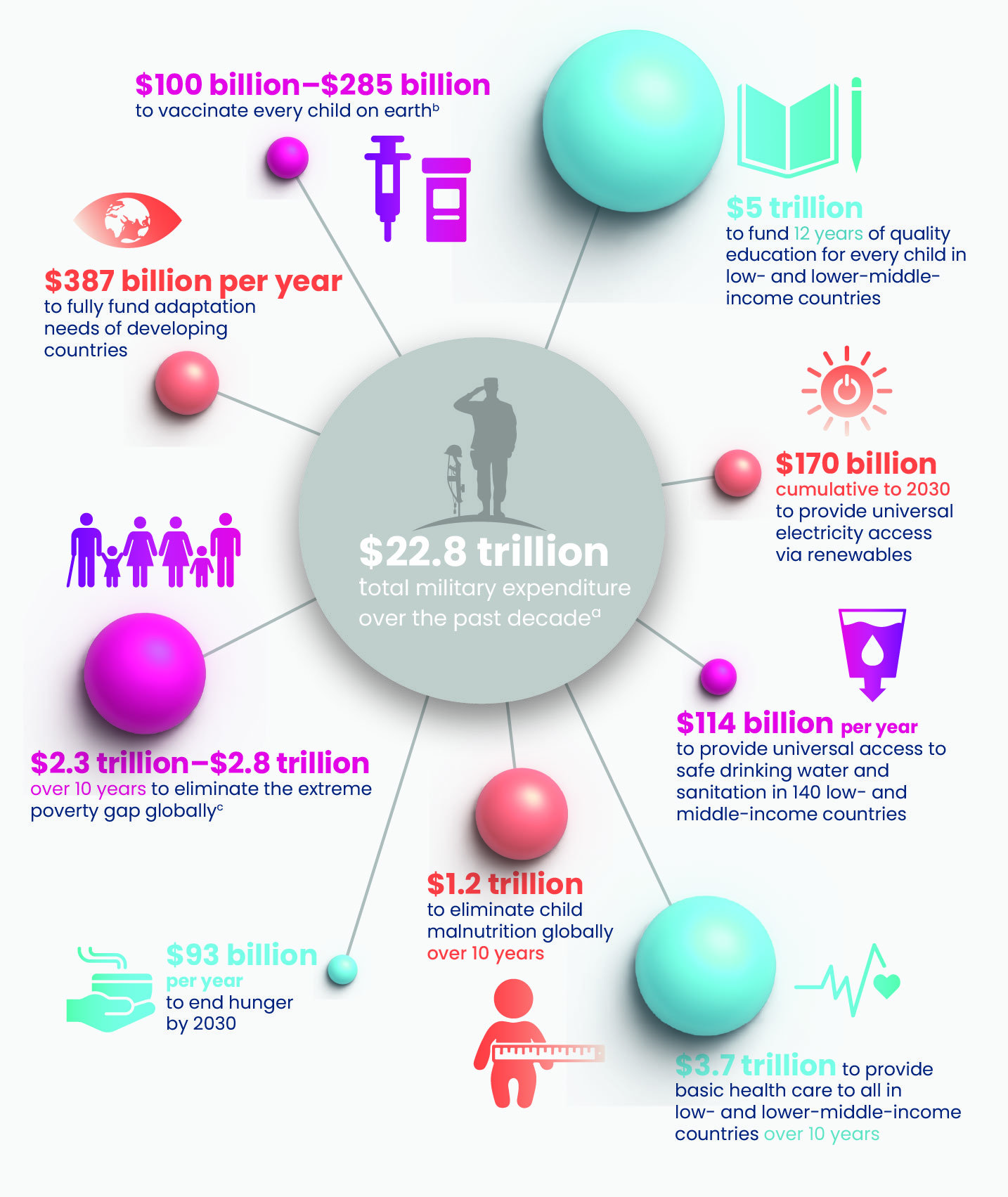
The world spent $22.8 trillion on military expenditure in the last decade—enough to fund solutions to poverty, healthcare, education, clean water and climate resilience. The size of each circle is proportional to the amount of spending represented.
Note:
a Total military expenditure over the past decade estimated at $22.8 trillion (2016-2025 in constant 2024 dollars).
b The range is $45.51 to $129.57 per child (UNICEF, 2024).
c Estimate uses the World Bank’s revised international poverty line of $3.00/day (June 2025 update), and the Our World in Data “total shortfall from extreme poverty” series (values in 2021, international dollars), which sums the global poverty gap or the theoretical cash transfers needed to bring everyone to the line. The latest global nowcast (2024–2025) implies around $230 billion to $280 billion per year.
Source: The Security We Need: Rebalancing Military Spending for a Sustainable and Peaceful Future, report of the Secretary-General on the impact of the global increase in military expenditure on the achievement of the Sustainable Development Goals (United Nations, New York, 2025).
In 2025, States and non-State actors continued their alleged use of anti‑personnel landmines and cluster munitions in ongoing armed conflicts. Separately, five European States gave formal notification of their withdrawal from the Anti‑Personnel Mine Ban Convention.[1] Both developments intensified concerns over the potential erosion of support for established humanitarian disarmament norms, driven by arguments that those norms should give way to security considerations. Against that backdrop, the Secretary‑General initiated a six-month global campaign that brought together States and humanitarian actors to uphold the norms of humanitarian disarmament, accelerating mine action as an enabler of human rights and sustainable development and advancing the vision of a mine-free world.
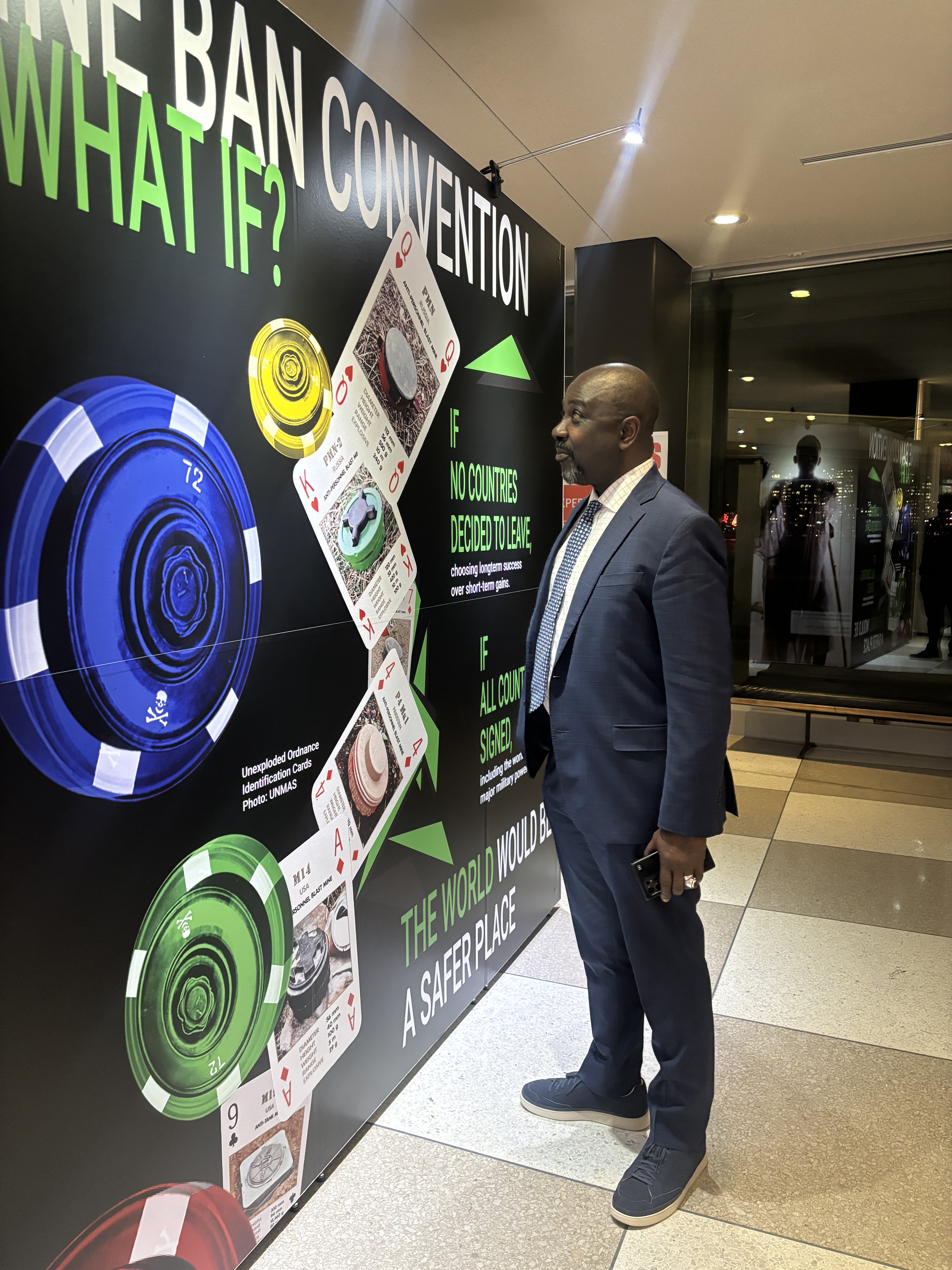
UNODA Director Adedeji Ebo views the “Forward NOT Fragmented” exhibition at United Nations Headquarters on 3 December. Through interactive displays, the exhibition highlighted the humanitarian impact of landmines, the achievements of the Mine Ban Convention and the importance of global efforts toward a mine-free world.
Multilateral discussions on lethal autonomous weapons systems gained momentum within the Convention on Certain Conventional Weapons.[2] While views continued to diverge over whether existing international humanitarian law was sufficient or new, legally binding rules were needed, the Group of Governmental Experts on Emerging Technologies in the Area of Lethal Autonomous Weapons Systems advanced substantive draft elements of a possible instrument without prejudging its character.
Building on the momentum generated by the successful fourth Review Conference of the Programme of Action on Small Arms and Light Weapons[3] and the International Tracing Instrument,[4] 2025 was marked by sustained efforts to operationalize newly agreed mandates and deepen international cooperation. New mechanisms to strengthen such cooperation were being developed, including a structured procedure to match assistance needs and offers and a dedicated funding mechanism for implementation of the Programme of Action.
Capacity‑building also expanded with the United Nations Fellowship Training Programme on Small Arms and Light Weapons Control, launched in the Caribbean and Africa. Preparations for the ninth Biennial Meeting of States on the Programme of Action, to be held in June 2026, advanced in parallel, including the start of work for the new open‑ended technical expert group established in 2024. Meanwhile, the Security Council continued to recognize the detrimental impact of small arms and light weapons in a range of country-specific and thematic discussions.
Through‑life conventional ammunition management remained central to efforts to reduce diversion and prevent unplanned explosions. A series of incidents at ammunition sites once again underscored the risks associated with inadequate stockpile management. In response, the International Ammunition Technical Guidelines were further promoted to help strengthen safe, secure and sustainable practices across the full life cycle of ammunition. At the same time, outreach on the Global Framework for Through‑life Conventional Ammunition Management continued, supporting States and regional organizations in advancing implementation of the 2023 commitments aimed at addressing diversion and unplanned explosions.
The Saving Lives Entity (SALIENT) supported sustainable projects in Ghana, Honduras, Jamaica, Kyrgyzstan, Lebanon, Mali, Panama and Papua New Guinea. The United Nations Trust Facility Supporting Cooperation on Arms Regulation (UNSCAR) continued to serve as a sustainable and predictable funding mechanism for international assistance in the field of conventional arms. During the 2024–2025 funding cycle, UNSCAR committed to the implementation of 11 projects, including one special-circumstances project in response to an unplanned munitions site explosion in Chad in June 2024. Despite its comparatively small overall funding package, UNSCAR delivered results across multiple areas of arms control and disarmament.
Participation in the two United Nations transparency instruments on conventional weapons increased in 2025. A total of 68 Member States submitted annual reports to the United Nations Report on Military Expenditures during its 2025 reporting cycle, up from 59 in the previous year. Similarly, 76 States submitted reports to the United Nations Register of Conventional Arms, up from 73 reports in 2024.
Arms Trade Treaty
The Arms Trade Treaty was created to establish common standards for international trade in conventional arms and to eradicate the illicit trade in conventional weapons. At the end of 2025, the Treaty’s total number of States parties stood at 117, with 25 signatory States that had not yet ratified it. Vanuatu became a State party in September 2025.
Eleventh Conference of States Parties
The eleventh Conference of States Parties took place in Geneva from 25 to 29 August under the presidency of Carlos Foradori (Argentina) and concluded with the adoption of a final report (ATT/CSP11/2025/SEC/834/Conf.FinRep/Rev). The Conference was attended by 94 States Parties, 18 signatory States and 4 States not party to the Treaty. In addition, 10 international organizations and regional organizations, and 46 civil society organizations participated as observers (ATT/CSP11/2025/SEC/833/Conf.PartList). In preparation for the Conference, the Treaty’s three working groups[5] convened from 25 to 28 February, and an informal preparatory meeting was held on 20 and 21 May.
Mélanie Régimbal, Chief of Service of the Geneva Branch of the United Nations Office for Disarmament Affairs, delivered a statement on behalf of the High Representative for Disarmament Affairs. In the statement, the High Representative emphasized that restraint in the international arms trade was an urgent humanitarian imperative. She urged States to apply rigorously the Treaty’s obligation to deny arms and ammunition transfers where there was an overriding risk that they could be used to commit or facilitate serious violations of international humanitarian law or international human rights law. She also highlighted the importance of universalization, welcomed the President’s focus on that objective and highlighted the role of regional organizations, civil society and youth advocates in bringing fresh energy, innovation and urgency to efforts to achieve the Treaty’s universality.
The Conference began with a thematic discussion on the Presidency’s theme of “Universalization as a Priority” (ATT/CSP11/2025/PRES/825/Conf.WP.UNIV). Six panellists, representing Colombia, Malawi, Vanuatu, the Inter-Parliamentary Union, the International Committee of the Red Cross and the Small Arms Survey, exchanged views on ways to reinvigorate efforts to advance the universalization of the Treaty. The Conference subsequently decided on measures to promote universalization, including engagement with industry, academia, the media, civil society, youth, survivors and affected communities as part of inclusive universalization strategies.
The Conference considered the reports of the Working Group on Treaty Universalization, the Working Group on Effective Treaty Implementation and the Working Group on Transparency and Reporting, as well as various documents submitted by the Management Committee.[6] The Conference welcomed the sixth meeting of the Diversion Information Exchange Forum, established by the sixth Conference of States Parties,[7] and called on all States parties and signatory States to continue using the Forum as a means to facilitate international cooperation in preventing and eradicating diversion. It further encouraged States parties and signatory States to facilitate the participation of enforcement officials in Forum meetings.
The Conference also adopted a decision establishing gender focal points under the Treaty and encouraged States parties to volunteer for the role, with a view to promoting the systematic integration of gender perspectives across all Arms Trade Treaty processes (ATT/CSP11.WGETI/2025/CHAIR/826/Conf.Rep/Annex). It further endorsed the proposal submitted by the United Kingdom to develop elements of a draft five-year strategy, to be put forward for a decision no later than the thirteenth Conference of States Parties (ATT/CSP11/2025/GBR/831/Conf.NP/Rev.).
Finally, the Conference decided to hold the twelfth Conference of States Parties from 24 to 28 August 2026 at the Geneva International Conference Centre. It elected Tsholofelo Glenda Tsheole (South Africa) as President, and Latvia, the Philippines, the United Kingdom and Uruguay as Vice-Presidents. Participants decided that the working group meetings and the informal preparatory meeting for the twelfth Conference would take place in Geneva from 16 to 19 March 2026 and on 27 and 28 May 2026, respectively.
Small arms and light weapons
Programme of Action on Small Arms and Light Weapons
Illicit flows of small arms and light weapons are a central driver of armed conflict and criminal armed violence worldwide. To address their widespread and devastating impact, Member States established the Programme of Action to Prevent, Combat and Eradicate the Illicit Trade in Small Arms and Light Weapons in All Its Aspects (A/CONF.192/15(SUPP)) in 2001, in which they committed to strengthening national small-arms legislation, enhancing import and export controls, improving stockpile management and fostering international cooperation and assistance. This framework was further reinforced in 2005 with the adoption of the International Instrument to Enable States to Identify and Trace, in a Timely and Reliable Manner, Illicit Small Arms and Light Weapons (see A/60/88, annex; and Corr.2).[8]
In 2025, work under the Programme of Action and its International Tracing Instrument focused on implementing mandates from the fourth Review Conference, which had concluded successfully in June 2024, and preparing for the ninth Biennial Meeting of States, scheduled for 2026.
In response to requests from Member States to strengthen international cooperation and assistance, the Office for Disarmament Affairs began conceptualizing two new mechanisms: a structured procedure to facilitate the matching of requests and offers of assistance and a dedicated funding mechanism to support implementation of the Programme of Action. Additionally, the United Nations Fellowship Training Programme on Small Arms and Light Weapons Control was launched in 2025, with iterations in the Caribbean and Africa.
The Office also initiated a study on obliterated markings at the request of States, to be published in 2026. As part of that effort, 38 States completed a comprehensive survey on the prevalence of altered markings in seized weapons and on national methods for recovery.
Meanwhile, preparations advanced for the ninth Biennial Meeting of States on the Programme of Action, to be held in New York from 1 to 5 June 2026. Australia was endorsed as Chair-designate of the Meeting on 12 December 2025 and convened the first informal exchange of Member States on the preparations.
Preparatory work also began for the first meeting of the open-ended technical expert group, established by the fourth Review Conference to develop recommendations for ensuring effective implementation of the Programme of Action and the International Tracing Instrument in light of developments in small-arms manufacturing, technology and design, including polymer and modular weapons and illicit 3D printing. The group was expected to produce consensus recommendations for consideration by States in 2028 and no later than the fifth Review Conference in 2030. To support States in preparing for the group’s work, the Office for Disarmament Affairs and the United Nations Institute for Disarmament Research (UNIDIR) held two online briefings, addressing modular and polymer designs in October 2025 and 3D printing and craft manufacturing in December 2025. The briefings identified good practices and possible cooperative measures in areas repeatedly raised over the previous decade, with a view to informing an insight report.
United Nations Small Arms and Light Weapons Fellowship Training Programme
In 2025, the Office for Disarmament Affairs, in collaboration with its Regional Centres and the United Nations Institute for Training and Research (UNITAR), launched the first United Nations Fellowship Training Programme on Small Arms and Light Weapons Control. The programme was established pursuant to General Assembly resolution 77/71, which requested the creation of a dedicated fellowship initiative to strengthen national capacities for implementing the Programme of Action and the International Tracing Instrument. Responding to Member States’ calls for more sustained, practical and region‑specific support, the fellowship programme introduced a structured global capacity‑building modality for practitioners responsible for the through‑life management of small arms and light weapons.
The programme is a flagship capacity‑building initiative aimed at strengthening national and regional implementation of the Programme of Action and the International Tracing Instrument. Its inaugural year comprised two regional editions, in the Caribbean and in Africa, each tailored to regional dynamics while applying a common training methodology integrating technical, operational and normative dimensions.
Caribbean edition
The first regional edition of the Fellowship was held from 28 July to 15 August in Trinidad and Tobago, bringing together 19 fellows from 15 Member States of the Caribbean Community (CARICOM). The curriculum combined an online introductory component with an intensive three‑week in‑person programme covering legal and policy frameworks, regional trends in illicit trafficking, physical security and stockpile management, forensic ballistics, marking and tracing, and border control practices.
Live demonstrations, including weapons test‑firing, ballistic comparison using optical microscopes and laser‑engraving marking, provided participants with practical exposure to core technical disciplines. Field visits to the Trinidad and Tobago Police Service Armoury, the Forensic Science Centre, the Trinidad and Tobago Defence Force and the Camp Omega Memorial reinforced the life‑cycle approach to safe and secure weapons management and underscored the human‑security impacts of inadequate stockpile practices.
The Caribbean iteration was delivered in close collaboration with UNITAR and the United Nations Regional Centre for Peace, Disarmament and Development in Latin America and the Caribbean, with host‑country support from the Government of Trinidad and Tobago. This partnership model ensured a comprehensive blend of normative, policy-oriented and operational expertise. Trinidad and Tobago’s national authorities, including the Police Service, the Defence Force, the Forensic Science Centre and the Strategic Services Agency, played a central role in providing access to facilities and technical personnel. The fellowship also benefited from CARICOM’s ongoing regional security initiatives, which informed regional-level discussions on illicit trafficking and coordination among national security institutions. Together, these partnerships helped embed the Fellowship within existing Caribbean institutional structures while enhancing interoperability and cooperation among participating States.
Africa edition
The second regional edition of the fellowship was held from 13 October to 7 November in Togo and Benin, bringing together 19 practitioners from 16 African Member States. The training began at the headquarters of the United Nations Regional Centre for Peace and Disarmament in Africa in Lomé, where fellows examined continental, regional and national small arms and light weapons control frameworks, including legal provisions, coordination mechanisms, reporting obligations under the Programme of Action and the role of civil society in arms control.
The programme then shifted to practical, field‑based modules at the Training Centre for Peacekeeping Operations in Lomé and the Training Centre for Post-Conflict Demining and Clearance in Ouidah. Fellows undertook armoury assessments, observed marking procedures, reviewed documentation practices and worked with specialized organizations on marking, tracing and international investigative cooperation.
The training culminated in observation of weapons and ammunition destruction activities, involving firearms, small‑calibre ammunition, grenades and anti‑tank ordnance, conducted under the safety protocols of the Training Centre for Post-Conflict Demining and Clearance. As in the Caribbean, fellows developed national project proposals to address concrete institutional priorities, with mentoring provided throughout the programme.
The fellowship’s activities in Africa were enabled by a network of regional, national and technical partners coordinated by the Office for Disarmament Affairs and the Regional Centre in Lomé. The Governments of Togo and Benin hosted and facilitated training activities, providing access to national and defence‑related infrastructure for field‑based components. The Training Centre for Peacekeeping Operations and the Training Centre for Post-Conflict Demining and Clearance provided the operational backbone of the fellowship, delivering hands‑on modules on armoury procedures, physical security and stockpile management, and safe destruction. Technical organizations, including Conflict Armament Research, the International Criminal Police Organization (INTERPOL) and the World Customs Organization, delivered specialized segments on tracing methodologies and international information‑sharing systems, including the INTERPOL Illicit Arms Records and Tracing Management System, and the World Customs Organization’s Customs Enforcement Network Communication Platform.
Civil society organizations, including the International Action Network on Small Arms and the West Africa Network for Peacebuilding, reinforced the fellowship’s focus on inclusive and community‑responsive approaches. Through those partnerships, the fellowship integrated regional expertise, national ownership and international best practices, supporting long‑term capacity development and cross‑border cooperation.
General Assembly
The General Assembly once again adopted the annual resolution on illicit small arms and light weapons (80/38) in its entirety without a vote, with Colombia leading the negotiations alongside South Africa and Japan. The resolution reiterated the establishment of the open-ended technical expert group and the decision to hold the ninth Biennial Meeting of States from 1 to 5 June 2026. It also welcomed the Secretariat’s work to implement mandates established in resolution 79/40.
For the first time, the General Assembly held a joint meeting with the Economic and Social Council recognizing the connection between illicit small arms and light weapons and sustainable development. The meeting, entitled “Small arms and light weapons control for preventing violence and advancing sustainable development”, took place on 17 March. It emphasized the developmental cost of small arms and light weapons and reinforced the relevance of the Programme of Action and the International Tracing Instrument to the Sustainable Development Goals, in particular Goal 16. One panel focused on development impacts, while a second addressed gender dimensions, highlighting the role of small arms in enabling gender‑based violence, the role of harmful gender norms in driving armed violence, and the importance of women’s participation and gender‑responsive arms‑control policies.
Security Council
In 2025, the biennial report of the Secretary‑General on small arms and light weapons (S/2025/670) noted that such weapons continued to fuel insecurity and drive armed violence in Afghanistan, the Democratic Republic of the Congo, Haiti, Libya, Somalia, the Sudan, Yemen and in other contexts.
The Secretary-General underscored the increasing convergence of illicit trafficking, terrorism and organized crime, noting, for example, that 70 per cent of terrorist attacks in the Sahel involved small arms. The report also linked small arms and light weapons to rising global military expenditure and put forward cross‑cutting recommendations to strengthen the Security Council’s response to their illicit proliferation. The Secretary-General urged Member States to integrate small arms and light weapons control into conflict‑prevention and early‑warning strategies, including by investing in interoperable data systems.
The Secretary-General also encouraged closer alignment between arms control and development processes, emphasizing the importance of systematically collecting, analysing and reporting data on weapons used in conflict‑related sexual violence and recommended strengthening gender‑responsive approaches across peace operations and sanctions regimes. He further advised the Council to address legislative and technical gaps enabling terrorists to acquire weapons, including by supporting implementation of resolution 2370 (2017) and improving national capacity to counter 3D‑printed and craft‑manufactured firearms. To reinforce the Council’s operational tools, he encouraged more consistent incorporation of weapons and ammunition management into peace operation mandates and sanctions regimes, including through benchmark assessments, tracing requirements and the deployment of arms‑control expertise in missions.
On 10 November, the Security Council held an open debate convened by Sierra Leone. The Council heard briefings from the Director and Deputy to the High Representative for Disarmament Affairs, Adedeji Ebo; the High Representative for the African Union’s Silencing the Guns Initiative, Mohamed Ibn Chambas; the Special Representative of INTERPOL to the United Nations, Roraima Ana Andriani; and the Executive Director of Volontariat pour le développement d’Haïti, Arnoux Descardes.
All 15 Council members participated, alongside 44 Member States and the European Union. Several delegations highlighted the role of new and emerging technologies, enforcement challenges associated with Security Council‑mandated arms embargoes and the links between illicit small arms and light weapons and gender‑based violence, youth insecurity and organized crime. Several delegations urged more systematic tracing and information‑sharing between sanctions panels and national authorities. The debate also drew attention to demand‑side drivers, including organized crime, political instability and socioeconomic inequalities, echoing the Secretary-General’s recommendation to integrate small arms and light weapons control into early‑warning and development planning.
On 4 April, Sierra Leone, together with Algeria, Guyana and Somalia, convened an Arria‑formula meeting on “Small Arms Control and Weapons Management in UN Sanctions Regimes”. Discussions emphasized practical challenges, including weak border control, proliferation of illicit maritime flows, inadequate tracing systems and limited national capacity to manage stockpiles. Consistent with the Secretary-General’s assessments, briefers recommended embedding weapons and ammunition management benchmarks within sanctions regimes and peace operations, improving coordination between sanctions panels and regional organizations, and strengthening technical assistance to national authorities.
In 2025, the third edition of Aide-Memoire: Options for reflecting weapons and ammunition management in decisions of the Security Council was published, updating a practical reference tool designed to help Security Council members incorporate clear, coherent and technically sound weapons and ammunition management language into resolutions. It draws on a review of more than 773 country-specific and thematic resolutions and presidential statements, as well as consultations with policy experts and United Nations field practitioners. The new edition is accompanied by an online dashboard enabling users to search for and download weapons and ammunition management-related language from Security Council decisions.
Arms embargoes
In the Central African Republic, following the lifting of the general arms embargo in 2024, armed groups continued to procure weapons regionally, while assessments conducted under the sanctions regime underscored the need for improved marking and tracing (see S/2025/384 and S/2025/385). The Security Council adopted resolution 2789 (2025), extending the sanctions measures imposed on armed groups operating in the Central African Republic.
In the Democratic Republic of the Congo, the Group of Experts reported ongoing violations, including cross‑border transfers and external support to armed groups (see S/2025/446). In June, the Security Council unanimously adopted resolution 2783 (2025), renewing the sanctions regime established under resolution 1533 (2004) and the mandate of the Group of Experts assisting the Security Council Committee established pursuant to resolution 1533 (2004) concerning the Democratic Republic of the Congo.
In Haiti, illicit firearms imports persisted at scale, enabled by porous land and maritime borders. The sophistication and volume of shipments suggested well-established supply chains, while limited border security facilitated the steady flow of arms (see S/2025/303). In September, through resolution 2793 (2025), the Council transitioned the previous Multinational Security Support Mission into the Gang Suppression Force and mandated the Force to support the Haitian National Police and the Haitian Armed Forces in recording and disposing of illicit arms, ammunition and other seized materiel. In October, the Security Council unanimously adopted resolution 2794 (2025), renewing for another year the Haiti arms embargo covering small arms and light weapons and their ammunition.
In May, the Security Council adopted resolution 2780 (2025) on Libya, renewing the authorization for Member States, acting nationally or through regional organizations, to inspect vessels that they have reasonable grounds to believe are violating the arms embargo. The Council renewed authorization for six months, departing from the established practice of one-year renewals.
On Somalia, the Council adopted resolution 2776 (2025), reimposing a targeted arms embargo on Al‑Shabaab while confirming that restrictions no longer applied to Somali Government security institutions. By that resolution, the Council also renewed the mandate of the Panel of Experts. The Panel reported that Al-Shabaab primarily obtained arms through battlefield captures and black-market purchases. Al-Shabaab was also assessed to have access to local arms markets and to exploit unsecured stockpiles (S/2025/777). The Security Council also adopted resolution 2775 (2025), extending Member States’ authority to inspect, seize and dispose of vessels and cargo suspected of carrying illicit weapons in violation of the sanctions regime.
In South Sudan, the Panel of Experts reported possible violations of the arms embargo involving the procurement of military equipment and training related to military activities (see S/2025/442). The Panel also noted that no substantive progress had been made towards the benchmark on weapons and ammunition management established under resolution 2577 (2021), in part because the Bureau for Community Security and Small Arms Control, the national coordinating body for weapons and ammunition management, had received no funding during the period (see S/2025/231).
In the Darfur region of the Sudan, arms proliferation continued to fuel conflict and the growth of black-market arms sales. The Rapid Support Forces obtained sophisticated weaponry and developed decentralized supply chains, enabling them to counter the air superiority of the Sudanese Armed Forces, as documented by the Panel of Experts on the Sudan (see S/2025/239). In September, the Security Council adopted resolution 2791 (2025), renewing the sanctions regime established under resolution 1591 (2005), including the arms embargo, and the mandate of the Panel of Experts. The renewal of the sanctions regime was the only formal Security Council outcome in 2025 addressing the security and humanitarian situation in Darfur and other parts of the Sudan.
In Yemen, the Panel of Experts’ analysis of smuggling trends revealed continued violation of the arms embargo, including through concealment or misdeclarations, as demonstrated by large‑scale maritime interdictions, including the seizure of 750 tons of illicit material and weapons in June (see S/2025/650).
Islamic State in Iraq and the Levant (also known as Da’esh) and Al-Qaida and their affiliates continued to exploit weak State capacity to control arms and borders, procuring small arms and light weapons through transnational trafficking networks. In the Syrian Arab Republic, Islamic State in Iraq and the Levant (Da’esh) and Al-Qaida affiliates purchased substantial quantities of arms diverted from abandoned former government stocks (see S/2025/482).
Peace operations
Peace operations mandates renewed in late 2024 for Libya, the Central African Republic and the Democratic Republic of the Congo — through resolutions 2755 (2024), 2759 (2024) and 2765 (2024), respectively — explicitly referenced weapons and ammunition management and continued to shape mission activities in 2025. In the Democratic Republic of the Congo, following the occupation of Goma in January 2025, the United Nations Organization Stabilization Mission in the Democratic Republic of the Congo (MONUSCO) oversaw the surrender and destruction of thousands of weapons, components and ammunition.
The United Nations Mine Action Service (UNMAS) also facilitated the destruction of nearly 1.4 million rounds of small arms and light weapons ammunition and provided technical assistance to prevent diversion as the mission withdrew. In December, the Security Council unanimously adopted resolution 2808 (2025), renewing MONUSCO’s mandate and calling for continued efforts to ensure the safe and effective management, storage, monitoring and security of weapons and ammunition stockpiles and to combat arms trafficking and diversion.
In Haiti, the transition from the Multinational Security Support Mission to the Gang Suppression Force through resolution 2793 (2025) in September included authorization to support the Haitian National Police and Armed Forces in seizing, recording and disposing of illicit arms and ammunition. Resolution 2794 (2025), concerning the arms embargo in Haiti, set out steps and benchmarks to prevent the illicit trafficking and diversion of arms and related materiel, including through strengthened border-control mechanisms.
In October, the Security Council unanimously adopted resolution 2796 (2025), extending the mandate of the United Nations Support Mission in Libya for one year and continuing to call on key Libyan institutions, with support from the United Nations, to take steps to secure and effectively manage stockpiles.
In November, the Security Council adopted resolution 2802 (2025), renewing the mandate of the United Nations Interim Security Force for Abyei, including the authorization for the Force to undertake weapons confiscation and destruction in the Abyei Area. The resolution received 12 votes in favour and three abstentions.[9]
Also in November, the Security Council adopted resolution 2800 (2025), extending the mandate of the United Nations Multidimensional Integrated Stabilization Mission in the Central African Republic for one year and mandating the Mission to continue supporting the Government in its efforts to safely, securely and effectively manage weapons and ammunition, including through the national small arms commission[10] and the implementation of its national action plan.
Mission drawdowns presented notable operational risks. In his report to the Security Council (S/2025/670), the Secretary-General cautioned that the closure of peace operations could lead to reversals in stockpile security unless supported by post‑mission transition measures.
In December, through resolution 2809 (2025), the Security Council decided that the United Nations Transitional Assistance Mission in Somalia would cease all operations on 31 October 2026. The road map for the Mission’s transition, proposed by the Secretary-General in his report S/2025/613, included reference to disarmament, demobilization and reintegration, although not to weapons and ammunition management.
Weapons and ammunition management and disarmament, demobilization and reintegration
In 2025, the Department of Peace Operations and the Office for Disarmament Affairs advanced a new phase of their joint initiative on “Effective weapons and ammunition management in a changing disarmament, demobilization and reintegration context”. Building on tools, partnerships and lessons developed in previous years, the initiative focused on strengthening operational impact, reinforcing regional and national ownership, and supporting coherent weapons and ammunition management approaches in priority disarmament, demobilization and reintegration contexts.
A central outcome of the year was the strengthening of regional frameworks and coordination mechanisms. The joint initiative provided technical support to the Regional Centre on Small Arms and Light Weapons in the Great Lakes Region, the Horn of Africa and Bordering States to advance implementation of the regional action plan adopted in November 2024. That support contributed to aligning national efforts with regional priorities, reinforcing political commitment and laying the groundwork for sustained and coordinated implementation across Member States.
Complementing that effort, a new two-year project funded by the United Nations Peace and Development Fund was approved for Burundi, the Democratic Republic of the Congo, Rwanda, Uganda and the United Republic of Tanzania. Early engagement with the Office of the Special Envoy of the Secretary-General for the Great Lakes Region and regional partners helped lay the groundwork for coordinated implementation, reinforced complementarity with existing disarmament, demobilization and reintegration and arms control processes, and enhanced regional coherence in addressing cross-border weapons dynamics. At the national level, the initiative contributed to strengthening institutional capacities and improving technical and operational approaches to weapons and ammunition management.
In Senegal, support for a baseline assessment, conducted in collaboration with UNIDIR, resulted in tailored recommendations to enhance legal frameworks, stockpile management, record-keeping, tracing and safe destruction practices. In Somalia, the publication of the study Weapons and Ammunition Dynamics in a Changing Disarmament, Demobilization and Reintegration Context in Somalia provided national authorities and international partners with analysis to adapt weapons and ammunition management approaches in a complex security environment. The study highlighted practical entry points for integrating community violence reduction and transitional weapons and ammunition management tools into efforts related to disarmament, demobilization and reintegration, contributing to more context-responsive risk-reduction strategies.
In South Sudan, the United Nations Mission in South Sudan (UNMISS) benefited from sustained technical support on weapons and ammunition management considerations in disarmament, demobilization and reintegration-related processes. That support included a technical training course on weapons and ammunition management for National Police Service personnel in Wau, delivered in collaboration with the National Police Service, UNMISS — including its Rule of Law and Security Institutions Service and United Nations Police component — and UNMAS. The training strengthened participants’ ability to manage, control and record weapons and ammunition stocks in line with international standards, promoted safe handling and storage practices, and reduced risks to security personnel and civilian populations. It also reinforced working relationships among national authorities and United Nations partners, enabling continued mentorship and coordination.
Capacity development remained a central pillar of the initiative. In December 2025, the annual training course on “Effective weapons and ammunition management in a changing disarmament, demobilization and reintegration context” was organized in close collaboration with UNITAR, UNMAS, the Folke Bernadotte Academy and the Kofi Annan International Peacekeeping Training Centre. The course brought together national authorities, regional organizations, United Nations entities and civil society representatives, strengthening their capacity to design and implement weapons and ammunition management initiatives in complex operational environments. Participants enhanced their understanding of cross-sector collaboration and developed practical approaches to address weapons and ammunition challenges across diverse disarmament, demobilization and reintegration settings.
Data collection for target 16.4
Under the Programme of Action on Small Arms and Light Weapons, the International Tracing Instrument and relevant United Nations resolutions, Member States are encouraged to submit voluntary biennial national reports on implementation. Those reports serve as an important source of information for monitoring Sustainable Development Goal target 16.4, which aims to significantly reduce illicit arms flows by 2030.
As co‑custodians of Sustainable Development Goal indicator 16.4.2, the Office for Disarmament Affairs and the United Nations Office on Drugs and Crime (UNODC) collect, verify and analyse data through two channels: national reports submitted under the Programme of Action and the International Tracing Instrument; and the Illicit Arms Flows Questionnaire. National reports under the Programme of Action contribute data on weapons collected, including those seized, surrendered or found and on actions subsequently taken; weapons destroyed; incidents of diversion, including during international transfers or from national stockpiles; and tracing activity, including tracing requests submitted and responded to, and the number of successfully traced cases.
The Office for Disarmament Affairs received 100 national reports under the Programme of Action covering the 2022–2023 biennial reporting cycle. According to those reports, 713,702 weapons were destroyed over the biennium, including 326,429 weapons, or 45 per cent, in Africa. A total of 977,617 weapons were collected. Of those, 550,000 weapons were marked, 680,000 were recorded, and 665,000 were destroyed, reflecting measures taken by States to ensure the appropriate management and control of collected weapons.
A total of 14,462 tracing requests were submitted and received. Of those, 3,176 requests matched available tracing data, meaning that 22 per cent of all requests resulted in a successful trace.
In partnership with UNODC, the Office for Disarmament Affairs submits consolidated datasets derived from reporting under the Programme of Action and the International Tracing Instrument to the United Nations statistical authorities responsible for Sustainable Development Goal reporting. That process helps ensure that the Programme of Action process directly supports global monitoring of illicit arms flows and that related findings are incorporated into United Nations reporting and analysis on the 2030 Agenda for Sustainable Development.[11] The next cycle of national reports under the Programme of Action was expected to cover the 2024–2025 implementation period with submissions scheduled for 2026, in time to inform preparations for the ninth Biennial Meeting of States on the Programme of Action and the International Tracing Instrument.
Silencing the Guns in Africa: Africa Amnesty Month
In 2025, the Office for Disarmament Affairs, in cooperation with the African Union and the Regional Centre on Small Arms and Light Weapons, supported Mali and Uganda in implementing Africa Amnesty Month as part of the African Union’s Silencing the Guns initiative. Both countries adapted activities to their national contexts, focusing on sensitization, community-based policing and voluntary weapons surrender.
In Mali, awareness campaigns and local-level engagement across Bougouni, Koutiala and San generated strong community participation and contributed to the safe surrender of illegally held weapons. Uganda hosted the continental launch and conducted nationwide multilingual media outreach, followed by workshops and community policing activities in Northern Uganda and the Rwenzori region.
Despite security-related disruptions in both countries, national focal points effectively adjusted their implementation schedules, demonstrating strong ownership and coordination. Overall, the initiative reaffirmed the importance of regular amnesty periods and underscored the value of continued support from the Office for Disarmament Affairs in strengthening technical capacity for weapons management and sustaining public awareness of the risks associated with illicit small arms and light weapons.
To share the impact and lessons learned from the Office’s Africa Amnesty Project with the African Union over the previous five years, the Office collaborated with the African Union Observer Mission in New York to organize the first side event on Africa Amnesty Month in New York. Convened in hybrid format, the event brought together panellists and participants in person at United Nations Headquarters and virtually from across regions. It provided a platform to assess progress and challenges in national implementation of Africa Amnesty Month and to gather stakeholder perspectives to inform future efforts.
The discussion contributed to broader deliberations on advancing the Silencing the Guns agenda and strengthening peace and security initiatives across Africa. Participants also underscored the importance of systematically sharing project findings in New York and other multilateral forums, including through side events and reporting under relevant frameworks such as the Programme of Action and the Global Framework on Through-life Conventional Ammunition Management (A/78/111, annex), to ensure that lessons from national and regional initiatives inform multilateral processes.
Modular Small-arms-control Implementation Compendium
The Modular Small-arms-control Implementation Compendium (MOSAIC) continues to provide governments and civil society with good-practice guidance on managing and controlling small arms and light weapons throughout their life cycle, in line with commitments set out in relevant international frameworks. The Office for Disarmament Affairs oversees MOSAIC, consistently reviewing and updating its modules with support from technical experts.
In 2025, the Office partnered with UNIDIR to update and pilot a MOSAIC assessment tool to enable States to conduct self-assessments of national small arms and light weapons control efforts. The desktop application, to be made available in Arabic, English, French and Spanish, is intended to help States identify gaps and priority areas, and to establish a baseline for measuring implementation of good practices over time. At the end of 2025, the tool covered MOSAIC modules within series 03, on legislative and regulatory issues, and series 05, on operational support.
United Nations system-wide coordination
United Nations Coordinating Action on Small Arms
The United Nations Coordinating Action on Small Arms (CASA) mechanism was established in 1998 to foster a coherent and cohesive approach within the United Nations system to small-arms policy and programming. In recent years, the mechanism addressed an increasingly broad set of policy issues, including the arms trade, armed violence and sustainable development. Participating entities[12] jointly address those issues from a wide variety of perspectives, taking into account economic and social development, disarmament, organized crime, terrorism, conflict prevention, peacekeeping, human rights and international humanitarian law, the safety of human settlements, public health, the environment, gender and children.
CASA partners met three times in 2025 to exchange information and provide inputs on relevant reports of the Secretary-General, including his report on small arms and light weapons for the Security Council (S/2025/670); implementation of the Global Framework for Through-life Conventional Ammunition Management; the Working Group on Firearms and the Illicit Arms Flows Questionnaire; the project on weapons and ammunition management in disarmament, demobilization and reintegration contexts; and the operations of United Nations funding mechanisms, including the Saving Lives Entity (SALIENT) trust fund and the United Nations Trust Facility Supporting Cooperation On Arms Regulation (UNSCAR). During the CASA working-level meeting held in December, the updated MOSAIC assessment tool was presented. In addition, CASA delivered a joint statement in June 2025 at the Preparatory Meeting of States on the Global Framework for Through-life Conventional Ammunition Management.
CASA also provided a forum for discussing the work of the task force established in accordance with the Executive Committee’s decision 2025/40.
Executive Committee decisions
On 27 August, the Executive Committee held a meeting that resulted in the adoption of decision 2025/40 on small arms and light weapons and decision 2025/39 on citizen security in the Caribbean. Decision 2025/40 builds on decision 2023/46 on small arms and light weapons, adopted on 3 November 2023. Both decisions highlight the need for a coherent approach bringing together arms control and disarmament.
Following implementation of Executive Committee decision 2023/46, the Office for Disarmament Affairs and UNODC established a joint task force, in collaboration with UNIDIR and the United Nations Development Programme (UNDP), to facilitate implementation of the Executive Committee decisions on small arms and light weapons.
The task force conducted a mapping exercise of ongoing work across all four decision areas at the national, regional and global levels, with a focus on identifying gaps, opportunities for further action and potential new partnerships. The exercise covered relevant United Nations initiatives and projects and informed the identification of new areas for action, including support to United Nations country teams and a joint comparative analysis of illicit arms flows data, international trade and export control mechanisms, to be published in the course of 2026.
Firearms Protocol and related intergovernmental processes
Working Group on Firearms
The open-ended intergovernmental Working Group on Firearms held its twelfth meeting in Vienna on 28 and 29 April. The Working Group, which meets annually, was established by the Conference of Parties to the United Nations Convention against Transnational Organized Crime as a standing mechanism of the Conference to advise and assist the Conference in overseeing and facilitating the implementation of the Protocol against the Illicit Manufacturing of and Trafficking in Firearms, Their Parts and Components and Ammunition (Firearms Protocol).
At its twelfth meeting, the Working Group addressed two topics: “Contribution of the Firearms Protocol to conflict prevention and peacebuilding efforts”[13] and “Effective criminal justice responses under the United Nations Convention against Transnational Organized Crime to the offences covered by the Firearms Protocol”.[14] Building on the provisions of the Firearms Protocol, the Working Group adopted various recommendations. Those recommendations appeared in its report on the meeting (CTOC/COP/WG.6/2025/4) and included support for effective armament, recovery and disposal measures, as well as documentation and tracing of firearms surrendered in the course of disarmament or weapons collection initiatives.
The fourth meeting of the Constructive Dialogue on Firearms, held after the conclusion of the Working Group, enabled further discussion of those topics with civil society, non-governmental organizations and other stakeholders. During that meeting, panellists addressed, among other issues, disarmament, demobilization and reintegration processes, examples of local disarmament initiatives, and their interlinkages with the Firearms Protocol.
In that context, the Mechanism for the Review of the Implementation of the United Nations Convention against Transnational Organized Crime and the protocols thereto continued to play a key role in promoting effective implementation of the Firearms Protocol. Through the mechanism, States parties assess implementation, identify challenges and good practices, and facilitate technical assistance and international cooperation. The Working Group supports the review process by considering progress made, exchanging views on implementation challenges and providing guidance. During the twelfth meeting, under agenda item 4, entitled “Matters pertaining to the review of the implementation of the Firearms Protocol”, 71 country reviews were identified as ongoing. Of those, 34 reviews were at the stage of preparation of responses to the self-assessment questionnaire, 36 were at the stage of written feedback, and one had been completed.
Saving Lives Entity
The Saving Lives Entity (SALIENT)[15] trust fund is a joint global initiative of UNDP and the Office for Disarmament Affairs. Launched in 2020, SALIENT provides financial support for multisectoral, development‑oriented approaches to reducing small‑arms proliferation and armed violence. It strengthens national capacities, integrates small‑arms control into development policies and promotes violence reduction through nationally led, people‑centred interventions.
SALIENT projects are implemented jointly by multiple United Nations entities in partnership with national governments. Each programme designates country focal points to ensure national ownership, community engagement and long‑term sustainability. The initiative is driven by the principle that achieving durable impact requires integrated strategies linking arms control measures with activities on governance, the rule of law, social cohesion, prevention of gender‑based violence and efforts against illicit economies.
In 2025, SALIENT supported sustainable projects in Ghana, Honduras, Jamaica, Kyrgyzstan, Lebanon, Mali, Panama and Papua New Guinea.
Country cases
In Ghana, the project “Addressing Small Arms and Ammunition Proliferation for Sustainable Peace and Development in Ghana and the ECOWAS Region”, implemented by the UNDP country office and UNODC, concluded in September 2025. The project reached more than 100,000 people through education and sensitization campaigns, contributing to a measurable decline in gun violence‑related incidents during the December 2024 elections. A digital outreach campaign generated 2.8 million impressions and was complemented by community activities, including peace marches, school theatre outreach and public messaging. The project also strengthened civilian‑security cooperation and enhanced vigilance at border points, improving law-enforcement responses to arms trafficking.
In Honduras, the project “Enhancing people‑centered citizen security by strengthening arms control policies and armed‑violence prevention frameworks” implemented by the UNDP country office and the United Nations Regional Centre for Peace, Disarmament and Development in Latin America and the Caribbean, was completed in August. Key results included the deployment of artificial intelligence‑powered firearm-detection tools in violence hotspots, a South-South exchange with the small arms programme in the Western Balkans, expanded community campaigns, gender‑responsive programming and youth‑led action plans. Reforms to arms‑depot management and firearm‑safety protocols in schools advanced accountability, while an innovative gender‑sensitive monitoring dashboard supported the development of a national action plan aligned with the regional firearms road map.[16]
In Jamaica, the joint programme “Reducing Small Arms & Light Weapons”, implemented by UNDP, United Nations Educational, Scientific and Cultural Organization (UNESCO), and UNODC with the Regional Centre for Disarmament in Lima, concluded in March 2025 after 39 months in two phases. The first phase delivered all planned outputs, while the extended phase consolidated impact through the completion of crime‑diagnostic studies; the drafting of protocols to prevent the presence of firearms in schools; the execution of a nationwide youth campaign; and continued capacity-building for law‑enforcement agencies on firearms‑trafficking investigations. The programme successfully scaled up targeted interventions and closed implementation as planned.
In Kyrgyzstan, the project implemented by the UNDP country office and the United Nations Regional Centre for Peace and Disarmament in Asia and the Pacific concluded in March 2025 with all outputs completed. Key accomplishments included the delivery of the national Programme of Action report with gender analysis; activation of the inter‑agency working group, which drafted a national action plan and organized a study visit to the Western Balkans; legal‑gap reviews leading to legislative amendments; launch of an automated weapons registry at the Ministry of Interior and provision of relevant training; and extensive engagement with civil society and the media. All indicators were met or exceeded.
In Lebanon, SALIENT supported the Lebanese Armed Forces and the Government in addressing the proliferation of non‑State arms, particularly small arms and light weapons, in a fragile post‑conflict setting. Following the 2024 cessation of hostilities and subsequent political transition, the initiative contributed to a strategic assessment towards a national small arms control road map and strengthened the stockpile‑management capabilities of the Lebanese Armed Forces. Implementation was embedded within broader cooperation involving UNDP, the Office of the United Nations Special Coordinator for Lebanon and international donors to reinforce State authority and reduce the circulation of illicit arms.
In Mali, the UNDP country office and the United Nations Regional Centre for Disarmament in Africa collaborated with the national small arms commission[17] on a SALIENT initiative to strengthen national systems for preventing small arms and light weapons proliferation. Support included assistance for the national action plan on small arms and light weapons for 2026–2030, capacity-building for the National Commission on Small Arms and national institutions, and oversight improvements for craft production of small arms and light weapons. Community awareness efforts contributed to reducing illicit arms circulation, while gender‑responsive approaches and social‑cohesion initiatives reinforced long‑term violence‑reduction goals.
In Panama, the project “Gun-free Schools for Peace and Sustainable Development of Colón”, implemented by the UNDP country office, the United Nations Population Fund (UNFPA) and UNODC, concluded in June 2025. It focused on preventing armed violence in schools and communities through evidence‑based programming, strengthening of institutions, community engagement, strategic communication and territorial interventions.
In Papua New Guinea, the project “Strengthening Arms Control and Armed Violence Prevention” successfully concluded in August 2025.[18] Implemented by the UNDP country office and UNFPA, with support from the United Nations Regional Centre for Peace and Disarmament in Asia and the Pacific, the joint initiative assisted the Government[19] in developing a national action plan on small arms and light weapons control by facilitating consultations and a national small‑arms survey. Additional SALIENT funding enabled expansion of survey coverage to five provinces. SALIENT also supported the “Sports for Peace” pilot programme in Tari, which entered the analysis phase. The Mines Advisory Group also provided technical support on stockpile management.
SALIENT global learning event
From 30 September to 1 October 2025, SALIENT convened a global learning event in Brindisi, Italy, bringing together beneficiary Governments, United Nations agencies, donors, civil society and technical experts. Participants reflected on achievements from SALIENT’s pilot and first programme phases, covering 2020–2025, reviewed evaluations, elaborated lessons learned and shaped the vision for SALIENT 2.0. Discussions highlighted priorities including predictable, multi‑year financing; strengthened United Nations joint delivery; adoption of digital innovations; deeper integration of gender‑ and youth‑inclusive approaches; and, in particular, embedding small‑arms control in national development and peacebuilding strategies.
United Nations Trust Facility Supporting Cooperation on Arms Regulation
Since its establishment in 2013, the United Nations Trust Facility Supporting Cooperation on Arms Regulation (UNSCAR) has served as a multi-donor funding mechanism supporting quick-impact, short-term, small-scale, theme-focused projects that promote and support the implementation of multilateral conventional arms, ammunition and transparency instruments and initiatives. Administered by the Office for Disarmament Affairs, UNSCAR has successfully mobilized international assistance, particularly in support of the Programme of Action.
As of the end of 2025, UNSCAR had benefited a total of 148 countries in all regions. It had allocated a total of $15 million through 147 projects, selected through an annual competitive application process and implemented in partnership with civil society organizations, regional organizations and United Nations entities. The 2025 funding cycle was supported by Australia, Cyprus, Czechia, Finland, Germany, the Philippines, Portugal, Slovakia and Spain. The consistent support of key donors allowed UNSCAR to increase its grant allocations in response to unprecedented demand from the 2025 Call for Proposals.
Key achievements and impacts
In the area of global and regional coordination, UNSCAR strengthened implementation of regional small arms instruments, road maps and mechanisms in Asia and the Pacific, the Western Balkans, Latin America and the Caribbean, and the Middle East and North Africa, while promoting national reporting on the Programme of Action, the Kinshasa Convention and the Nairobi Protocol. UNSCAR supported civil society organizations, regional organizations and United Nations entities through funding, in coordination with the Office’s regional centres in Lomé, Lima and Kathmandu. UNSCAR also supported capacity-building and outreach for United Nations resident coordinator offices and United Nations country teams on integrating small-arms control into sustainable development processes, including common country analyses and United Nations sustainable development cooperation frameworks.
Stockpile management efforts remained a cornerstone of UNSCAR activities. Support continued for Norwegian People’s Aid and its arms control activities in Bosnia and Herzegovina. In one provincial police district, UNSCAR-supported activities enabled the installation of a data collection system, the delivery of training, and the completion of marking and registration for the entire stockpile of 738 service weapons, along with the labelling and registration of 324 confiscated weapons by February 2025. In Libya, the UNSCAR advanced weapons and ammunition management, supported development of a road map towards a national action plan, strengthened the capacity of State actors to enhance weapons security, and funded the construction and refurbishment of storage facilities. UNSCAR also provided continued support for munitions storage in Chad. In December, UNSCAR undertook a monitoring mission to Tripoli and Misrata, Libya, participating in a weapons and ammunition workshop and facilitating strengthened dialogue and coordination among national authorities and international partners, including the United Nations Support Mission in Libya.
UNSCAR provided funding to support States that had requested support through the Programme of Action national reporting mechanism, in line with UNSCAR’s long-standing priority of supporting implementation of the Programme of Action. In the area of gender-responsive programming, all UNSCAR-funded projects incorporated gender-responsive elements. UNSCAR also supported projects specifically addressing the disproportionate and negative impacts of illicit small arms and light weapons on women. In the 2024–2025 cycle, UNSCAR supported a project implemented by the Women’s Institute for Alternative Development, which facilitated community dialogues on women’s security in Jamaica and Trinidad and Tobago. During the 2025 Call for Proposals, gender issues, including the women, peace and security agenda, remained one of UNSCAR’s thematic priorities. All 103 applicants were required to ensure the meaningful participation and representation of women in UNSCAR-funded activities, and 72 applications, or 70 per cent, indicated that their proposed projects would contribute to advancing the women, peace and security agenda.
Operational framework and future directions
In response to its 2025 Call for Proposals, UNSCAR received a record 103 applications - an increase from 60 submissions in 2024. Following a review by the Strategic Planning Group, 17 projects were selected and approved by the Office for Disarmament Affairs for implementation in 2026. The increase in applications reflected both heightened global interest in related issues and funding pressures on non-governmental organizations active in the sector. UNSCAR funding proposals are required to promote the 2030 Agenda for Sustainable Development, in particular Goals 5 and 16; integrate arms control into national development frameworks; comply with MOSAIC and International Ammunition Technical Guidelines standards; support Action 7 of A New Agenda for Peace on reducing the human cost of weapons; and incorporate gender-responsive approaches in line with the women, peace and security agenda.
UNSCAR continued to uphold the principle of national ownership by prioritizing partnerships with civil society organizations, recognizing their essential roles in advancing arms control at the global, regional and national levels. Throughout 2025, UNSCAR engaged regularly with the Arms Trade Treaty Voluntary Trust Fund and the SALIENT trust fund to ensure coordinated planning, prevent overlaps in funding and maximize complementarity in resource allocation among relevant funding mechanisms.
Drawing on discussions at the fourth Review Conference on the Programme of Action in June 2024, the Office for Disarmament Affairs circulated a note verbale in November 2025 requesting States to consider financial contributions to UNSCAR and to promote it as a supporting mechanism for States to access. Continued donor support allowed UNSCAR to increase the number of projects supported in 2026. UNSCAR planned to continue engaging with financial contributors while considering options for broadening its pool of donors.
Ammunition
In 2025, through-life conventional ammunition management continued to gain prominence as a critical component of international peace and security, reflecting growing recognition of the risks posed by ammunition across its life cycle. States, regional organizations and international partners advanced efforts to strengthen policy frameworks, operational guidance and cooperation mechanisms aimed at reducing diversion, preventing unplanned explosions and supporting safe, secure and sustainable ammunition management practices at national, regional and global levels.
Against that backdrop, incidents of unplanned explosions at ammunition sites in multiple regions throughout the year underscored the persistent safety risks associated with inadequate ammunition management. In response, the Office for Disarmament Affairs continued to promote the International Ammunition Technical Guidelines through the UN SaferGuard programme, supporting States in strengthening safe and secure ammunition management across the full life cycle.
In parallel, the Office sustained engagement with States and relevant stakeholders across various subregions to advance outreach and implementation of the Global Framework for Through-life Conventional Ammunition Management (A/78/111, annex), adopted in 2023 as a comprehensive approach to addressing illicit trafficking, diversion and unplanned explosion of conventional ammunition.
Global Framework for Through-life Conventional Ammunition Management: follow-up and review process
The year 2025 marked a significant milestone in the follow-up and review process of the Global Framework. In June, States and relevant stakeholders convened in New York for the Preparatory Meeting of States of the Global Framework, advancing collective efforts to operationalize the Framework and establish arrangements for its effective implementation.
The Office for Disarmament Affairs supported States in identifying a Chair for the Preparatory Meeting of States and provided substantive support to the Chair, Marthinus van Schalkwyk (South Africa), in convening inclusive informal consultations with States, regional groups, international and regional organizations, civil society and non-governmental organizations.
The Preparatory Meeting concluded successfully with the consensus adoption of a substantive outcome document containing concrete recommendations for the Preparatory Meeting to be convened in 2027 (A/AC.299/2025/PM/1). In line with its mandate, the Preparatory Meeting laid the foundation for an effective follow-up and review mechanism under the Global Framework, elaborating practical modalities and processes to support implementation and to guide preparations for the 2027 Meeting of States.
States endorsed a template for voluntary national reporting, developed and presented by the Secretariat and encouraged its test use to provide an initial overview in 2026, with a view to informing discussions in 2027. The reporting template, to be formally adopted by the Meeting of States, is intended to support progress tracking, identify achievements, gaps and challenges, and highlight assistance needs. States further requested the Secretariat to support reporting through guidance, training and a user-friendly reporting platform and reiterated their request for implementation of the mandates assigned to the Secretariat under the Global Framework.
To further support implementation efforts, the Office for Disarmament Affairs, in collaboration with UNIDIR, Conflict Armament Research and the Ammunition Management Advisory Team of the Geneva International Centre for Humanitarian Demining, launched a voluntary implementation guide for the Global Framework. The guide is intended to assist stakeholders in understanding the political commitments reflected in the Framework’s 15 objectives and in translating its enabling measures into concrete actions at the national, subregional, regional and global levels.
Looking ahead, the Office for Disarmament Affairs planned to continue providing substantive and technical support for the implementation of the Global Framework, including by assisting States in preparing for the first Meeting of States in 2027 and by supporting efforts to promote safe, secure and sustainable through-life conventional ammunition management practices at the national, regional and multilateral levels.
General Assembly resolution on through-life ammunition management
In 2025, the General Assembly adopted the annual resolution on through-life conventional ammunition management (resolution 80/43), co-sponsored by France, Germany and South Africa. Through the resolution, the Assembly welcomed the successful convening of the Preparatory Meeting of States on the Global Framework, as well as its report and the recommendations contained therein. It also noted the dates for the first Meeting of States, scheduled to take place in New York from 12 to 23 July 2027 to review implementation of the Global Framework. In addition, the resolution welcomed the first report of the Secretary-General on through-life conventional ammunition management, submitted pursuant to resolution 79/54, and reaffirmed the importance of continued support for States in implementing safe, secure and sustainable through-life ammunition management practices.
International Ammunition Technical Guidelines and UN SaferGuard activities
In line with the mandates set out in the Global Framework for Through-life Conventional Ammunition Management and General Assembly resolutions 78/47 and 79/54, the Office for Disarmament Affairs continued in 2025 to advance the review and expansion of the International Ammunition Technical Guidelines (IATG) and to strengthen the UN SaferGuard programme, both key tools supporting effective through-life conventional ammunition management.
As a contribution towards expanding the Guidelines with new voluntary operational guidance on the security aspects of ammunition management, the Office launched a new governance structure for the IATG Technical Review Board, comprising two dedicated working groups. The Office supported the identification of qualified experts for both working groups, seeking to ensure both equitable geographic representation and the full, equal, meaningful and effective participation of women. With technical support from the Ammunition Management Advisory Team of the Geneva International Centre for Humanitarian Demining and from Conflict Armament Research, the Office convened the inaugural meetings of both working groups in Geneva in 2025, enabling substantive progress on their respective workstreams.
Throughout the year, the Office also continued to manage the UN SaferGuard programme, reinforcing its role as the United Nations knowledge-management platform for promoting outreach on the IATG and supporting safe, secure and sustainable through-life ammunition management practices. In cooperation with the Austrian Ministry of Defence, the Ammunition Management Advisory Team of the Geneva International Centre for Humanitarian Demining and the Small Arms Survey, the Office organized the third iteration of the global United Nations SaferGuard Training on the IATG for Women Ammunition Technical Experts, held in Austria in July.
Under the UN SaferGuard programme, the Office further contributed to a workshop organized by the Ammunition Management Advisory Team in December to support the Gambia, Ghana and Liberia in meeting their reporting obligations under relevant global and regional arms control instruments. During the workshop, the Office conducted outreach on the Global Framework for Through-life Conventional Ammunition Management and the working version of its reporting template, supporting participating States in preparing for the voluntary submission of initial implementation overviews in 2026.
The Office planned to continue supporting the progressive development and application of the IATG and the effective delivery of the UN SaferGuard programme, including through strengthened partnerships, inclusive technical processes and sustained assistance to States in implementing safe, secure and sustainable ammunition management practices.
Improvised explosive devices
Security Council
In 2025, the Security Council continued to address improvised explosive devices as a cross-cutting threat to international peace and security, recognizing their links to terrorism, organized crime, illicit trafficking in conventional arms, civilian harm, arms embargo violations and the effectiveness of United Nations peace operations. Of the 44 resolutions adopted by the Council during the year, 7 included direct references to improvised explosive devices, reflecting sustained attention to their evolving impact across multiple conflict contexts.
Across those resolutions, the Council addressed a range of issues concerning improvised explosive devices, including their use in conflict settings, their transfer and that of their components, international cooperation in countering them, the protection of civilians and the importance of partnerships. The Council repeatedly expressed deep concern over the humanitarian consequences of improvised explosive devices, including in the Democratic Republic of the Congo, Yemen and the Golan Heights, highlighting their disproportionate impact on civilians — particularly children, internally displaced persons and refugees — as well as on peacekeepers and humanitarian personnel.
International assistance and coordination featured prominently in the Council’s deliberations, with emphasis on capacity-building, information sharing, supply-chain analysis and strengthened partnerships. The Council underscored the role of international and regional cooperation frameworks, including collaboration among the African Union States, notably through the African Union Support and Stabilization Mission in Somalia, the European Union, the United Nations system and maritime cooperation mechanisms. United Nations peace operations, including the United Nations Organization Stabilization Mission in the Democratic Republic of the Congo (MONUSCO) and the United Nations Multidimensional Integrated Stabilization Mission in the Central African Republic, were requested to support civilian protection, build national capacities to counter improvised explosive devices and manage weapons and ammunition, and contribute to mandate implementation. Relevant United Nations entities, including UNODC and the United Nations Disengagement Observer Force (UNDOF), were tasked with supporting national strategies, advancing security sector reform, and preventing and mitigating threats from improvised explosive devices.
Reflecting evolving threat dynamics, the Council highlighted emerging challenges and opportunities in countering improvised explosive devices, including through technologies such as explosive precursor controls and sense-and-warn systems. It also examined efforts to disrupt cross-border supply chains, including maritime routes used for trafficking components of such devices. Those focuses signalled a gradual shift from responses centred primarily on armed group activity towards a more comprehensive approach targeting upstream enablers and trafficking networks.
In relation to Somalia, the Council welcomed progress in the development of a firearms bill and a national strategy for countering improvised explosive devices, as well as a technical assessment related to the arms embargo targeting Al-Shabaab. It encouraged continued training in explosive ordnance disposal to strengthen Somali capacities for analysis, tracing and chain-of-custody management of improvised explosive devices and their components and called for sustained coordination to degrade Al-Shabaab. The Council further requested the Secretary-General to continue providing United Nations support to Somalia in countering threats from improvised explosive devices, including through the African Union Support and Stabilization Mission in Somalia.
In the Democratic Republic of the Congo, the Council mandated MONUSCO, with support from UNMAS, to enhance assistance to Congolese security forces in capacities to counter improvised explosive devices and dispose of explosive ordnance.
Regarding the Middle East, the Council expressed concern over the humanitarian threat posed in Yemen by explosive remnants of war, including improvised explosive devices and called on the Houthis to take measures to address their indiscriminate effects. It also underscored the importance of deploying counter-improvised explosive device capabilities to ensure the safety and security of UNDOF personnel and equipment in the Golan Heights.
Overall, developments in 2025 reflected a sustained and increasingly integrated Security Council approach to addressing threats from improvised explosive devices. That approach combined humanitarian protection, support to peace operations and preventive measures targeting supply chains and enabling networks, while reinforcing international cooperation and national capacity-building.
Amended Protocol II to the Convention on Certain Conventional Weapons
States also took up the issue of improvised explosive devices at two meetings held in the framework of the Protocol on Prohibitions or Restrictions on the Use of Mines, Booby-traps and Other Devices, as amended on 3 May 1996, also known as Amended Protocol II to the Convention on Certain Conventional Weapons (for more information, see the section “Amended Protocol II” below).
United Nations Mine Action Service
In 2025, UNMAS trained 485 peacekeepers, including 245 instructors, in essential skills for countering improvised explosive devices. In coordination with the United Nations Triangular Partnership Programme, UNMAS delivered an All Arms Search Course to 17 African Member States and qualified 171 new national instructors. In addition, UNMAS provided technical support to the United Nations Integrated Training Service to assist national and regional centres in Benin, Cameroon, Kenya, Pakistan and Tunisia in aligning their curricula with United Nations requirements.
In close coordination with the Policy and Doctrine Team of the Office of Military Affairs, UNMAS reviewed key manuals, standards and guidelines in 2025, leading to the endorsement of new editions of the United Nations Improvised Explosive Device Threat Mitigation Handbook, the United Nations Peacekeeping Missions Military Explosive Ordnance Disposal Unit Manual, and the United Nations Peacekeeping Missions Military Engineer Unit Manual. The revised publications were made available on the Peacekeeping Resource Hub for broad implementation.
UNMAS also reviewed and updated key training curricula on countering improvised explosive devices, including Explosive Hazard Awareness Training, the Improvised Explosive Device Threat Mitigation Course and the All Arms Search Course. It aligned the curricula with revised United Nations doctrine and operational best practices, ensuring consistency between policy, guidance and training delivery.
The growing threat of uncrewed aerial systems, particularly those carrying explosive devices, continued to present challenges for peacekeeping missions and global security. The Mine Action Service contributed to advancing United Nations policy and advocacy efforts in countering uncrewed aerial systems. As a member of the United Nations working group on counter-uncrewed aerial systems, it provided technical expertise on the use of improvised explosive devices in such systems, informing the development of countermeasures.
Explosive weapons in populated areas
Throughout 2025, the use of explosive weapons in populated areas remained a major concern for States, civil society and the United Nations. Such use continued to cause devastating levels of civilian casualties and harm, leaving survivors without homes, functioning civilian infrastructure or access to essential services. It also damaged and destroyed cultural heritage sites, polluted the environment, displaced communities and prevented their return owing to widespread contamination by explosive remnants of war. According to Action on Armed Violence, an independent research organization, incidents involving explosive weapons remained widespread in 2025. Explosive violence was recorded across 47 countries and territories in 2025, with Gaza, , Lebanon, Myanmar, the Sudan and Ukraine among the worst-affected contexts.
In his annual report to the Security Council on the protection of civilians in armed conflict (S/2025/271), the Secretary-General regretted that parties to conflict had blatantly violated the law of armed conflict, including by directing attacks against civilians and civilian objects and by launching indiscriminate attacks with inaccurate or heavy weapons. He observed that the increasing use of large bombs with high-explosive yields in densely populated areas had contributed substantially to rising civilian casualties. He further regretted that practices to distort the law of armed conflict to legitimize civilian harm are eroding the core humanitarian principles of international humanitarian law. Civilians continued to be disproportionately affected by the use of explosive weapons in populated areas, accounting for 91 per cent of recorded deaths and injuries.
The Secretary-General recognized the decision by some States to suspend arms exports owing to the risk that such exports could be used to commit violations of international humanitarian law. In that connection, he called on States to condition arms exports on compliance with international law. Relatedly, international and civil society organizations increasingly called on States that had endorsed the Political Declaration on Strengthening the Protection of Civilians from the Humanitarian Consequences Arising from the Use of Explosive Weapons in Populated Areas to make any potential export or transfer of explosive weapons conditional on the receiving party’s willingness to implement the Declaration’s provisions.
The Office for Disarmament Affairs continued its efforts to promote the universalization, implementation and operationalization of the Declaration. That work included supporting the organization of the second International Conference of the Political Declaration and developing an aide-mémoire for national political authorities and armed forces. The Office also continued regional outreach, including through a regional universalization and capacity-building workshop for Northern Africa and Western Asia, held in Rabat on 2 and 3 October. The workshop aimed to examine region-specific challenges, encourage States from the region to participate in the Declaration’s international conferences, establish a network of national focal points and strengthen the capacity of relevant government experts to support implementation.
The second International Conference of the Political Declaration took place in San José, Costa Rica, on 19 and 20 November. The Conference brought together more than 200 participants from 60 States, as well as 36 international, regional and civil society organizations. Participants focused on four core areas: aligning commitments with practice to advance civilian protection; harm reduction and protection through data collection and sharing; moving from policy to action through training, resources and field application; and enabling access to humanitarian assistance for communities affected by the use of explosive weapons in populated areas. The Conference concluded with the issuance of an outcome statement by the champion States, Costa Rica, Ireland and Norway, setting out recommendations for the way forward.
Data collection and civilian casualty recording
The Office of the United Nations High Commissioner for Human Rights, in its capacity as custodian agency for Sustainable Development Goal indicator 16.1.2 on conflict-related deaths, continued to report documented casualties in internationally recognized armed conflicts.[20] It collected data disaggregated by civilian status, sex, age and cause of death for a range of purposes, including preventing human rights violations, supporting accountability and promoting data-driven decision-making.
In 2025, documented civilian deaths directly linked to armed conflict decreased by 23 per cent compared with 2024, falling to 37,163. That decline interrupted three consecutive years of increases and was observed in 15 of the 20 conflicts covered. However, civilian deaths rose sharply in the Sudan and in the Democratic Republic of the Congo. The broader trend should also be interpreted with caution, given evolving hostilities and constraints on data collection and verification in some contexts. The human toll remained severe in 2025, with approximately one recorded civilian death every 14 minutes.
Western Asia and Northern Africa accounted for 65 per cent of recorded civilian deaths in armed conflict in 2025, followed by sub-Saharan Africa, with 24 per cent. Children represented 20 per cent of recorded civilian deaths, with three boys killed for every two girls. Women and girls as a group represented 25 per cent of recorded civilian deaths. Gaza accounted for 70 per cent of children and 60 per cent of women killed in conflicts worldwide, while in Myanmar women and girls represented 43 per cent of recorded civilian deaths. In the 16 conflicts with available cause-of-death data, heavy weapons and explosive munitions were the most frequently reported cause, accounting for 57 per cent of deaths, followed by small arms and light weapons at 28 per cent.
Export controls
Wassenaar Arrangement
The twenty-ninth Wassenaar Arrangement Plenary meeting was chaired by Kaifu Atsushi (Japan) and took place in Vienna on 3 and 4 December.
In 2025, the Wassenaar Arrangement continued to contribute to international and regional security and stability by promoting transparency and greater responsibility in the transfer of conventional arms and dual-use goods and technologies, thus preventing destabilizing accumulations. The Wassenaar Arrangement Control Lists were updated and improved, taking into account international security developments, technological change and market trends. The Arrangement engaged in targeted outreach activities with non-participating States and relevant international and regional organizations to promote effective export controls worldwide.
Participating States continued to exchange information on transfers of arms and dual-use goods and technologies, as well as the risks associated with potentially destabilizing arms flows to specific geographical regions, including areas of conflict. They also reaffirmed the important role of strong export controls and close cooperation in preventing arms diversion and the acquisition of conventional arms and dual-use goods and technologies by terrorists. Participating States also continued a comprehensive and systematic review of the Wassenaar Arrangement Munitions List and the List of Dual-Use Goods and Technologies to ensure their ongoing relevance.
During the year, participating States updated and clarified Control List entries, including those covering lasers frequently used in the automotive, shipbuilding and aerospace industries; imaging sensors and cameras; seabed surveying equipment; parachutes and paragliders; and ceramic composite materials. They also removed from the Control List the entries that had covered certain temperature sensors, as well as underwater vision and light systems, which are now deemed to have no military significance.
Participating States further shared experiences in the implementation of national export controls, including licensing and enforcement practices. They updated the Best Practice Guidelines on Internal Compliance Programmes for Dual-Use Goods and Technologies, maintaining the relevance of that tool for governments and industry. They also maintained informal technical contacts with the Missile Technology Control Regime and the Nuclear Suppliers Group on Control List issues at the expert level; hosted an enhanced technical briefing to provide updates to non-participating States on recent changes to the Wassenaar Arrangement Control Lists and to share experiences regarding export-control implementation; and reviewed the progress of current membership applications.
On 1 January 2026, the Republic of Korea was to become Chair of the Wassenaar Arrangement Plenary, Belgium was to become Chair of the General Working Group, and the Netherlands was to continue as the Chair of the Experts Group. Canada was to continue as Chair of the Licensing and Enforcement Officers Meeting.
The Wassenaar Arrangement planned to hold its next regular Plenary meeting in Vienna in December 2026, marking the thirtieth anniversary of the Arrangement.
Transparency in conventional arms and military expenditures
Within the framework of the United Nations Register of Conventional Arms, Member States continued to report their imports and exports of conventional weapons in seven categories: battle tanks; armoured combat vehicles; large-calibre artillery systems; combat aircraft and uncrewed combat aerial vehicles; attack helicopters and rotary-wing uncrewed combat aerial vehicles; warships; and missiles and missile launchers. States also submitted information on their imports and exports of small arms and light weapons under the “seven plus one” option, as recommended by the 2019 Group of Governmental Experts on the Register. States were also requested to provide background information on national arms transfer policies, as well as additional data on military holdings and procurement through national production.
In 2025, the Office for Disarmament Affairs continued to publish reports submitted by States in the Register’s dedicated database (www.unroca.org). The “Transparency in the global reported arms trade” platform features information dating back to 1992.
In May, the Office for Disarmament Affairs partnered with UNIDIR to hold three virtual training workshops on preparing submissions for the Register. Intended for national points of contact and staff from permanent missions of Member States, the workshops helped raise awareness of the importance of transparency in armaments while building relevant States’ reporting capacity. For the first time, the workshops were held in English, French and Spanish to support broader outreach. More than 60 government representatives attended.
Group of Governmental Experts
Pursuant to General Assembly resolution 77/69, entitled “Transparency in armaments”, the 2024–2025 Group of Governmental Experts on the Continuing Operation of the United Nations Register of Conventional Arms and its Further Development, chaired by María Jimena Schiaffino (Argentina), concluded its work in June following its second and third sessions in Geneva and New York. The Group discussed participation, scope and relevance of the Register. After extensive deliberations, the Group adopted a consensus report (A/80/121) containing several recommendations addressed to the Secretary-General, Member States, the Secretariat and the next Group of Governmental Experts.
Annual reporting to the Register
In 2025, 76 Member States (39 per cent) submitted reports on their transfers of conventional arms in the previous calendar year. Reports submitted by the deadline were added to the relevant report of the Secretary-General (A/80/226) and reflected in the online database. Participation in the Register during the period 2022–2025 reflected an increase from the prior three years, owing in part to the information-sharing arrangement between the Arms Trade Treaty secretariat and the Office for Disarmament Affairs, by which States parties to the Treaty may share their annual reports with the Office to be considered a submission to the Register.
Of the 76 reports received in 2025, 28 were “nil” reports, indicating that the reporting Member States had not undertaken any transfers of arms in the Register’s seven categories in 2024.
Among the other 48 reports, 26 contained information on exports, and 27 contained information on imports of major conventional arms. In addition, 13 States provided background information on military holdings, 5 States submitted details on procurement of weapons through national production, and 51 States shared information concerning international transfers of small arms and light weapons.
Regarding participation in the Register, a long-standing pattern of regional variation continued in 2025. The number of reports submitted by African States increased from 8 in 2024 to 10 in 2025, while the figure for Asia and the Pacific increased from 7 to 10. The number of reporting Eastern European States increased from 15 to 16, and the submissions of Latin America and the Caribbean increased from 13 to 14. Meanwhile, Western European and other States submitted 26 reports, 2 fewer than in 2024.
Trends in global arms transfers
According to the Stockholm International Peace Research Institute (SIPRI), which maintains a database on the global arms trade, the volume of international transfers of major arms in 2021–2025 was 9.2 per cent higher than in 2015–2020, while imports of major arms to Europe increased by 143 per cent between the 2016–2020 and 2021–2025 periods. The five largest exporters during the most recent five-year period were the United States, France, the Russian Federation, China and Germany. The five largest importers of major arms were Ukraine, India, Saudi Arabia, Qatar and Pakistan.
Objective information on military matters, including transparency of military expenditures
United Nations Report on Military Expenditures
The General Assembly created the United Nations Report on Military Expenditures in 1980 to enhance transparency in military spending. States are requested to provide information on their annual military expenditures using templates developed by the United Nations Secretariat. Member States that do not allocate any funds to military activities may submit a nil report. Those that do maintain armed forces are encouraged to submit either a standardized or simplified form, both of which disaggregate spending by service branches and function. Member States wishing to report only total military expenditure may complete the “single figure” form, which was adopted following a recommendation by the 2017 Group of Governmental Experts.
In April, the Office for Disarmament Affairs, in collaboration with SIPRI, held a virtual training workshop for national points of contact and staff from permanent missions of Member States on preparing submissions to the United Nations Report on Military Expenditures. The workshop contributed to raising awareness of the importance of transparency in military expenditures and building States’ reporting capacity. It was designed on the basis of a practical guide, published by SIPRI and funded through UNSCAR, on how to use public national budgets to prepare national reports for submission to the instrument. Thirty-nine government representatives attended the workshop.
Reports submitted by Member States are made available by the Office for Disarmament Affairs through a report of the Secretary-General and via an interactive online database (milex-reporting.unoda.org).
Annual reporting on military expenditures
In 2025, 68 States, or 35 per cent of all Member States, submitted information to the United Nations Report on Military Expenditures, compared with 59 received in 2024. Of the reports submitted in 2025, 10 were nil forms, 8 provided a single figure, and 1 used another format for military expenditure. The majority of reporting States, 25 in total, used the standardized form, while the remaining 24 reports were based on the simplified form.
The participation rate continued to vary by region. The number of reports submitted by African States increased from 0 in 2024 to 1 in 2025. Participation among Asia-Pacific States increased from 10 submissions in 2024 to 12 in 2025. The number of reports submitted by Eastern European States remained steady, with 17 reports submitted in both 2024 and 2025. Of the States in Latin America and the Caribbean, 14 provided information in 2025, compared with 10 in 2024. Submissions among Western European and other States increased from 22 in 2024 to 24 in 2025.
Trends in global military spending
According to data published by SIPRI, global military spending rose to $2.887 trillion in 2025, a record amount for the eleventh consecutive year. This represented a real-term increase of 2.9 per cent compared to the previous year and an increase of 41 per cent over the previous decade. The top military spenders in 2025 were the United States, China, the Russian Federation, Germany and India. Together, those States accounted for 58 per cent of total military expenditures.
Rising military expenditure and its impact on the achievement of the Sustainable Development Goals
On 9 September, the Secretary-General launched his report The Security We Need: Rebalancing Military Spending for a Sustainable and Peaceful Future, mandated by Action 13 (c) of the Pact for the Future (resolution 79/1).
The Office for Disarmament Affairs, in collaboration with UNDP and the Executive Office of the Secretary-General, organized extensive consultations with United Nations entities, international financial institutions, Member States, academia, think tanks, experts and civil society organizations. The Office also launched a call for papers, resulting in 57 submissions. The consultations as well as the submissions in response to the call for papers informed the Secretary-General’s report, which examined the drivers and trends in military spending and assessed their implications for achieving the Sustainable Development Goals.
The report concluded that the continued rise in military expenditure poses significant challenges to progress on the Goals. It recommended prioritizing diplomacy and confidence-building; placing military spending at the centre of disarmament discussions; promoting transparency and accountability in military budgets; reinvigorating financing for development; and reframing security through a human-centred lens. To ensure broad dissemination, a dedicated outreach campaign and web page were launched to engage States and the wider public.
Confidence-building measures in the field of conventional arms
Military confidence-building measures are planned procedures involving the national defence organizations of States that aim to prevent hostilities, avert escalation, reduce military tension and ultimately build mutual trust and strong and secure relations between countries. Such measures continued to be recognized as essential tools for preventing and resolving conflict.
In accordance with the General Assembly’s biennial resolution entitled “Information on confidence-building measures in the field of conventional arms” (79/59), the Office for Disarmament Affairs continued to engage with interested Member States and regional organizations to develop and advance military confidence-building measures and to strengthen understanding of the topic. The Office also maintained its online repository of military confidence-building measures, providing examples of tested measures in the areas of communication and coordination, observation and verification, military constraint, training and education, and cooperation and integration.
In 2025, the Secretary-General selected “Transparency and Confidence-Building Measures” as the new focus of the Advisory Board for Disarmament Matters. Beginning in January 2026, the Board was expected to provide an overview of the historical development and implementation of transparency and confidence-building measures, examine the current geopolitical context and relevant trends, and explore the role of regional and international organizations in their implementation.
Convention on Certain Conventional Weapons
The Convention on Prohibitions or Restrictions on the Use of Certain Conventional Weapons Which May Be Deemed to Be Excessively Injurious or to Have Indiscriminate Effects (Convention on Certain Conventional Weapons) entered into force in 1983 with the aim of banning or restricting for humanitarian reasons the use of weapons considered to be indiscriminate or to cause unnecessary or unjustifiable suffering. Trinidad and Tobago acceded to the Convention in 2024 and became a High Contracting Party on 29 January, bringing the total number of High Contracting Parties to 128.
2025 Meeting of the High Contracting Parties to the Convention on Certain Conventional Weapons
The 2025 Meeting of the High Contracting Parties took place in Geneva on 12 November, with Arthur Kafeero (Uganda) as Chair. The Meeting drew participants from 85 High Contracting Parties and six observer States. Also taking part in its work were two United Nations entities, three international organizations and seven non-governmental organizations and other entities (for the list of participants, see CCW/MSP/2025/INF.1). The Meeting concluded with the adoption of a final report (CCW/MSP/2025/8).
Ahead of the 2025 Meeting of the High Contracting Parties, all regional groups had informed the Convention’s Implementation Support Unit that they were not in a position to identify a candidate for the role of Chairperson. The reluctance stemmed from the unresolved issue of observer participation in the work of the Meeting. In the absence of a nominated Chairperson, the Non-Aligned Movement nominated Uganda with the understanding that Arthur Kafeero would chair a one-day meeting focused on adopting essential administrative and procedural decisions to ensure continuity of the Convention’s work in 2026. High Contracting Parties endorsed that proposal before the meeting.
On 12 November, the Meeting proceeded directly to the adoption by consensus of its final report. The report contained the administrative and procedural decisions necessary to ensure continuity of the Convention’s work in 2026, including arrangements for meetings to be held that year. It also called on States to contribute to the Convention’s Sponsorship Programme.
The Meeting further decided to nominate a representative of the Group of the Non-Aligned Movement as President-designate of the seventh Review Conference of the High Contracting Parties to the Convention.
Group of Governmental Experts related to emerging technologies in the area of lethal autonomous weapons systems
The Group of Governmental Experts on Emerging Technologies in the Area of Lethal Autonomous Weapons Systems met in Geneva for 10 days in 2025, in accordance with a decision taken by the 2023 Meeting of the High Contracting Parties to the Convention on Certain Conventional Weapons. The meetings of the Group in 2025 were chaired by Robert in den Bosch (Kingdom of the Netherlands).
In accordance with its mandate and agenda (CCW/GGE.1/2025/1), the Group continued its work to further consider and formulate, by consensus, a set of elements of an instrument without prejudging its nature.[21] As part of that work, it considered a revised version of the rolling text suggested by the Chair, which contained draft elements on a working characterization of lethal autonomous weapons systems for the purpose of the Group’s work; the application of international humanitarian law to such systems; prohibitions and restrictions; other measures to ensure compliance with international humanitarian law; and accountability. Throughout the year, the Group further refined the draft set of elements contained in the rolling text, identified areas of convergence and worked to identify concrete options for bridging divergences, including differing understandings of key concepts.
Discussions focused on developing a workable characterization of lethal autonomous weapon systems, in particular by clarifying the scope of their core functions — namely, the selection and engagement of targets — so as to avoid regulatory loopholes while ensuring that the definition would not be rendered so narrow as to undermine its future relevance. Delegations also examined how existing international humanitarian law applies to such systems, reaffirming that international humanitarian law remains fully applicable. At the same time, they engaged in detailed exchanges on how core principles such as distinction, proportionality and precautions in attack, operate in contexts of increasing autonomy, including the assessment of compliance in dynamic operational environments.
Another central theme was the articulation of requirements for meaningful or appropriate human involvement in the use of force. While there was broad agreement on the indispensability of human involvement, particularly in decisions to employ force, significant differences persisted regarding terminology and the required quality, timing and extent of human control or supervision.
Divergent views also persisted on whether novel prohibitions were necessary to address the concerns posed by lethal autonomous weapons systems or whether existing law was sufficient. The Group continued its consideration of possible prohibitions of systems deemed inherently unacceptable, as well as regulations governing other autonomous systems to ensure compliance with international law. Under the prohibitions track, discussions addressed systems that could not be used in accordance with international humanitarian law, including systems lacking human judgment and control, as well as systems designed to target persons, the civilian population or civilian objects. Under the regulatory track, delegations debated measures relating to reliability, predictability, explainability, traceability, testing and evaluation, weapons reviews, risk mitigation, and requirements for accountability and responsibility.
Divergences remained over whether additional elements were needed to address proliferation risks, acquisition by non-State actors and system vulnerabilities. Differences also persisted on the inclusion of domestic accountability mechanisms and on whether accountability should be framed solely within international humanitarian law or also encompass other bodies of international law.
In line with its mandate, the Group was expected to adopt its final report, containing the set of elements, and submit it to the seventh Review Conference of the Convention on Certain Conventional Weapons, scheduled for November 2026.
Amended Protocol II
The Protocol on Prohibitions or Restrictions on the Use of Mines, Booby-traps and Other Devices, as amended on 3 May 1996, also known as Amended Protocol II to the Convention on Certain Conventional Weapons, was designed to limit indiscriminate harm from such weapons by requiring all feasible precautions by parties to protect civilians from their use. At the end of 2025, the Protocol had 107 High Contracting Parties.
Group of Experts
On 9 and 10 September, the Amended Protocol II Group of Experts met to consider improvised explosive devices, in preparation for the twenty-seventh Annual Conference of the High Contracting Parties to the Protocol. The discussions were chaired by Carlos Foradori (Argentina), with France and Peru serving as Coordinators. Following the meeting, the Coordinators issued a report summarizing the discussions (CCW/AP.II/CONF.27/2).
Building on its work on improvised explosive devices since 2009, the Group held a general exchange of views and thematic panel discussions on new types of improvised explosive devices, methods of clearance, risk education and other methods to protect civilians, updates on relevant developments in other forums addressing the threat posed by improvised devices, and national and regional responses.
Throughout the discussions, delegations expressed deep concern about the continuing humanitarian challenges posed by explosive devices, including improvised explosive devices, booby traps and unexploded ordnance. They highlighted the increasing sophistication and diversity of improvised explosive devices, which complicated detection and response. Participants also emphasized the role that technology could play in enhancing the effectiveness of clearance operations involving improvised explosive devices, while stressing that technology served as a force multiplier and could not fully replace more traditional methods. Many delegations reiterated the importance of sustained international and regional cooperation to address the threat comprehensively.
Experts highlighted key strategies for combating improvised explosive devices, including the development of multi-stakeholder approaches and the promotion of international cooperation and knowledge-sharing. Experts highlighted several measures and recommendations to strengthen responses to improvised explosive devices, including: (a) anticipating future technological developments and monitoring dual-use materials; (b) integrating clearance in a wider people-centred and conflict-sensitive approach to releasing land to local communities; (c) improving trauma care, including by enabling local actors as first responders to improvised explosive device-related incidents, to increase chances of survival, notably in low-resource settings; and (d) establishing closer ties between the women, peace and security agenda and mine action.
The discussions also underscored the importance of risk education and civilian protection, the scale of contamination by improvised explosive devices and its significant impact on socio-economic development. Delegations emphasized that risk education programmes should be tailored to the specific needs of different groups, including men, women and children, and should be adaptable to environmental factors, including those exacerbated by climate change. Growing concerns related to the funding of clearance operations, especially in urban settings, were also raised.
Exchanges further highlighted other forums and international instruments that could support efforts to counter improvised explosive devices. In that regard, participants referred to the Global Framework for Through-life Conventional Ammunition Management, and its objective 10, to “deny unauthorized recipients, including criminals, organized criminal groups and terrorists, access to usable cached, abandoned and uncleared conventional ammunition and its energetic material”.
Twenty-seventh Annual Conference
On 11 November, Carlos Foradori (Argentina) presided over the twenty-seventh Annual Conference of the High Contracting Parties to Amended Protocol II. Of the 107 High Contracting Parties to the Protocol, 65 participated in the Conference, along with 6 other High Contracting Parties to the Convention. Other participants included the UNMAS, the European Union, the International Committee of the Red Cross and the Geneva International Centre for Humanitarian Demining (for the list of participants, see CCW/AP.II/CONF.27/INF.1).
The Conference was unable to commence its substantive work owing to the unresolved debate over observer participation. As no consensus was reached on that matter, the High Contracting Parties could not adopt the agenda or confirm the rules of procedure. Consequently, the Conference proceeded directly to adopting a procedural final document (CCW/AP.II/CONF.27/5), which ensured the continuity of work under the Protocol in 2026.
In the procedural final document, the Annual Conference decided that the 2026 session of the Group of Experts would continue to be held for two days. It also decided to nominate a representative of the Eastern European Group as President-designate of the twenty-eighth Annual Conference, to be held in 2026.
Protocol V
Protocol V of the Convention, on explosive remnants of war, was adopted in 2003 to prevent and minimize the humanitarian impact of unexploded ordnance and abandoned explosive weapons, including through provisions on clearing and destroying explosive remnants of war, protecting civilians, recording the use of explosive ordnance and providing international cooperation and assistance. Following the completed accession of Trinidad and Tobago in January 2025, the Protocol had 99 High Contracting Parties at the end of the year.
Meeting of Experts
In preparation for the nineteenth Annual Conference of the High Contracting Parties to Protocol V, a Meeting of Experts on the Protocol took place on 8 September. The discussions were chaired by Bastian Volz (Germany), on behalf of the President-designate of the nineteenth Annual Conference, Thomas Göbel (Germany). The Coordinator on Clearance of Explosive Remnants of War and Technical Assistance, Hannah Abubakar (Philippines), and the Coordinator on Victim Assistance, Andreas Bilgeri (Austria), moderated thematic discussions in their respective areas of responsibility. The Coordinators issued a report on the discussions following the Meeting (CCW/P.V/CONF/2025/2).
The Meeting opened with a presentation on the role of ammunition management in implementing Protocol V, in particular articles 4 and 9. The panellist from the Geneva International Centre for Humanitarian Demining outlined safety and security risks that might arise at any stage of the ammunition life cycle, emphasized the need for through-life ammunition management and introduced relevant new digital tools under development.
During the first thematic discussion, on victim assistance, delegations heard presentations from the Fondation suisse de déminage, the Danish Refugee Council and Burkina Faso. The panel highlighted the need to support the socioeconomic inclusion of victims of explosive remnants of war, as well as the importance of involving and training local actors to foster additional resilience among affected communities. Experts also explored synergies among humanitarian disarmament instruments related to explosive ordnance, including the Anti-Personnel Mine Ban Convention, the Convention on Certain Conventional Weapons and the Convention on Cluster Munitions.
In the second thematic discussion, focusing on clearance of explosive remnants of war and technical assistance, representatives from the Lao People’s Democratic Republic, Australia, the humanitarian demining organization APOPO,[22] the International Committee of the Red Cross and the Geneva International Centre for Humanitarian Demining emphasized the importance of national ownership and openness to innovation in explosive ordnance clearance. They also highlighted the benefits brought by new technologies in the field, while noting several technical, operational and financial challenges.
Throughout the Meeting, delegations shared relevant good practices, measures and policies implemented at the national level, including the development of legal instruments and national action plans. Emphasis was also placed on the need to foster synergies among humanitarian disarmament instruments in the field of victim assistance, as well as on the importance for affected States of seeking context-specific, sustainable and responsive international assistance, including within the framework of Protocol V. Delegations also highlighted the critical need for disaggregated data collection and analysis to ensure tailored responses.
Nineteenth Annual Conference
On 10 November, Thomas Göbel (Germany) presided over the nineteenth Annual Conference of the High Contracting Parties to Protocol V. Of the 99 High Contracting Parties to Protocol V, 62 participated in the Conference, along with 6 High Contracting Parties to the Convention and 2 observer States. Other participants included the European Union, the Geneva International Centre for Humanitarian Demining, the International Committee of the Red Cross and the UNMAS.[23]
The Conference was unable to commence its substantive work owing to the unresolved debate over observer participation. As no consensus was reached on that matter, the High Contracting Parties were not able to adopt the agenda or confirm the rules of procedure. Consequently, the Conference proceeded directly to the consideration and adoption of a procedural final document (CCW/P.V/CONF/2025/5).
In that document, the Annual Conference decided that the Meeting of Experts would be held for one day in 2026 and should continue to focus on victim assistance, clearance of explosive remnants of war and technical assistance. It also decided to nominate a representative of the Eastern European Group as President-designate of the twentieth Annual Conference, to be held in 2026.
Work of the Implementation Support Unit
Support to office holders, meetings and processes
During the year, the Implementation Support Unit provided substantive and logistical preparations for the nineteenth Annual Conference of the High Contracting Parties to Protocol V, the twenty-seventh Annual Conference of Amended Protocol II, the 2025 Meeting of the High Contracting Parties to the Convention and the two 2025 sessions of the Group of Governmental Experts on emerging technologies in the area of lethal autonomous weapon systems. During those meetings, the Unit advised office holders on substantive and procedural matters and supported them in fulfilling their duties, including through preparing organizational and final documents. It also supported and facilitated informal consultations, negotiations and bilateral meetings by providing technical, logistical and administrative assistance.
The Unit also supported the preparation and organization of the 2025 Meeting of Experts on Protocol V, held on 8 September, and the meeting of the Group of Experts on Amended Protocol II, held on 9 and 10 September. That support included preparing and circulating relevant documentation, identifying panellists and briefing office holders and coordinators.
The Implementation Support Unit assisted office holders in their outreach to High Contracting Parties concerning national annual reporting responsibilities and to States not parties concerning universalization. Its support included the provision of substantive background information and analysis, briefings and draft letters to Permanent Missions to the United Nations. Those letters highlighted the important role of the Convention and its Protocols in addressing the humanitarian impact of armed conflict, as well as the positive contribution of accession to the realization of human rights and the achievement of the Sustainable Development Goals. The Unit also continued to promote universalization of the Convention and its Protocols through outreach to States not parties, often in collaboration with Convention office holders.
The Unit continued to receive and process national implementation reports submitted annually by High Contracting Parties, pursuant to paragraph 5 of the decision on compliance adopted by the third Review Conference of the Convention, article 13 (4) of Amended Protocol II and article 10 (2) (b) of Protocol V.[24] Where permitted, the Unit made those reports available online on the respective databases.
The Implementation Support Unit also continued to administer the Convention’s Sponsorship Programme. It worked with the Programme’s Steering Committee to designate a Coordinator, issue a call for applications and select awardees and collaborated with the Geneva International Centre for Humanitarian Demining in coordinating with sponsored delegates. In 2025, the Programme supported the participation of 24 delegates from 23 States, including 10 non-High Contracting Parties. The Unit organized several briefings for the sponsored delegates, in order to strengthen the implementation of the Convention, and to support its universalization. The Coordinator of the Sponsorship Programme submitted to the 2025 Meeting of the High Contracting Parties to present all the activities undertaken within the Programme in 2025 (CCW/MSP/2025/3).
The Unit submitted a report to the 2025 Meeting of the High Contracting Parties, summarizing its activities during the year (CCW/MSP/2025/4).
Outreach and implementation activities
The Implementation Support Unit contributed to outreach efforts, including through the social media channels of the Office for Disarmament Affairs, to raise awareness of the Convention, its Protocols and related activities. Substantive contributions by the Unit supported the Office in developing the Implementation Guide for the Convention on Certain Conventional Weapons.[25] The publication was launched on 2 September during a dedicated side event on the margins of the Group of Governmental Experts on lethal autonomous weapons systems. It is designed to assist High Contracting Parties in fulfilling their obligations under the Convention by providing practical guidance for national implementation, including on integrating the Convention’s requirements into domestic legal, administrative and institutional frameworks.
The Unit also engaged in regular communication with States not party to the Convention, international and regional organizations, non-governmental organizations, civil society and academia to raise awareness of and provide information on the Convention. In particular, it briefed new disarmament delegates, disarmament fellows and visiting students, and provided tailored briefings to national authorities on the Convention and its Protocols.
Cluster munitions
The Convention on Cluster Munitions entered into force in 2010, prohibiting the use, development, production, transfer or stockpiling of cluster munitions under any circumstances. It also created a framework for clearing contaminated areas and destroying stockpiles, as well as providing risk-reduction education in affected communities. In 2025, the total number of States parties fell to 111, following the withdrawal of Lithuania from the Convention, effective 6 March.[26]
Thirteenth Meeting of States Parties
The thirteenth Meeting of States Parties to the Convention on Cluster Munitions took place from 16 to 19 September in Geneva, pursuant to the decision of the second Review Conference (CCM/CONF/2021/6, para. 84). Carlos D. Sorreta (Philippines) presided over the Meeting, which was attended by 70 States parties, 1 State that had ratified or acceded to the Convention but for which it was not yet in force, 5 State signatories and 16 observers (for the list of participants, see CCM/MSP/2025/INF.1). The Office for Disarmament Affairs served as the secretariat of the Meeting, which concluded with the adoption of a final report by consensus (CCM/MSP/2025/21).
At the first plenary meeting, on 16 September, delegations heard video messages from the High Representative for Disarmament Affairs and from Gilles Carbonnier, Vice-President of the International Committee of the Red Cross. Opening statements were delivered by Julien Thöni (Switzerland); Umarbek Pulodov, on behalf of cluster munition victims; Martina Musìo, winner of the Youth for Humanitarian Disarmament Multimedia Contest organized by the Philippines; the Convention’s Implementation Support Unit; and the Office for Disarmament Affairs. As part of the opening ceremony, the Meeting viewed the winning video project of the contest. Switzerland, the United Kingdom, Iraq, and Mexico were elected Vice-Presidents of the Meeting.
At the Meeting, States parties reaffirmed their determination to put an end to the unacceptable harm caused by cluster munitions and underscored their obligation never, under any circumstances, to use, develop, produce, otherwise acquire, stockpile, retain or transfer cluster munitions. In that connection, the Meeting expressed grave concern at the significant increase in civilian casualties and humanitarian impact resulting from the repeated and well-documented use of cluster munitions since the second Review Conference.
With regard to recent challenges to universalization efforts, the Meeting deeply regretted Lithuania’s withdrawal from the Convention, effective 6 March, pursuant to article 20. It noted that this was the first case of withdrawal of a State from a multilateral humanitarian disarmament instrument prohibiting an entire class of weapons. The Meeting reiterated the offer to engage in constructive dialogue and encouraged Lithuania to rejoin the Convention. It also expressed concern that withdrawal could create a precedent with repercussions for the integrity and sanctity of humanitarian disarmament instruments and international humanitarian law. In that regard, the Meeting emphasized the legal obligation of the States parties to promote universal adherence to and strict observance of the Convention’s norms, including by discouraging, in every possible way, the use, development, production, stockpiling and transfer of cluster munitions.
The Meeting underlined that due to their wide-area effect and high level of unexploded ordnance, cluster munitions kill, injure and destroy indiscriminately, causing unacceptable harm and severe suffering to civilians, and that any perceived military utility is outweighed by the humanitarian harm they cause. In that regard, the Meeting further noted the importance of putting forth concerted efforts by the States parties and all stakeholders to foster the stigma around the use of cluster munitions, ensure an increase in membership in the Convention and further strengthen its humanitarian norms. It also recalled that the norms established by international humanitarian law and enshrined in the Convention function precisely as a guardrail to protect civilians in times of conflict or heightened insecurity.
In its consideration of the status and operation of the Convention, the Meeting took stock of implementation and progress made since the twelfth Meeting of States Parties. It welcomed the progress report on the implementation of the Lausanne Action Plan, covering the period from 1 July 2024 to 30 June 2025 (CCM/MSP/2025/8).
The Meeting assessed and granted the requests submitted by Afghanistan, Chile, Lebanon, Mauritania and Somalia for an extension of their respective deadlines for completing the clearance and destruction of cluster munition remnants in accordance with article 4, paragraph 1, of the Convention.
Recalling the request of the twelfth Meeting of States Parties to consult on and recommend suggested ways forward, the Meeting took note of the discussions and recommendations emerging from the stakeholder’s dialogue held during the 2025 Intersessional Meeting (CCM/MSP/2025/21). Taking note of the strong participation, the Meeting recommended continuing the dialogues as a source of substantive input to the forthcoming preparations for the third Review Conference, including on ways to incorporate recommendations and concrete actions into the next action plan, expected to succeed the Lausanne Action Plan.
With reference to the decision of the twelfth Meeting of States Parties, the Meeting noted the convening of the 2025 Intersessional Meeting of the Convention, which had addressed emerging challenges to the norm prohibiting cluster munitions, capacity constraints for victim assistance, significant budget cuts impacting implementation of the Convention, and the increased significance of risk education considering reduced levels of clearance activity.
On its final day, the Meeting confirmed Thongsavan Phomvihane (Lao People’s Democratic Republic) as President of the third Review Conference, to be held in Vientiane from 14 to 18 September 2026. It also confirmed that the first and second preparatory meetings would take place in Geneva on 30 March and 1 July 2026, respectively.
Anti-personnel landmines
Anti-personnel landmines are victim-activated weapons that kill and maim indiscriminately, even many years and decades after armed conflicts end. Most victims of anti-personnel landmines are civilians. A complete prohibition on this category of weapon took effect with the entry into force, on 1 March 1999, of the 1997 Convention on the Prohibition of the Use, Stockpiling, Production and Transfer of Anti-Personnel Mines and on their Destruction (Anti-Personnel Mine Ban Convention or Ottawa Convention). The Convention also provides for positive obligations, including destruction of existing mine stocks; clearance of all mine-contaminated areas within established deadlines; promotion of international cooperation and assistance; and support for the needs of survivors, their families and affected communities within the Convention’s victim-assistance framework.
Multilateral efforts to uphold the Convention
In 2025, the international framework governing anti-personnel landmines faced unprecedented challenges. States and other stakeholders deplored the continued use of anti-personnel landmines and cluster munitions in several ongoing armed conflicts. During the year, five States notified the Secretary-General, as depositary, of their withdrawal from the Anti‑Personnel Mine Ban Convention: Estonia, Latvia and Lithuania on 27 June, Finland on 10 July and Poland on 20 August. The withdrawals of Estonia, Latvia and Lithuania took effect on 27 December, reducing the number of States parties to 163 by the end of the year. Those developments intensified concerns about the potential erosion of support for established humanitarian disarmament norms prohibiting the use of indiscriminate weapons, including in the context of arguments that such norms should give way to security considerations.
Against that backdrop, the Secretary-General launched a global campaign on 16 June to uphold humanitarian disarmament norms, accelerate mine action as an enabler of human rights and sustainable development, and advance the vision of a mine-free world. The Office for Disarmament Affairs and the Department of Peace Operations, represented by the UNMAS, led the campaign in close coordination with other members of the Inter-Agency Coordination Group on Mine Action.[27] The messaging was integrated into high-level United Nations statements delivered at key disarmament forums, Security Council meetings and other related events. The campaign was also prominently featured in communications around major United Nations observances.
States also responded through the First and Fourth Committees of the General Assembly. In resolution 80/35, entitled “Implementation of the Convention on the Prohibition of the Use, Stockpiling, Production and Transfer of Anti-Personnel Mines and on Their Destruction”, tabled by Japan, Cambodia and Zambia, the General Assembly noted with regret the withdrawals by five States and acknowledged the Secretary-General’s campaign on humanitarian disarmament and mine action. In its biennial resolution 80/74, entitled “Assistance in mine action”, the General Assembly reflected the role of mine action in enabling activities across the United Nations system, encouraging United Nations entities to account for explosive ordnance contamination in their assessments, planning and budgeting, where relevant to their core mandates. The resolution followed the issuance of the report of the Secretary-General (A/80/272), in which he highlighted the growing use of explosive ordnance and resulting contamination in conflict-affected areas, rising civilian casualties from the use of explosive weapons in populated areas and persistent challenges to the implementation and universalization of humanitarian disarmament treaties. In that report, the Secretary-General called on States parties to fully uphold their treaty obligations and refrain from withdrawal and urged all States to accede to disarmament treaties, including the Anti-Personnel Mine Ban Convention.
Twenty-second Meeting of the States Parties to the Anti-Personnel Mine Ban Convention
The twenty-second Meeting of the States Parties took place in Geneva and was chaired by its President, Ichikawa Tomiko (Japan), supported by eight Vice-Presidents: Burkina Faso, Denmark, Germany, Kingdom of the Netherlands, Peru, Thailand, Türkiye and the United Kingdom. It concluded with the adoption of a final report (APLC/MSP.22/2025/15).
Pursuant to established practice, the Meeting commenced with a high-level opening ceremony. The ceremony featured video messages by the Minister for Foreign Affairs of Japan, Toshimitsu Motegi, and the Secretary-General of the United Nations. Remarks were also delivered by the High Representative for Disarmament Affairs; two special envoys of the Convention, Princess Astrid of Belgium and Prince Mired Bin Raad Bin Zeid Al Hussein of Jordan; Vice-President of the International Committee of the Red Cross, Gilles Carbonnier; Chairman and Chief Executive Officer of Amputee Self Help Network Uganda and member of the International Campaign to Ban Landmines, Alex Munyambazazi; and the President of the Council of Foundation of the Geneva International Centre for Humanitarian Demining, Barbara Haering.
At the first plenary session, on 1 December, the Meeting warmly welcomed the ratification of the Convention by the Marshall Islands and the accession of Tonga, the first States to join the Convention since 2017.
The Meeting reaffirmed the determination of the States Parties to the Convention to put an end to the suffering and casualties caused by anti-personnel mines, including anti-personnel mines of an improvised nature, and their commitment to strengthen their efforts to achieve their common goal of a mine-free world and the full and equal inclusion of survivors and victims. In keeping with the Siem Reap-Angkor Action Plan 2025–2029 (APLC/CONF/2024/PM.2/2) and the Siem Reap-Angkor Declaration on a Mine-Free World (APLC/CONF/2024/PM.2/3), the Meeting condemned the use of anti-personnel mines by any actor.
The Meeting marked the culmination of the Secretary-General’s campaign on humanitarian disarmament and mine action, with several initiatives aimed at upholding the norms and principles enshrined in humanitarian disarmament treaties and reinvigorating mine action as an essential enabler of human rights and sustainable development. Those initiatives included a video message by the Secretary-General at the ceremonial opening and a joint statement on universalization delivered by the High Representative for Disarmament Affairs on behalf of the principals of the Inter-Agency Coordination Group on Mine Action. On the final day of the Meeting, Mexico, on behalf of the Group of Champions, together with other States, delivered a joint statement in support of the campaign, committing to uphold the Convention through concrete and practical actions.
In considering the general status and operation of the Convention, including progress made and remaining challenges in pursuing its aims and applying the Siem Reap-Angkor Action Plan 2025–2029, the Meeting welcomed the documents “Achieving the aims of the Siem Reap-Angkor Action Plan: Progress Report 2024–2025” (APLC/MSP.22/2025/8) and “Siem Reap-Angkor Action Plan: Status of Implementation” (APLC/MSP.21/2023/9). It noted the importance of those documents in measuring progress and establishing a baseline for implementation of the Action Plan over the following four years.
The Meeting’s discussions on the general status and operation of the Convention were focused primarily on the article 5 extension request process, including requests by States parties to extend their respective deadlines for destroying mines in mined areas. Following the established procedure and taking into account the requests submitted under article 5, the Meeting granted the extension requests of Angola, Argentina, Burkina Faso, Cambodia, Colombia, the Democratic Republic of the Congo, Ecuador, Ethiopia, Nigeria, Senegal, South Sudan, Tajikistan, Türkiye and Zimbabwe. In that context, the Meeting welcomed the document “Activities and Priorities for Implementation 2025–2026” by the Committee on Article 5 Implementation (APLC/MSP.22/2025/3). It also warmly welcomed the announcement by Oman of the completion of its article 5 mine clearance obligations, noting with appreciation the voluntary declaration of completion submitted by Oman in that regard. [28]
The Meeting noted with regret that five States had decided to withdraw from the Convention pursuant to its article 20: Estonia,[29] Latvia[30] and Lithuania[31] notified the depositary on 27 June; Finland[32] did so on 10 July; and Poland[33] completed the step on 20 August. The Meeting took note of the considerations expressed by those States regarding their withdrawals and noted the commitments to adhere to international humanitarian law and continue supporting mine action. It also noted the views expressed by States parties and stakeholders regarding those developments, including numerous concerns about the challenges posed to the norms established by the Convention and the implications for international humanitarian law and wider humanitarian disarmament.
The Meeting further took note of the communication by Ukraine dated 18 July 2025 to the Secretary-General, as depositary of the Convention, in which Ukraine stated that it had “decided, as of July 17, 2025, to suspend the operation” of the Convention. It also took note of communications by Belgium (17 October), Austria (17 October), Switzerland (17 October), Norway (20 October) and Colombia (4 December) to the Secretary-General objecting to that suspension; the communication by New Zealand (25 November) to the Secretary-General; the communication by Ireland (11 November) to the High Representative for Disarmament Affairs regarding its objection communicated directly to Ukraine; the communication by France (20 October) to the United Nations Secretariat; and the statement by Australia and the United Kingdom in relation to Ukraine’s communication (23 October). The Meeting affirmed that the Convention does not allow suspension of its operation or consequently its obligations. It called upon Ukraine, as a State party, to engage further within the framework of the Convention and invited Ukraine, the President and office holders of the Convention to sustain a cooperative dialogue (APLC/MSP.22/2025/15, paras. 51–52).
The Meeting welcomed updates by States parties reporting on the implementation of victim-assistance commitments, as well as the document “Activities and Priorities for Implementation 2025–2026” by the Committee on Victim Assistance (APLC/MSP.22/2025/11). The Meeting expressed particular concern about continued casualties caused by anti-personnel mines and emphasized the importance of working to address the needs and rights of mine victims in all parts of the world.
The Meeting also welcomed updates on cooperation and assistance provided by States parties and organizations, as well as the document “Activities and Priorities for Implementation 2025–2026” by the Committee on the Enhancement of Cooperation and Assistance (APLC/MSP.23/2025/12).
The Meeting emphasized the importance of all States parties reporting updated information annually in accordance with article 7, on transparency measures. It encouraged States parties to make use of tools developed to facilitate reporting, including the reporting guide and online reporting tool, and to seek support from the Implementation Support Unit in preparing their reports. The Meeting took note of the document entitled “Building synergies and improving transparency reporting outcomes across conventional arms control instruments” (APLC/MSP.22/WP.29), submitted by Australia.
On its final day, the Meeting decided to hold the twenty-fourth Meeting of the States Parties at the end of November or beginning of December 2027 and elected Christophe Payot (Belgium) as President of that Meeting. It also adopted the estimated costs of the twenty-fourth Meeting, as contained in APLC/MSP.22/2025/14.
Footnotes
-
[1]
Convention on the Prohibition of the Use, Stockpiling, Production and Transfer of Anti-Personnel Mines and on Their Destruction.
↩ -
[2]
Convention on Prohibitions or Restrictions on the Use of Certain Conventional Weapons Which May Be Deemed to Be Excessively Injurious or to Have Indiscriminate Effects.
↩ -
[3]
Programme of Action to Prevent, Combat and Eradicate the Illicit Trade in Small Arms and Light Weapons in All Its Aspects.
↩ -
[4]
International Instrument to Enable States to Identify and Trace, in a Timely and Reliable Manner, Illicit Small Arms and Light Weapons.
↩ -
[5]
The Working Group on Effective Treaty Implementation, the Working Group on Transparency and Reporting and the Working Group on Treaty Universalization
↩ -
[6]
See ATT/CSP11.WGTU/2025/CHAIR/828/Conf.Rep, ATT/CSP11.WGETI/2025/CHAIR/826/Conf.Rep, ATT/CSP11.WGTR/2025/CHAIR/827/Conf.Rep, ATT/CSP11.MC/2025/MC/823/Conf.Rep and ATT/CSP11.MC/2025/MC/824/Conf.Prop.
↩ -
[7]
ATT/CSP6/2020/SEC/635/Conf.FinRep.Rev1, para 40.
↩ -
[8]
The General Assembly adopted the International Tracing Instrument by resolution 60/71 of 8 December 2005.
↩ -
[9]
China, Pakistan and the Russian Federation.
↩ -
[10]
Commission Nationale de lutte contre la prolifération et la circulation illicite des Armes Légères et de Petit Calibre.
↩ -
[11]
See Global Progress Report on Sustainable Development Goal 16: Indicators on Peaceful, Just and Inclusive Societies, 23 September 2025, p. 57.
↩ -
[12]
The following United Nations entities participate in CASA: Counter-Terrorism Executive Directorate, Department of Economic and Social Affairs, Department of Global Communications, Department of Peace Operations, Department of Political and Peacebuilding Affairs, International Civil Aviation Organization, Office for Disarmament Affairs, Office for the Coordination of Humanitarian Affairs , Office of the Special Adviser on Africa, Office of the Special Adviser on the Prevention of Genocide, Office of the Special Representative of the Secretary-General for Children and Armed Conflict, Office of the Special Representative of the Secretary-General on Violence against Children, Office of the United Nations High Commissioner for Human Rights, United Nations Children’s Fund, United Nations Development Programme (UNDP), United Nations Entity for Gender Equality and the Empowerment of Women (UN-Women), United Nations Environment Programme, Office of the United Nations High Commissioner for Refugees, United Nations Human Settlements Programme (UN-Habitat), United Nations Institute for Disarmament Research, United Nations Mine Action Service, Office of Counter-Terrorism, United Nations Office on Drugs and Crime (UNODC), and World Health Organization.
↩ -
[13]
Background paper prepared by the Secretariat: CTOC/COP/WG.6/2025/2.
↩ -
[14]
Background paper prepared by the Secretariat: CTOC/COP/WG.6/2025/3.
↩ -
[15]
For more information, visit the websites of UNDP and the Office for Disarmament Affairs.
↩ -
[16]
Central America and Dominican Republic Roadmap to Prevent Illicit Trafficking and Proliferation of Firearms, Ammunition and Explosives.
↩ -
[17]
Secrétariat permanent de lutte contre la prolifération des armes légères et de petit calibre.
↩ -
[18]
The effort was implemented in coordination with the project on small arms and light weapons funded by the European Union.
↩ -
[19]
Through the Department of the Prime Minister and National Executive Council of Papua New Guinea.
↩ -
[20]
Figures cited in this section are based on direct, documented civilian deaths in 20 of the world’s deadliest conflict settings. In high-intensity hostilities, limitations in access and information, including challenges in verifying civilian status, may result in underreporting, delayed attribution and subsequent revisions as additional information becomes available. Data covered 20 conflict-situation countries: Afghanistan, Burkina Faso, Cameroon, Central African Republic, Colombia, Democratic Republic of the Congo, Ethiopia, Iraq, Lebanon, Libya, Mali, Myanmar, Philippines, Occupied Palestinian Territory and Israel, Somalia, South Sudan, Syrian Arabic Republic, Ukraine and Yemen.
↩ -
[21]
The full mandate of the Group is to “further consider and formulate, by consensus, a set of elements of an instrument without prejudging its nature and other possible measures to address emerging technologies in the area of lethal autonomous weapon systems taking into account the example of existing Protocols within the Convention, proposals presented by High Contracting Parties and other options related to the normative and operational framework on emerging technologies in the area of lethal autonomous weapon systems, building upon the recommendations and conclusions of the Group, and bringing in expertise on legal, military, and technological aspects.”
↩ -
[22]
Anti-Persoonsmijnen Ontmijnende Product Ontwikkeling.
↩ -
[23]
For the list of participants, see CCW/P.V/CONF/2025/INF.1.
↩ -
[24]
Detailed information on the status of reporting under the different instruments is contained in the following conference room papers: CCW/P.V/CONF/2025/CRP.2, CCW/AP.II/CONF.27/CRP.2 and CCW/MSP/2025/CRP.2.
↩ -
[25]
The implementation guide was developed with the support of the European Union.
↩ -
[26]
For more information, see the websites of the Convention Munitions Convention Implementation Support Unit and the Office for Disarmament Affairs.
↩ -
[27]
UNMAS of the Department of Peace Operations, Office for Disarmament Affairs, UNDP, United Nations Office for the Coordination of Humanitarian Affairs, Office of the United Nations High Commissioner for Human Rights (OHCHR), United Nations High Commissioner for Refugees, United Nations Children’s Fund, United Nations Entity for Gender Equality and the Empowerment of Women (UN-Women), United Nations Office for Project Services (UNOPS), the Food and Agriculture Organization of the United Nations, the World Food Programme and the World Health Organization (WHO). UNIDIR and the World Bank are observers.
↩ - [28] ↩
- [29] ↩
- [30] ↩
- [31] ↩
- [32] ↩
- [33] ↩