From nuclear arms control to aviation safety, the international community has risen to the challenge of technologies that could destabilize our societies — by agreeing to rules, building institutions, and insisting on human dignity. The window is closing to shape AI — for peace, for justice, for humanity. We must act without delay.
Developments and trends, 2025
In 2025, United Nations bodies continued to make progress in addressing emerging challenges related to developments in science and technology and their implications for international peace and security.
In the second year of its three-year cycle, the United Nations Disarmament Commission continued its consideration of an agenda item entitled “Recommendations on common understandings related to emerging technologies in the context of international security” (for more information, see chap. 7).
In 2025, the Open-ended Working Group on the Prevention of an Arms Race in Outer Space in All Its Aspects commenced its work pursuant to General Assembly decision 79/512, holding an organizational session in February and substantive sessions in April and July under the chairmanship of Carlos Foradori (Argentina). After initial difficulties in agreeing on organizational matters, at its second session, the Working Group adopted its agenda and indicative timetable for 2025–2028 and began substantive exchanges on evolving outer space threats, the applicable legal and normative framework and possible legally binding and non-legally binding measures to prevent an arms race in outer space.
With respect to information and communications technologies (ICTs), the Open-ended Working Group on Security of and in the Use of ICTs (2021–2025) held its tenth and eleventh substantive sessions and concluded its mandate with the consensus adoption of a final report (A/80/257). Through the report, which the General Assembly subsequently endorsed in its resolution 80/16, States agreed to a new permanent mechanism: the Global Mechanism on Developments in the Field of ICTs in the Context of International Security and Advancing Responsible State Behaviour in the Use of ICTs.
Discussions on autonomous weapons systems also advanced in 2025, as the Group of Governmental Experts on Emerging Technologies in the Area of Lethal Autonomous Weapons Systems continued to convene pursuant to the 2023 decision of the High Contracting Parties to the Convention on Certain Conventional Weapons[1] (CCW/MSP/2023/7, para. 20). Building on work undertaken in previous sessions, the Group engaged in more focused and interactive exchanges aimed at advancing convergence on the elements of a possible instrument, without prejudging its nature, and taking into account the example of existing Protocols within the Convention. Through its deliberations, the Group further refined a working characterization of such systems, explored in greater detail the application of international humanitarian law and examined options for prohibitions and regulations. Discussions also placed stronger emphasis on measures to enhance compliance with international humanitarian law, as well as on accountability and responsibility across the full life cycle of autonomous weapons systems. The 2025 session reflected a strengthened effort to move from conceptual debate towards more structured and outcome-oriented work (for more information, see chap. 3).
Further to its decision in resolution 79/62, the General Assembly convened open informal consultations on lethal autonomous weapons systems at United Nations Headquarters on 12 and 13 May 2025. Representatives of Member States and observer States, international and regional organizations, the International Committee of the Red Cross and civil society, including the scientific community and industry, considered the report of the Secretary-General on lethal autonomous weapons systems (A/79/88), with a particular focus on relevant aspects raised in the report that may thus far not have been discussed in detail in the Group of Governmental Experts.
Responding to a mandate in General Assembly resolution 79/239, the Secretary-General submitted a report on artificial intelligence (AI) in the military domain and its implications for international peace and security (A/80/78). The report incorporated the views of 32 States and groups of States, one regional organization, the International Committee of the Red Cross, 12 civil society organizations, three representatives of the scientific community and one representative of industry. It summarized States’ perspectives on opportunities and challenges associated with AI in the military domain, existing and emerging normative proposals, relevant initiatives and next steps. In his observations and conclusions, the Secretary-General noted that the use of military AI in situations involving the use of force required particular attention. Pending the total elimination of nuclear weapons, he urged all States possessing such weapons to agree that any decision on nuclear use be made by humans, not machines. Noting the importance of a multi-stakeholder approach, he recommended that States take concrete steps to establish a dedicated and inclusive process to comprehensively tackle the issue of AI in the military domain and its implications for international peace and security.
Figure 5. Addressing emerging technologies: 2025 in numbers
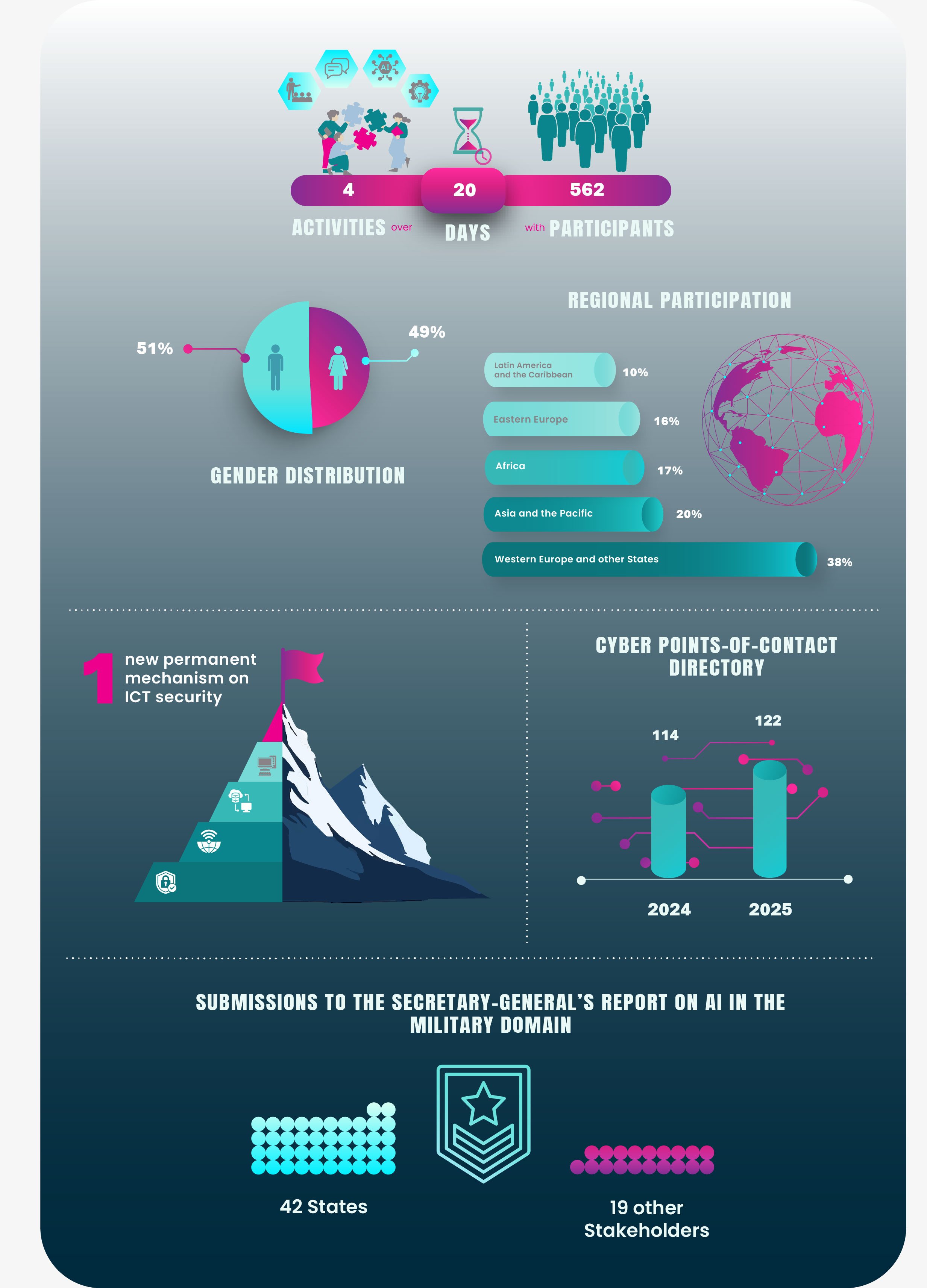
Emerging issues
Outer space
Open-ended Working Group on the Prevention of an Arms Race in Outer Space in All Its Aspects
In 2025, the Open-ended Working Group on the Prevention of an Arms Race in All Its Aspects commenced its work. The General Assembly had established the Working Group in 2024 by decision 79/512 for the period 2024–2028, replacing the working groups established by resolutions 78/20 and 78/238. Under that decision, the General Assembly tasked the new Open-ended Working Group with submitting recommendations on the prevention of an arms race in outer space in all its aspects and further decided that its discussions and recommendations would be informed by all relevant General Assembly resolutions on the topic, including resolutions 78/20 and 78/238.
Organizational session
The Open-ended Working Group held its organizational session on 6 and 7 February. In advance of the session, the Office for Disarmament Affairs carried out consultations with the main sponsors of decision 79/512 and resolutions 78/20 and 78/238 on the election of a Chair and other organizational modalities. On 31 January, the Secretariat issued a note verbale welcoming nominations of officers for the Open-ended Working Group. On 4 February, the Office for Disarmament Affairs received a note verbale from the Permanent Mission of the Argentine Republic to the International Organizations in Geneva nominating Carlos Foradori for the position of Chair.[2]
In accordance with normal practice, the Office for Disarmament Affairs opened the session and sought to carry out the election of the Chair. One delegation, however, was not in a position to proceed with the election based on the nomination received, pending instructions from its capital. The Office therefore conducted informal consultations on how to move forward, including on the possible election of Vice-Chairs. On 7 February, there was consensus on electing Carlos Foradori as Chair for 2025.
The organizational session subsequently adopted its provisional agenda and took up the matter of the draft agenda for its substantive sessions. The session discussed proposed amendments to the draft agenda. While many delegations expressed support for the draft as proposed by the Chair, the session was unable to adopt the agenda for the substantive meetings or proceed with its consideration of other organizational matters. The Chair carried out informal consultations, open to all Member States, on 4 and 6 March with a view towards reaching agreement on the agenda.
First session
The Working Group held its first session from 7 to 11 April. Despite the Chair’s efforts to arrive at the session with agreement in principle on the outstanding organizational matters, the session convened under a provisional agenda containing placeholders for the substantive elements. The Chair conducted most of the work of the session in informal meetings or closed consultations in various formats. By the evening of 10 April, agreement in principle had emerged among a group of States on a draft agenda. One delegation, however, insisted on also reaching agreement on a programme of work for all sessions of the Working Group through 2028 to support adoption of all outstanding organizational matters as a package. At the final meeting of the session, on 11 April, the Chair announced that there was no consensus on the adoption of the agenda and that he intended to conduct open-ended consultations during the intersessional period with a view to achieving agreement on the outstanding organizational matters by the start of the second session in July. Several States expressed their commitment to work towards agreement on those matters before the second session.
The Chair continued his bilateral consultations from the week following the first session. On 13 June, the Secretariat circulated a revision[3] of the indicative timetable, proposing sub-items and topics for the period 2025–2028. The Chair convened virtual informal consultations on 19 June to seek feedback from Member States. Based on those consultations, the Secretariat circulated a further revised indicative timetable[4] on 2 July. The Chair convened a further virtual informal consultation on 10 July and subsequently continued bilateral meetings. In advance of the third session, on 18 July, a third revised indicative timetable was circulated.[5]
Second session
The Working Group held its second session from 21 to 25 July. Discussions on the first day focused on the indicative timetable, and the Secretariat circulated a fourth revision[6] before the end of the day. On 22 July, the Working Group adopted its agenda (A/AC.297/2025/3) and indicative timetable (A/AC.297/2025/CRP.2/Rev.5) for the period 2025–2028 in a single decision.
The timetable included one substantive item: item 6, “Consider and make recommendations on the prevention of an arms race in outer space in all its aspects, including on substantial elements of a legally binding instrument or instruments and non-legally binding measures, inter alia, norms on the prevention of an arms race in outer space in all its aspects, including, inter alia, on prohibiting the placement of weapons in outer space and on addressing activities and behaviours with the aim of reducing space threats”.
The timetable provided for three subtopics under this item. Sub-item (a) addressed general considerations. Sub-item (b) included a specific focus on “substantial elements of a legally binding instrument or instruments”. Sub-item (c) was on “non-legally binding measures, inter alia, norms on the prevention of an arms race in outer space in all its aspects”. The timetable further provided for specific topics under each sub-item. The Working Group could consider the timetable at each session and agree by consensus to add to or adapt it.
The Working Group also agreed that requests by non-State entities to participate in its work would be approved on a non-objection basis for the entire duration of the Group’s sessions.
In accordance with its indicative timetable, the Working Group held its general exchange of views under agenda item 5. Member States described principles and objectives related to the prevention of an arms race in outer space in all its aspects. They discussed the benefits of various approaches, including those focused on capabilities, activities and behaviours, as well as on approaches focused on a legally binding instrument, non-legally binding measures or a combination of both.
The Open-ended Working Group then commenced its substantive work under agenda item 6, first discussing topic (i) under item 6 (a), on general considerations related to the evolving nature of outer space activities, threats and related capabilities. Many Member States noted that the number of threats in outer space had continued to rise. They attributed that development to a variety of factors, including the increasing number of objects in orbit; the increasing number of State and non-governmental entities launching and operating satellites, especially small satellites; increasing spending and dependence of militaries on outer space assets; and the continued significance of outer space for strategic security.
Member States proposed various characteristics and criteria for defining threats in the context of the Working Group’s mandate. These included as focuses the distinction between hazards and threats; conduct, intent and consequences; and kinetic and non-kinetic means, which might have reversible or irreversible effects or which might fall below the threshold for the use of force or an armed attack. Many States also affirmed the need to address all four vectors of threats: Earth-to-space, space-to-space, space-to-Earth and Earth-to-Earth.
Member States described various capabilities, activities and behaviours that could be regarded as threats, including the threat or use of force in or from outer space; the development, deployment and use of any kind of anti-satellite weapons; the placement of weapons in outer space; the development and deployment of nuclear weapons in outer space; the development and deployment of anti-missile systems in outer space; the development, testing or use of direct-ascent anti-satellite missiles; non-kinetic threats such as electronic warfare and cyberattacks; behaviours that undermine trust; and certain strategies, concepts and policies. Member States also discussed concerns raised by dual-use capabilities and activities, such as rendezvous and proximity operations, as well as the use of civilian and commercial infrastructure for military purposes.
The Open-ended Working Group then turned to topic (ii) under item 6 (a), on general considerations related to existing normative and legal framework, including measures related to the threat or use of force. Many States reaffirmed the applicability of international law to outer space, including the Charter of the United Nations, as provided in article III of the Outer Space Treaty (1967).[7]
In that regard, many States reaffirmed the relevance of the Outer Space Treaty and many of its provisions, including its articles I, II, III, IV, VI, VII and IX. Many States also reaffirmed the relevance of other outer space treaties, including the Rescue Agreement (1968),[8] the Liability Convention (1972),[9] the Registration Convention (1974)[10] and the Moon Agreement (1979).[11] Many States also reaffirmed the relevance of certain multilateral arms control treaties to which they are party, including the Partial Test Ban Treaty (1963)[12] and the Environmental Modification Convention (1976).[13] Several States also affirmed the applicability of other bodies of international law, including the law of State responsibility, the law of neutrality, the law of the sea, international telecommunications law and international environmental law.
States expressed various views on the applicability of international humanitarian law to outer space, including on the desirability of discussing that matter. Many States referred to various non-legally binding measures that they regarded as complementing and informing, but not replacing, the legal framework applicable to outer space. Examples included the Benefits Declaration (1996),[14] the 2013 report on transparency and confidence-building measures, the long-term sustainability guidelines, the debris mitigation guidelines, the Hague Code of Conduct against Ballistic Missile Proliferation and resolutions of the General Assembly.
Several States suggested areas for further examination, including the application of international law to emerging technologies, the application of Articles 2 (4) and 51 of the Charter of the United Nations, the application of article IX of the Outer Space Treaty, the further application of the Convention on Registration of Objects Launched into Outer Space, and the application of other bodies of international law, including the law of State responsibility and the law of neutrality.
The Open-ended Working Group also initiated consideration of topic (i) under item 6 (b), on a general exchange on all matters, including principles, objectives and preliminary elements, as well as on topic (i) under item 6 (c), on a general exchange on all matters, including principles and objectives. Under item 6 (b), a proposal was made for elements of the preamble of a possible future treaty on the prevention of an arms race in outer space, including on the prevention of the placement of weapons in outer space.
The Working Group also heard statements from intergovernmental organizations and other entities, in accordance with General Assembly decision 79/512.
In accordance with General Assembly decision 79/512, on 24 October, the Chair provided an update on the work of the Open-ended Working Group to the First Committee of the General Assembly.
Republic of Korea-United Nations Joint Conference on Disarmament and Non-Proliferation Issues
The Ministry of Foreign Affairs of the Republic of Korea and the United Nations Regional Centre for Peace and Disarmament in Asia and the Pacific co-hosted the twenty-fourth Republic of Korea-United Nations Joint Conference on Disarmament and Non-Proliferation Issues at United Nations Headquarters in New York on 4 and 5 December 2025. The conference addressed “The Evolution of Outer Space Security in an Era of Growing Insecurity”.
The High Representative for Disarmament Affairs, Izumi Nakamitsu, and the Deputy Permanent Representative of the Republic of Korea to the United Nations, Kim Sangjin, opened the conference and delivered introductory remarks. Carlos Foradori delivered a keynote speech in his capacity as Chair of the Open-ended Working Group on the Prevention of an Arms Race in Outer Space in All Its Aspects.
The first session addressed the growing significance of outer space in the volatile and complex security environment. Chaired by the United Nations Office for Disarmament Affairs, the session featured speakers from the European Union External Action Service, the Permanent Mission of Pakistan to the United Nations and the Secure World Foundation. The aim of the session was to take stock of the current security environment, highlighting the evolution of security concepts, doctrines and policies, as well as the growing significance of outer space in the context of space security, including its weaponization. Participants also examined the nexus between different weapon systems and space-based technologies and the role of such technologies in contemporary armed conflict.
The second session addressed the evolving threats to space systems and threat perceptions. Chaired by the British-American Scientific Information Council, the session featured speakers from the Ministry of Foreign Affairs of the Republic of Korea, the Permanent Mission of France to the United Nations and the Union of Concerned Scientists. The discussion addressed recent trends in evolving threats to space systems, focusing on capabilities designed for intentional acts of destruction, damage, disruption or interference; dual-use systems with similar potential; and operations and behaviours that could lead to misperceptions, misunderstanding, miscalculations or escalation. Its focus also included sources of threats across various vectors, as well as threat perceptions from militarily significant States and other emerging space actors, including non-governmental entities.
The third session addressed outer space and emerging technologies. Chaired by the United Nations Office for Disarmament Affairs, the session featured speakers from Astroscale Japan, Project Ploughshares and the United Nations Institute for Disarmament Research. Participants explored the intersection between outer space and rapidly advancing technologies, including potential dual-use capabilities and capabilities enabled by AI, quantum technologies and cybercapabilities. They also examined the opportunities such innovations offer to enhance the safety, efficiency and sustainability of space operations, as well as the potential risks they introduce to global stability and security.
The fourth session addressed strengthening the international governance of space. Chaired by the United Nations Regional Centre for Peace and Disarmament in Asia and the Pacific, the session featured speakers from the Permanent Mission of Costa Rica to the United Nations, the United Nations Office for Outer Space Affairs and the Institute of Air and Space Law at McGill University. Attendees focused on the current status and evolution of space governance, together with the opportunities and risks presented by that evolution. They also examined existing legal frameworks — including norms, rules and principles — and assessed requirements for ensuring that space governance keeps pace with emerging developments and challenges, including those identified in the Pact for the Future (General Assembly resolution 79/1). The session also addressed the roles of intergovernmental bodies, United Nations institutions, private actors and other stakeholders.
The fifth session addressed the future of outer space security in promoting peace, security and international cooperation. Chaired by the Chair of the Open-ended Working Group on the Prevention of an Arms Race in Outer Space in All Its Aspects, the session featured speakers from the Permanent Mission of Brazil to the Conference on Disarmament, the Permanent Mission of the United Kingdom of Great Britain and Northern Ireland to the United Nations and the Philippine Space Agency. Participants considered the future of outer space as a shared domain essential to global peace and sustainable development, including ways in which the international community could foster trust, transparency and cooperative mechanisms to prevent conflict and ensure that space remains a realm of peaceful use.
Information and communications technologies in the context of international security
In 2025, threats emanating from the use of information and communications technologies (ICTs), including those affecting international peace and security, remained significant. Convergence between ICTs and other advancing technologies, particularly AI, continued to transform the threat landscape rapidly, diversifying threats and increasing the speed, scale and impact of incidents.
Ransomware attacks surged in 2025, with a large proportion targeting critical infrastructure and critical information infrastructure.[15] Large-scale cryptocurrency thefts were noted in relation to the evasion of Security Council sanctions and non-proliferation regimes.[16] Supply-chain vulnerabilities were exploited by malicious actors, compromising data and disrupting manufacturing and retail sectors.[17]
At the United Nations, the Open-ended Working Group on Security of and in the Use of ICTs 2021–2025, chaired by Burhan Gafoor (Singapore), concluded its mandate with the consensus adoption of a final report (A/80/257) that, inter alia, established a permanent mechanism on ICT security matters to begin work in 2026. Throughout 2025, the Open-ended Working Group continued its steady progress, culminating in the conclusion of its mandate in July. It drew upon earlier achievements, including agreement on eight global confidence-building measures, the establishment of a global points of contact directory and common understandings of the ICT threat landscape.
The agreement by States to establish the Global Mechanism on Developments in the Field of ICTs in the Context of International Security and Advancing Responsible State Behaviour in the Use of ICTs represented a critical juncture after decades of work. Its establishment reflected the commitment of States to continue engaging on ICT security matters against the backdrop of escalating geopolitical tensions, proliferating ICT threats and actors, and the rapid development and adoption of new technologies, both within and outside conflict situations.
Throughout 2025, participation in the Global Intergovernmental Points of Contact Directory grew to 313 points of contact representing 121 Member States, supported by a dedicated capacity-building programme for points of contact. Building on guidance materials published in 2024, the Office for Disarmament Affairs hosted a simulation exercise for points of contact in March and published an e-learning course entitled “Capacities Required for Effective Participation in the ICT Security Points of Contact Directory” on the Disarmament Education Dashboard in December.
The Security Council continued to consider technology-related matters, including those involving ICTs. On 14 January, it held an Arria formula meeting on commercial spyware and the maintenance of international peace and security, convened by the United States and co-sponsored by Australia, Austria, Canada, Estonia, Finland, France, Japan, Latvia, Lithuania, the Kingdom of the Netherlands, Norway, Poland, the Republic of Korea, Sweden and the United Kingdom.
United Nations Working Group on Security of and in the Use of Information and Communications Technologies 2021–2025
The United Nations Open-ended Working Group on Security of and in the Use of Information Communications Technologies 2021–2025 convened its tenth and eleventh substantive sessions in February and July, respectively, concluding its mandate and with the consensus adoption of a final report (A/80/257). In that document, the Working Group endorsed and built upon its first (A/77/275), second (A/78/265) and third (A/79/214) progress reports and provided the finalized modalities for the Global Mechanism on Developments in the Field of Information Communications Technologies in the Context of International Security and Advancing Responsible State Behaviour in the Use of Information Communications Technologies. The Group had set out initial elements in annex C of its third annual progress report, including on guiding principles, functions and scope, structure, modalities and decision-making. In the final report, States reiterated a call to ensure a seamless transition to the new process.
Tenth substantive session
The tenth substantive session of the Open-ended Working Group was held from 17 to 21 February at United Nations Headquarters. States engaged on a range of issues within the remit of the Working Group’s programme of work, comprising six agenda items: existing and potential threats; rules, norms and principles; applicability of international law to the use of ICTs; confidence-building measures; capacity-building; and regular institutional dialogue. A dedicated stakeholder segment was also held, with interventions from 14 entities.[18]
In discussions on the evolving threat landscape, States expressed concern over malicious ICT activity conducted by non-State actors, as well as the rapid and widespread adoption of advancing technologies, such as AI, and their areas of convergence with ICTs. Several States acknowledged that the General Assembly had designated 2025 as the International Year of Quantum Science and Technology through resolution 78/287, and they reflected on the nexus between quantum technologies and ICTs, including implications for existing encryption methods. States noted the rising integration of AI in ICT-enabled activities, such as mis- and disinformation campaigns, and the potential of AI to substantially increase the scale and impact of such activities.
States also recognized the low barriers to entry for non-State actors engaging in malicious ICT activity and noted an increase in incidents involving ransomware and hacktivist groups. Several States expressed alarm over ICT incidents affecting critical infrastructure, including healthcare services and subsea cables. States variously emphasized the urgent need for cooperation and capacity-building to support resilience and workforce development. In that connection, a proposal for a United Nations voluntary fund for capacity-building was discussed.
States continued to engage in discussions on further strengthening the framework of responsible State behaviour in the use of ICTs, including by exchanging views on efforts to implement the existing norms of responsible State behaviour on potential gaps and on possible elaboration of additional norms and/or legally binding obligations.
On the matter of a future permanent mechanism on ICT security, States reaffirmed support for annex C of the third annual progress report (A/79/214), entitled “Elements for the Open-Ended Action-Oriented Permanent Mechanism on ICT Security in the context of international security”, and noted it would provide the basis for further discussions at the subsequent eleventh and final substantive session.
Eleventh substantive session
The eleventh and final substantive session of the Open-ended Working Group took place from 7 to 11 July at United Nations Headquarters. The programme of work was largely dedicated to textual negotiations on sequential drafts of the final report. The Chair circulated a zero draft on 23 May. States advanced various language proposals in group and national capacities on all chapters of the draft report, acknowledging the importance of reaching a balanced and consensual outcome.
In the agreed text of the final report (A/80/257), the Open-ended Working Group built upon its three prior annual progress reports.[19] In the area of existing and potential threats, States noted the growing risks posed by intersections between AI and ICTs, including from the use of large language models and generative models; the challenge of quantum computing to cryptography; and vulnerabilities in the Internet of things and cloud computing services. The Working Group emphasized the importance of protecting critical infrastructure and critical information infrastructure from malicious activity, highlighting in particular undersea cables and orbit communication networks, with States noting the potential for disruption to essential services with national, regional and global effects. Supply chain vulnerabilities, commercially available ICT intrusion capabilities and the growing number of non-State actors involved in malicious ICT activity were also noted as risks with potential implications for international peace and security.
In its final report, the Open-ended Working Group underscored the importance of the framework of responsible State behaviour in the use of ICTs, taking note of annex A of the third annual progress report (A/79/214), entitled “Voluntary Checklist of Practical Actions”. Regarding the applicability of international law, the final report reflected various exchanges on topics such as State responsibility and due diligence. The Working Group also noted action-oriented proposals advanced by States to deepen dialogue on international law, including by convening expert briefings, sharing national views and positions, undertaking capacity-building initiatives and considering possible gaps and the development of ICT-specific legally binding obligations.
Further to the establishment of the Global Intergovernmental Points of Contact Directory in May 2024, the Open-ended Working Group encouraged the participation of all States in the Directory, its further operationalization, development and practical measures, including simulation exercises for points of contact and consideration of communication modalities. A dedicated Global ICT Security Cooperation and Capacity-Building Portal was also requested, based on the structure set out in an initial report by the Office for Disarmament Affairs entitled “Initial Report outlining the proposal for the development and operationalization of a dedicated Global Information and Communications Technologies Security Cooperation and Capacity-Building Portal”, circulated on 4 February (A/AC.292/2025/2).
The Open-ended Working Group also agreed upon final elements concerning the structure and modalities of the future permanent mechanism. Its key elements included the following:
- A new single-track, State-led Global Mechanism on Developments in the Field of ICTs in the Context of International Security and Advancing Responsible State Behaviour in the use of ICTs, to begin work in 2026 with a two-day organizational session, followed by a one-week substantive plenary session and one week of dedicated working group sessions, which would report to plenary sessions with updates and recommendations
- A five-year cycle consisting of two biennial cycles followed by a one-year review cycle
- Substantive plenary sessions organized in accordance with the five pillars of the framework of responsible State behaviour.
States decided that the Global Mechanism would comprise the following dedicated thematic groups:
- An integrated, policy-oriented and cross-cutting dedicated thematic group drawing on the five pillars of the framework to address specific challenges in the sphere of ICT security in the context of international security to promote an open, secure, stable, accessible, peaceful and interoperable ICT environment with the participation of, inter alia, technical experts and other stakeholders.
- An integrated, policy-oriented and cross-cutting dedicated thematic group drawing on the five pillars of the framework to accelerate ICT security capacity-building with the participation of, inter alia, capacity-building experts, practitioners and other stakeholders.
- Additional ad hoc dedicated thematic groups with fixed durations and roundtable discussions that could be convened as necessary.
Additionally, the Open-ended Working Group set out elements for modalities on the participation of interested parties and stakeholders in the work of the Global Mechanism, including businesses, non-governmental organizations and academia.
To support broad and inclusive participation in the final session, the Office for Disarmament Affairs convened the second iteration of a delegate sponsorship programme[20] to support the attendance of capital-based experts, primarily from least developed, landlocked and small island developing States.[21] The sponsorship programme provided a tailored virtual and in-person programme of capacity-building sessions, including a practical workshop on navigating text-based negotiations, a dialogue on the agenda item concerning regular institutional dialogue and an interactive simulation exercise on implementation of the voluntary, non-binding norms of responsible State behaviour in cyberspace.
Global Intergovernmental Points of Contact Directory
In line with the establishment of the Global Intergovernmental Points of Contact Directory, a simulation exercise was convened on 10, 11, 17 and 18 March by the Office for Disarmament Affairs, United Nations Institute for Disarmament Research and the International Telecommunication Union. More than 130 points of contact representing 80 States registered for the exercise, which simulated uses of the Directory in response to a fictional ICT incident affecting multiple States.
United Nations-Singapore Cyber Fellowship
From 13 to 17 May, the Office for Disarmament Affairs and the Cybersecurity Agency of Singapore co-convened the United Nations-Singapore Cyber Fellowship, at the Association for Southeast Asian Nations-Singapore Cybersecurity Centre for Excellence in Singapore.
The Fellowship, established in 2022, held its sixth iteration in 2025, providing participants with a week-long interactive programme of substantive ICT security briefings, panels, practical site visits to national critical infrastructure sites, research laboratories and academic institutions, communications workshops and a simulated crisis communications exercise. As of 2025, 140 fellows representing 97 Member States had participated in the programme.
Building on past iterations, the programme was refined to address existing and emerging ICT security threats, incident management, the development of national strategies, and regional and multilateral cooperation. The sixth iteration of the Fellowship was attended by 22 senior government officials in policy, legal, diplomatic and technical roles, 13 of whom were women, representing 59 per cent.
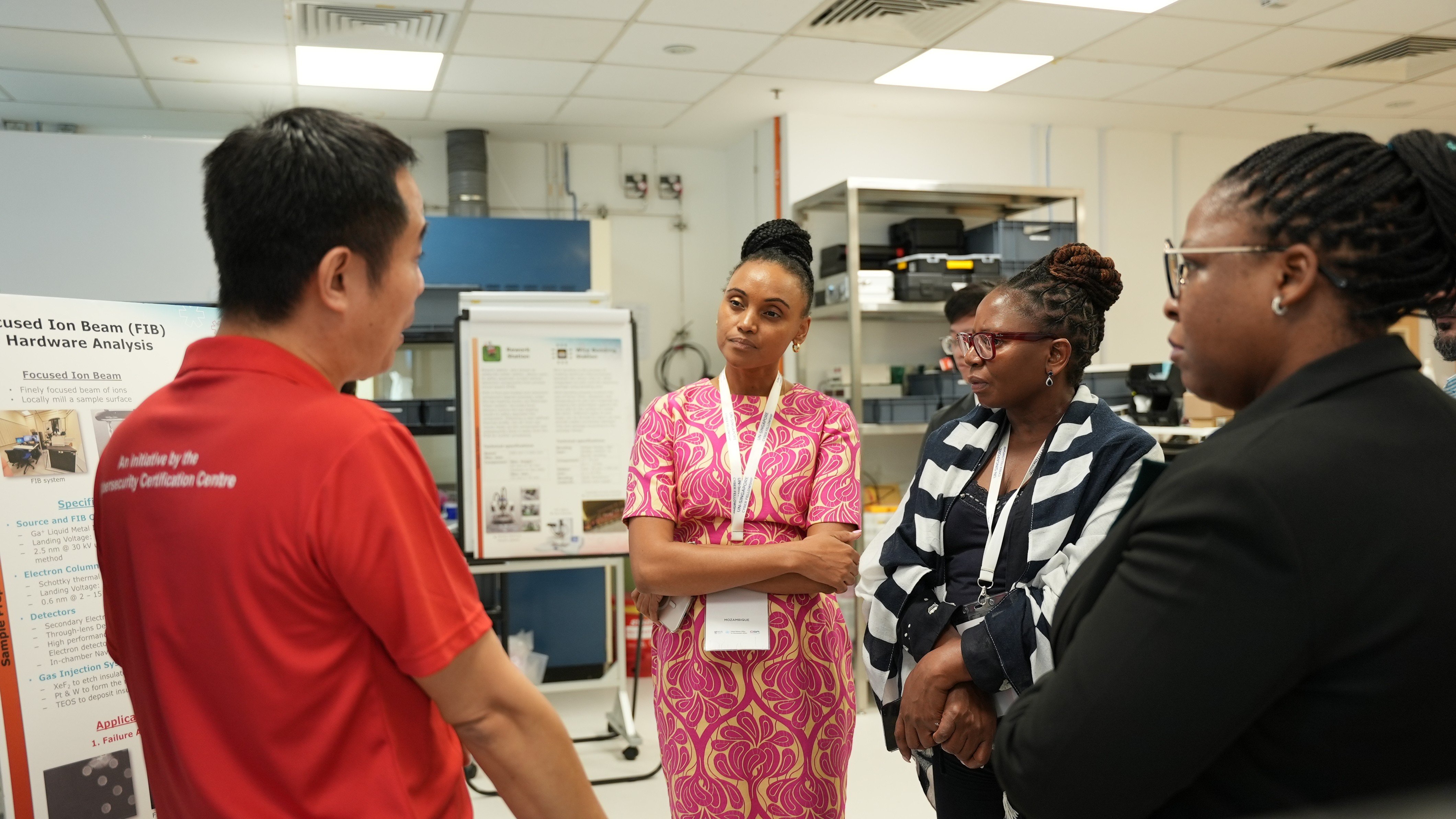
Participants of the UN-Singapore Cyber Fellowship engage in a technical briefing during a site visit in Singapore, exchanging knowledge and experiences to enhance cybersecurity capacity and international collaboration.
Developments in science and technology and their potential impact on international security and disarmament efforts
In 2025, the Office for Disarmament Affairs prepared the eighth edition of the report of the Secretary-General on current developments in science and technology and their potential impact on international security and disarmament efforts (A/80/237). In the report, the Secretary-General addressed scientific and technological developments in the following areas: (a) AI and autonomy; (b) uncrewed systems; (c) digital technologies; (d) biology and chemistry; (e) space and aerospace systems; (f) electromagnetic technologies; and (g) materials technologies. The eighth edition of the report also included a cross-sectional analysis on the international cooperation, including capacity-building.
In the report’s conclusions, the Secretary-General recommended that United Nations bodies and entities continue to encourage multi-stakeholder and geographically equitable engagement on those matters, including by industry and other private sector actors, through formal and informal platforms. Noting that Member States had hitherto focused on the impact of specific technologies on international peace and security, he also recommended that Member States identify multilateral forums to discuss synergies between technologies.
Lethal autonomous weapons systems
Convention on Certain Conventional Weapons
High Contracting Parties to the Convention on Certain Conventional Weapons took up the issue of lethal autonomous weapons systems within the framework of the Group of Governmental Experts on Emerging Technologies in the Area of Lethal Autonomous Weapons Systems for more information, see chap. 3).
Informal consultations
Further to its resolution 79/62, the General Assembly convened open informal consultations on lethal autonomous weapons systems at United Nations Headquarters on 12 and 13 May. The consultations were open to participation by representatives of Member States, observer States, and international and regional organizations, the International Committee of the Red Cross and civil society, including the scientific community and industry. Over the course of the two days, statements were made by representatives of 39 States and 15 non-governmental organizations.
The agenda followed the structure of the report of the Secretary-General on lethal autonomous weapons systems (A/79/88), with a particular focus on relevant aspects raised in the report that may thus far not have been discussed in detail in the Group of Governmental Experts on Emerging Technologies in the Area of Lethal Autonomous Weapons Systems. The high-level opening was addressed by the Secretary-General and the President of the International Committee of the Red Cross by pre-recorded video messages, as well as by the Chair of the General Assembly First Committee, among other speakers. Those remarks were followed by a briefing by the Chair of the Group of Governmental Experts; a presentation by the Office for Disarmament Affairs on the report of the Secretary-General; and dedicated discussions on each of the headings in section IV of that report, covering legal, humanitarian, security, technological and ethical considerations. States also had an opportunity to present on regional and global conferences and other initiatives related to lethal autonomous weapons systems. The closing session featured a statement by the Director and Deputy to the High Representative for Disarmament Affairs, in which he shared his summary and impressions of the informal consultations.
Missile-related issues
On 7 and 8 October, the International Institute for Strategic Studies held the sixth meeting of its Missile Dialogue Initiative in Berlin. The initiative was established in 2019 by the International Institute for Strategic Studies in partnership with Germany. Meeting participants discussed evolving challenges of missile technology and their implications for arms control, deterrence and strategic stability.
Armed uncrewed aerial vehicles
On 19 September, the Global Interagency Security Forum, the Office of the United Nations High Commissioner for Refugees (UNHCR), Insecurity Insight and the World Food Programme convened an event entitled “The Rise of Armed Drones: Impact on Humanitarian Operations and Security Risk Management” at the UNHCR headquarters in Geneva. Representatives of Member States, United Nations entities and civil society discussed the impact of armed uncrewed aerial vehicles on humanitarian operations and the protection of humanitarian personnel, strengthening security risk management to enable aid in the era of uncrewed aerial vehicles, and diplomatic engagement and collective advocacy.
Participants discussed how armed uncrewed aerial vehicles had impeded humanitarian operations in locations around the world. They noted that the “Declaration for the Protection of Humanitarian Personnel”, which was subsequently launched on the margins of the general debate of the General Assembly, contained commitments to ensuring respect for international humanitarian law and for allowing and facilitating full, safe, rapid and unhindered humanitarian access. Implementation of these commitments would also entail grappling with the threat posed to humanitarian action by armed uncrewed aerial vehicles.
Cross-cutting issues
Relationship between disarmament and development
In its annual resolution on the relationship between disarmament and development (80/25), the General Assembly once again underscored the importance of the mutually reinforcing link between the two areas. In that context, the Assembly reiterated its concern that rising global military expenditure was diverting resources that could otherwise be directed towards development needs.
In his annual report to the General Assembly on the disarmament-development nexus (A/80/125), the Secretary-General highlighted ongoing efforts across the United Nations system to further strengthen synergies in that area. On 17 March, the Presidents of the General Assembly and the Economic and Social Council jointly organized a landmark meeting, entitled “Small arms and light weapons control for preventing violence and advancing sustainable development”. The convening Presidents issued a summary of the meeting as its outcome, highlighting such recommendations as: implementing a “whole-of-government”, cross-sectoral and human-centred approach; pursuing efforts to integrate small arms and light weapons control measures into development strategies at the national and regional levels, as well as into broader human security and socioeconomic themes; supporting enhanced cooperation between the First and Second Committees of the General Assembly; recognizing the rising global costs of conflict and military expenditures as a critical issue; incorporating gender-responsive arms control policies within broader violence-prevention strategies, including the women, peace and security agenda; and engaging youth in arms control and disarmament initiatives.
Meanwhile, the Office for Disarmament Affairs and the United Nations Office on Drugs and Crime (UNODC) continued to collect and analyse data on weapons collected from illicit contexts and their status in accordance with indicator 16.4.2 of the 2030 Agenda for Sustainable Development. (For more information on data collection for target 16.4 of the Sustainable Development Goals, see chap. 3.)
For its part, the Office for Disarmament Affairs continued its efforts to integrate small-arms control into development processes and frameworks, thereby further strengthening the linkages between disarmament and development at the country level. The Office also maintained its financial support for arms control projects through the United Nations Trust Facility Supporting Cooperation on Arms Regulation (UNSCAR) and the Saving Lives Entity (SALIENT) funding facility. (For more information on UNSCAR and SALIENT, see chap. 3.)
Terrorism and disarmament
Work of the United Nations Global Counter-Terrorism Coordination Compact
Led by the United Nations Office of Counter-Terrorism, the United Nations Global Counter-Terrorism Coordination Compact (Counter-Terrorism Compact) maintained its efforts to enhance coordination and coherence across the United Nations system in support of Member States’ implementation of the United Nations Global Counter-Terrorism Strategy and relevant General Assembly and Security Council resolutions. One of the largest United Nations coordination frameworks, the Counter-Terrorism Compact held its eleventh Coordination Committee meeting in February, focusing on the commitment made in the 2024 Pact for the Future to enhance coordination with regional organizations, civil society and academia. Its first retreat, held in June 2025, further strengthened regional partnerships to support coordinated policy interventions and capacity-building under Action 23 (c) of the Pact for the Future.
The Counter-Terrorism Compact’s eight working groups convened 33 inter-agency meetings throughout the year, including regular quarterly meetings, as well as specialized thematic discussions. The gatherings enabled in-depth briefings on key issues, facilitated the exchange of best practices, and supported joint research initiatives, monitoring and evaluation efforts, resource mobilization and capacity-building activities. The working groups discussed critical security challenges, including countering the financing of terrorism, preventing terrorist travel, enhancing maritime and aviation security, and protecting vulnerable targets. They also examined terrorism-related threats associated with small arms and light weapons; uncrewed aircraft systems; chemical, biological, radiological and nuclear weapons; and emerging risks from technologies such as AI.
The Office of Counter-Terrorism continued to maintain the digital Counter-Terrorism Compact Coordination Platform, providing a virtual collaboration space for 1,050 focal points representing 46 Counter-Terrorism Compact entities, 139 Member States and 14 regional organizations to share information and coordinate activities.
The Working Group on Emerging Threats and Critical Infrastructure Protection held four quarterly meetings in 2025,[22] addressing a range of security challenges. Sessions focused on advancing chemical emergency response exercises in Africa, analysing the use of uncrewed aircraft systems by non-State armed groups and strengthening implementation of the Biological Weapons Convention.[23] The Working Group also tracked global cyberthreats and ICT incidents, while assessing vulnerabilities in air and maritime transportation.
Chaired by the International Criminal Police Organization (INTERPOL) with support from three Vice-Chairs, the Office for Disarmament Affairs, the United Nations Interregional Crime and Justice Research Institute (UNICRI) and the World Customs Organization (WCO), the Working Group explored thematic areas relating to countering weapons of mass destruction disinformation; chemical, biological, radiological and nuclear-related misinformation; biosecurity and rapid response coordination; dual-use research governance; biological risk mitigation; proliferation risks; chemical security; and the implications of AI for counter-terrorism and the protection of critical infrastructure. It underscored the need to enhance visibility of Counter-Terrorism Compact efforts through a system-wide calendar of events. Across its four quarterly meetings in 2025, the Working Group benefited from expert contributions by the Counter-Terrorism Compact entities, including the Office for Disarmament Affairs, UNICRI, the Office of Counter-Terrorism, the Organisation for the Prohibition of Chemical Weapons (OPCW), WCO and the World Health Organization (WHO), as well as the International Atomic Energy Agency (IAEA), the European Union and the National Research Council of Canada.
Meanwhile, the Working Group on Border Management and Law Enforcement relating to Counter-Terrorism focused on preventing terrorist access to weapons, vulnerabilities in aviation and customs, countering threats to vulnerable targets, regional strategies under the so-called Valletta Principles, maritime security and cybersecurity, and the use of AI and advanced technologies in border management and law enforcement.
Work of the United Nations Office of Counter-Terrorism and its Counter-Terrorism Centre
Throughout 2025, the Office of Counter-Terrorism continued its wide-ranging outreach and capacity-building initiatives across global, regional and national platforms, strengthening Member States’ capabilities to address the threats posed by terrorist acquisition and use of weapons. Operating through its United Nations Counter-Terrorism Centre and its multi-year programme “Countering Terrorist Use of Weapons”, the Office engaged with more than 800 officials representing over 100 Member States. Those efforts focused on countering terrorist access and use of both non-conventional and conventional weapons, including weapons of mass destruction; chemical, biological, radiological and nuclear materials; small arms and light weapons; improvised explosive devices; and uncrewed aircraft systems.
To combat chemical terrorism, the Office organized a national training course to enhance the capacities of Iraqi authorities on critical infrastructure and key resources protection, held in Amman from 28 to 31 July.
To counter radiological and nuclear terrorism, through the promotion of the universalization and effective implementation of the International Convention for the Suppression of Acts of Nuclear Terrorism, the Office delivered tailored technical capacity-building training courses to Cambodia, from 24 to 27 June, and Colombia, from 28 to 31 October, focusing on radiological and nuclear terrorism threats and countermeasures; the latter training course was delivered in partnership with the Organization of American States (OAS). Cambodia also gained increased awareness from an advocacy event to promote the Convention on 23 June. In addition, the Office brought together representatives from Kazakhstan, Kyrgyzstan and Uzbekistan in a regional tabletop exercise, delivered in partnership with UNICRI, on preventing the smuggling and use of radiological and nuclear material by terrorists in Central Asia, held from 10 to 12 December.
The Office of Counter-Terrorism, together with UNODC, also raised awareness on the International Convention for the Suppression of Acts of Nuclear Terrorism through a high-level event on preventing and suppressing nuclear terrorism while respecting human rights, held in Geneva on the margins of the fifty-eighth regular session of the Human Rights Council on 12 March. Additionally, on the margins of the IAEA General Conference in Vienna on 17 September, the Office of Counter-Terrorism and UNODC convened a high-level event marking 20 years since the adoption of the Convention and the Amendment to the Convention on the Physical Protection of Nuclear Material.
With respect to the terrorism-arms-crime nexus, the Office of Counter-Terrorism and UNODC delivered seminars for Kazakhstan on 29 and 30 May, for Kyrgyzstan on 26 and 27 May, and for Turkmenistan on 22 and 23 September, focusing on best practices and information exchange on addressing trafficking in and diversion of small arms and light weapons to terrorists. The Office also partnered with UNODC to deliver national training on the collection and use of specific evidence in small arms and light weapons trafficking and terrorism cases for Turkmenistan from 9 to 12 September, for Kyrgyzstan from 6 to 9 October, and for Tajikistan from 14 to 18 October. A regional meeting bringing together all five Central Asian Member States was held on 18 November to present the results of the training project and advance its legacy.
The Office joined the Counter-Terrorism Preparedness Network to co-organize an event in London on 16 July to commemorate the twentieth anniversary of the terrorist attacks there. It also launched a project on supporting Eastern Africa in countering terrorist use of improvised explosive devices on 11 September, together with the Counter-Terrorism Committee Executive Directorate and the United Nations Mine Action Service.
In accordance with Security Council resolution 2370 (2017), the Office conducted capacity consultations on terrorist acquisition and use of small arms and light weapons, improvised explosive devices and uncrewed aerial systems, held in Turkmenistan from 4 to 6 November and in Uzbekistan from 26 to 28 November. The consultations were conducted in cooperation with the Counter-Terrorism Committee Executive Directorate and the United Nations Institute for Disarmament Research (UNIDIR).
Those initiatives were facilitated through extensive collaboration with regional and international partners, including the Counter-Terrorism Committee Executive Directorate, the Counter-Terrorism Preparedness Network, the European Union, the IAEA, INTERPOL, OAS, OPCW, UNICRI, UNIDIR, the United Nations Mine Action Service, UNODC, the Office for Disarmament Affairs and WHO, reinforcing coordinated global responses to evolving terrorist weapon threats.
Work of the United Nations Office on Drugs and Crime on the prevention and suppression of chemical, biological, radiological and nuclear terrorism
Throughout 2025, UNODC sustained its efforts to advance adherence to and robust implementation of international legal instruments targeting chemical, biological, radiological and nuclear terrorism, operating under its established mandate (78/226).[24]
UNODC provided legislative guidance to five States, helping them strengthen their counter-terrorism legislation and regulatory frameworks to align with international standards against chemical, biological, radiological and nuclear terrorism. That assistance included incorporating obligations from the International Convention for the Suppression of Acts of Nuclear Terrorism into national legislation.
The Office continued its virtual speaker series examining the International Convention for the Suppression of Acts of Nuclear Terrorism, addressing key elements of the Convention and challenges related to nuclear terrorism.[25] The January session focused on the importance of promoting gender perspectives in nuclear security and nuclear terrorism prevention, particularly in the context of the Convention. In addition, UNODC continued a webinar series on the Convention,[26] with a March session on the national experience of Tajikistan in adhering to and effectively implementing the Convention. Led by national and international specialists, those virtual programmes reached participants worldwide and strengthened their comprehension of the international legal framework.
To underscore the importance of integrating respect for human rights into efforts to counter terrorism, including nuclear terrorism, UNODC co-organized a hybrid high-level side event on the margins of the fifty-eighth session of the Human Rights Council in Geneva on 12 March. Organized with the Office of Counter-Terrorism and the Office of the United Nations High Commissioner for Human Rights, the side event featured the participation of Ben Saul, the Special Rapporteur on the promotion and protection of human rights and fundamental freedoms while countering terrorism.[27]
To raise awareness among key decision makers about the importance of the International Convention for the Suppression of Acts of Nuclear Terrorism, UNODC, in cooperation with the United States, held a high-level seminar for Vienna-based diplomats on 11 April.
In September, on the margins of the sixty-ninth regular session of the IAEA General Conference, held in Vienna, UNODC partnered with the IAEA, the Office of Counter-Terrorism and Morocco to co-organize a high-level side event commemorating the twentieth anniversary of the adoption of the Amendment to the Convention on the Physical Protection of Nuclear Material and the International Convention for the Suppression of Acts of Nuclear Terrorism.
UNODC also worked to enhance criminal justice capabilities among States parties to the International Convention for the Suppression of Acts of Nuclear Terrorism, supporting their ability to investigate, prosecute and adjudicate nuclear and radiological crimes through regional criminal investigation and mock trial exercises. Those activities included training courses for selected States in South-East Asia, held in Thailand on 27 and 28 February, and for selected English-speaking African countries, held in Kenya from 14 to 16 October.[28]
To further pursue the Convention’s universalization and robust implementation, UNODC conducted an online regional workshop for Caribbean Community countries on 24 November.[29] The Office also conducted, in cooperation with UNICRI, national seminars on the Convention as part of its training series for judicial and prosecutorial training centres of States parties, including sessions for Thailand on 24 and 25 February; for Ukraine on 27 and 28 February; for the United Arab Emirates on 28 November; and for the Western Balkans on 7 November.[30]
Recognizing the importance of empowering youth and ensuring their active participation in advancing peace and security, the Office continued its programme designed to cultivate future leaders to champion the Convention in their home countries. UNODC held the second Universalization Youth Academy for the Convention in Vienna from 7 to 10 July and a reunion for the first class on 12 May.[31]
To enhance international cooperation and information exchange for detecting, preventing, suppressing and investigating offences outlined in article 2 of the Convention, UNODC continued its campaign encouraging States parties that had not yet designated their competent authorities and liaison points for information transmission and receipt under article 7, paragraph 4, of the Convention to do so. It also extended the campaign to invite States that had previously provided information to update or confirm it.[32] Since the start of the campaign, UNODC had received 34 new notifications and 13 updated designations, bringing the total number of States parties with designated national contact points to 58.
UNODC also raised awareness about its existing technical assistance resources for incorporating requirements of the International Convention for the Suppression of Acts of Nuclear Terrorism into domestic legislation. Those materials were accessible on the Office’s continuously updated Convention website (www.unodc.org/icsant) in all six United Nations official languages, with some also available in Portuguese. The Office also maintained its e-learning modules on the international legal framework against chemical, biological, radiological and nuclear terrorism, which nearly 3,400 practitioners from 137 States had completed since its 2019 launch, and on the Convention, completed by more than 1,700 practitioners from 145 States since its 2022 launch. The modules were available in all United Nations official languages and Portuguese.
UNODC maintained broad cooperation with United Nations entities, international and regional organizations, civil society and academic institutions to strengthen implementation of the international legal framework against chemical, biological, radiological and nuclear terrorism. Its engagements included support for Office for Disarmament Affairs activities related to resolution 1540 (2004), cooperation with OPCW, INTERPOL, the Office of Counter-Terrorism and the European Union, as well as participation in events of Parliamentarians for Global Action, the Women in Nuclear Law Initiative and academic institutions.
Contribution of the International Atomic Energy Agency to global anti-terrorism efforts
IAEA maintains a central role in strengthening the global nuclear security framework and coordinating international nuclear security activities while preventing duplication and overlap of efforts. Nuclear security encompasses the prevention, detection of and response to criminal or intentional unauthorized acts involving or directed at nuclear material, other radioactive material, associated facilities or associated activities. Responsibility for nuclear security within a State rests entirely with that State, in accordance with its respective national and international obligations.
The IAEA continued to assist States, upon request, in their domestic efforts to establish and continuously maintain effective and comprehensive nuclear security for all nuclear and other radioactive material. It supported States in establishing effective and sustainable national nuclear security regimes and, where appropriate, in fulfilling their obligations under instruments such as the Convention on the Physical Protection of Nuclear Material and its Amendment, as well as relevant Security Council resolutions, including resolution 1540 (2004). The Convention and its Amendment are the principal binding international instruments relevant to nuclear security.
The Convention on the Physical Protection of Nuclear Material establishes legal obligations for Parties regarding the physical protection of nuclear material used for peaceful purposes during international transport; the criminalization of certain offences involving nuclear material; and international cooperation, for example, in the case of theft, robbery or any other unlawful taking of nuclear material or credible threat thereof.
The Amendment to the Convention significantly strengthens the original instrument in several important ways. It extends the scope of the original treaty to cover physical protection of nuclear facilities and nuclear material used for peaceful purposes in domestic use, storage and transport. It also further criminalizes offences related to illicit trafficking and sabotage of nuclear material or nuclear facilities and provides for strengthened international cooperation considering the expanded scope, such as assistance and information-sharing in the event of sabotage.
The entry into force of the Convention in 1987 and its Amendment in May 2016 were crucial milestones in the development of the international legal framework for nuclear security, as they remain the only internationally legally binding undertakings in the area of physical protection of nuclear material and of nuclear facilities used for peaceful purposes. The Convention, as strengthened by its Amendment, is relevant for all States, not only those with nuclear facilities or nuclear materials. In its role as depositary of the Convention and its Amendment, the IAEA, under the direction of its Director General, began preparations for a Conference of the Parties to the Amendment to be held in April 2027. That Conference would be the second of its kind, following a request from the requisite number of parties for a follow-on Conference during the first such Conference, held in 2022.
Implementation of Security Council resolution 1540 (2004)
In 2025, the Security Council Committee established pursuant to resolution 1540 (2004)[33] (1540 Committee) was chaired by Eloy Alfaro de Alba from 29 May to 31 December. The Committee discussed and started working towards adopting its programme of work for 2026–2027. Over the course of the year, the Committee held five formal meetings. The Office for Disarmament Affairs, the Department of Political and Peacebuilding Affairs and the 1540 Committee’s Group of Experts continued to support the work of the Committee.
In 2025, the 1540 Committee began discussions on the 2027 Comprehensive Review of the implementation of resolution 1540 (2004). As part of that process, the Committee adopted a modalities paper to serve as the framework for conducting the Review. That work was undertaken pursuant to paragraph 3 of resolution 2663 (2022), by which the Security Council decided that the 1540 Committee would conduct comprehensive reviews on the status of implementation of resolution 1540 (2004), both after five years and before the renewal of its mandate.
National implementation
By paragraph 4 of resolution 1540 (2004), the Security Council mandated States to submit a first report on the steps they had taken or intended to take to implement the resolution. By the end of 2025, 185 of the 193 Member States had submitted their first report, while eight States had yet to do so.[34] Moreover, 124 Member States had submitted at least one additional report. As of the end of the year, Member States had submitted a total of 541 first and additional national reports on steps taken to implement resolution 1540 (2004).
In 2025, Kyrgyzstan, the Lao People’s Democratic Republic and Türkiye submitted additional information on their implementation efforts to the Committee. In resolution 1977 (2011) and its successors,[35] the Security Council encouraged States to provide additional information on their implementation efforts, including, voluntarily, on their laws and regulations and on States’ effective practices.
The Security Council encouraged States, in resolution 1977 (2011) and subsequent resolutions, to voluntarily prepare national action plans to map out their priorities and plans for implementing key provisions of resolution 1540 (2004). To that end, the Office for Disarmament Affairs organized workshops in Nigeria and Cambodia, held on 7 and 8 April and from 23 to 25 April, respectively, to enhance awareness about the resolution’s objectives, review the status of national implementation, identify areas requiring improvement, and establish priorities and targets for an action plan. The Office also collaborated with the Inter-American Committee against Terrorism of the Organization of American States in support of a workshop on the national action plan of Costa Rica, held in San José on 21 and 22 August, and a workshop on the update of Panama’s national action plan, held in Panama City on 15 and 16 September.
The Office for Disarmament Affairs also organized a national workshop in Malawi in support of the country’s ongoing efforts to achieve the full and effective implementation of resolution 1540 (2004). The aim of the event was to raise awareness of the State’s obligations. In addition, Botswana and South Africa, with support from the Office, conducted a peer-exchange exercise on implementing the resolution and strengthening export controls, held in Pretoria from 4 to 6 November. This exercise represented the first peer exchange of its kind in the African region.
From 25 to 27 February, the Office of Disarmament Affairs, in collaboration with India, supported a capacity-building programme on the implementation of resolution 1540 (2004) and strategic trade controls for Asia-Pacific States, held in Palasamudram, India. The programme aimed to strengthen regional implementation of the resolution and enhance national export control regimes.
To facilitate dialogue with the 1540 Committee on implementing resolution 1540 (2004), States are encouraged to submit up-to-date information on national points of contact, preferably both in their capitals and at their respective permanent missions in New York. In 2025, responding to renewed calls from the 1540 Committee and regular outreach by the Office for Disarmament Affairs’ 1540 Africa and Asia regional coordinators, one Member State designated its 1540 points of contact for the first time. In total, 22 States[36] named or provided updates regarding their points of contact, bringing the total number of States with designated points of contact for resolution 1540 (2004) to 156.
In its resolution 2325 (2016), the Security Council encouraged the Committee to enhance the capacity of national points of contact for resolution 1540 (2004), particularly by organizing regional training courses to support States in implementing the resolution. In 2025, the Office for Disarmament Affairs, in cooperation with the 1540 Committee, organized a 1540 point of contact training course for Latin America and the Caribbean, held in Panama City from 15 to 17 December and co-hosted by Panama. The training course strengthened participants’ understanding of the scope and obligations of resolution 1540 (2004), while providing a platform for participating States to share national experiences, particularly regarding the role of points of contact. International organizations attending the course also shared effective practices to foster coordinated implementation of resolution 1540 (2004) and related multilateral instruments, including strategies for efficiently channelling and coordinating international assistance.
In 2025, the 1540 Committee approved its first voluntary technical reference guide and made it available through the Committee’s website. The guide supports States in implementing resolution 1540 (2004), specifically operative paragraph 3 (d), which addresses the obligation to establish, develop, review and maintain effective national export control systems. The development of the guide was in line with paragraph 13 of resolution 2663 (2022), in which the Security Council encouraged the Committee to provide practical and voluntary technical tools to assist States in their implementation efforts.
Assistance
In 2025, Benin, Guatemala and Timor-Leste submitted new assistance requests to the 1540 Committee. Two additional requests relating to existing assistance requests were submitted to the Committee for assistance in drafting a voluntary national implementation action plan or updating a national report on the implementation of resolution 1540 (2004). In its resolution 2663 (2022), the Security Council reiterated that many Member States still required assistance in implementing resolution 1540 (2004) and emphasized the importance of improving the 1540 Committee’s matchmaking mechanism to ensure effective, timely and tailored assistance.
Cooperation with international, regional and subregional organizations
In resolution 1540 (2004) and its successors,[37] the Security Council recognized the need to enhance the coordination of efforts at national, subregional, regional and international levels to strengthen a global response to the threat from non-State actors. The Council also recognized the vital role of international, regional and subregional organizations, including United Nations bodies, in supporting Member States’ implementation of resolution 1540 (2004).
The Office for Disarmament Affairs sustained its engagement with States and other stakeholders throughout the year. It regularly invited representatives of governments and international, regional and subregional organizations providing 1540-related assistance in Africa, Asia, and Latin America and the Caribbean to collaborative engagements to showcase their support efforts and identify new cooperation opportunities.
The Office for Disarmament Affairs also continued to strengthen coordination among United Nations entities and key stakeholders through dedicated inter-entity cooperation. Back-to-back with the open briefing of the 1540 Committee, the Office for Disarmament Affairs organized an inter-entity meeting on programme support and coordination for the implementation of resolution 1540 (2004), held on 30 and 31 October, to discuss enhancing coordination and synergy in programme delivery amid financial constraints and a rapidly evolving technological environment.
The 1540 Committee continued its cooperation with the Security Council Committee established pursuant to resolutions 1267 (1999), 1989 (2011) and 2253 (2015) concerning Islamic State in Iraq and the Levant (Da’esh), Al-Qaida and associated individuals, groups, undertakings and entities. In November, the three Committees delivered a joint briefing to the Security Council, demonstrating their continued cooperation within their respective mandates (S/PV.10049).
Transparency and outreach
On 29 October, the Committee held an open briefing (Part 1 and Part 2) to provide an overview of its activities across all aspects of resolution 1540 (2004), with particular attention to assistance-related matters, in line with operative paragraph 26 of resolution 2663 (2022). The session brought together Member States and international, regional and subregional organizations, providing a platform for showcasing assistance offers and enabling national delegations to share insights, lessons learned and best practices.
In its resolution 2663 (2022), the Security Council encouraged the Committee to develop, in agreement with the relevant Member States and with the assistance of its Group of Experts, a multi-year programme of outreach to States. The Committee developed and approved the Multi-year Programme of Outreach to States, which was posted on the Committee’s website.
The Office for Disarmament Affairs continued its academic outreach initiatives during the year.[38] Under the Erlangen Initiative, the Office and the Government of Germany co-organized two conferences aimed at raising awareness within the scientific and academic community about the risks associated with the misuse of scientific and technological developments and fostering dialogue between government regulators and academia on effective means to control intangible technology transfers. In that context, the second regional conference under the initiative was held for South-East Asian States in Manila on 14 November, followed by the third global conference in Munich, Germany, on 26 and 27 November.
In addition, recalling Security Council resolutions 2325 (2016) and resolution 2663 (2022), which stressed the role of science and technology in the implementation of resolution 1540 (2004), the 1540 TechHorizon initiative was inaugurated through a workshop convened on 18 September in London by the University of Warwick in partnership with the Office for Disarmament Affairs. At the workshop, which was attended by a consortium of United Kingdom-based academics, participants discussed how emerging technologies presented both risks and opportunities for preventing the proliferation of weapons of mass destruction to and by non-State actors. They also underscored the value of interdisciplinary academic collaboration in supporting capacity-building, responsible technology governance and the effective implementation of resolution 1540 (2004).
The Office for Disarmament Affairs also updated the online training course on resolution 1540 (2004) to reflect developments including the adoption of Security Council resolution 2663 (2022) and the outcomes of the 2022 Comprehensive Review. All six modules provided an updated overview of the status of, and progress achieved in, the implementation of resolution 1540 (2004).
On 28 November, the Office for Disarmament Affairs co-organized with the Vienna Center for Disarmament and Non-Proliferation and the Permanent Mission of Türkiye to the United Nations in Vienna a panel event in Vienna on the educational and capacity-building impact of resolution 1540 (2004).
Throughout 2025, the 1540 Committee, including through its Chair and Group of Experts, participated in 26 outreach events organized by States, international and regional organizations, and civil society organizations. The activities supported transparency and fostered greater cooperation and awareness among States, parliamentarians, relevant organizations and civil society regarding resolution 1540 (2004) obligations and their implementation.
With support from the Office for Disarmament Affairs, the Committee completed a comprehensive update of the website (www.un.org/en/sc/1540) in all six United Nations official languages. In addition to updating substantive content, the revision provided a streamlined navigation approach and organized the site’s structure in line with the Committee’s programme of work. With support from the Office, the site continued to serve as both a public awareness tool and a key information source on resolution 1540 (2004).
The Office for Disarmament Affairs also launched a periodical, “1540er”, in 2025. The publication provides quarterly updates on key developments related to the Office’s support for resolution 1540 (2004). It also highlights practitioners working to implement the resolution, or “1540ers”, and their experiences and lessons learned.
Footnotes
-
[1]
Convention on Prohibitions or Restrictions on the Use of Certain Conventional Weapons Which May Be Deemed to Be Excessively Injurious or to Have Indiscriminate Effects.
↩ -
[2]
On 30 January, the Conference on Disarmament decided (CD/2443), inter alia, to reappoint Carlos Foradori as the Coordinator of Subsidiary Body 3 on the prevention of an arms race in outer space.
↩ -
[3]
A/AC.297/2025/CRP.2/Rev.1.
↩ -
[4]
A/AC.297/2025/CRP.2/Rev.2.
↩ -
[5]
A/AC.297/2025/CRP.2/Rev.3.
↩ -
[6]
A/AC.297/2025/CRP.2/Rev.4.
↩ -
[7]
Treaty on Principles Governing the Activities of States in the Exploration and Use of Outer Space, including the Moon and Other Celestial Bodies.
↩ -
[8]
Agreement on the Rescue of Astronauts, the Return of Astronauts and the Return of Objects Launched into Outer Space.
↩ -
[9]
Convention on International Liability for Damage Caused by Space Objects.
↩ -
[10]
Convention on Registration of Objects Launched into Outer Space.
↩ -
[11]
Agreement Governing the Activities of States on the Moon and Other Celestial Bodies.
↩ -
[12]
Treaty Banning Nuclear Weapon Tests in the Atmosphere, in Outer Space and under Water.
↩ -
[13]
Convention on the Prohibition of Military or Any Other Hostile Use of Environmental Modification Techniques.
↩ -
[14]
Declaration on International Cooperation in the Exploration and Use of Outer Space for the Benefit and in the Interest of All States, Taking into Particular Account the Needs of Developing Countries.
↩ -
[15]
Microsoft Digital Defense Report 2025, Microsoft, October 2025.
↩ -
[16]
Targeted Update on the Implementation of FATF Standards on Virtual Assets and Virtual Asset Service Providers, Financial Action Task Force, June 2025.
↩ -
[17]
IBM X-Force 2025 Threat Intelligence Index, IBM Institute for Business Value and Red Hat, April 2025.
↩ -
[18]
European Union Institute for Security Studies, Hitachi America, Academia Méxicana de Cyberseguridad y Derecho Digital, Women in Cybersecurity Middle East, Centre of Excellence for National Security RSIS, German Council on Foreign Relations, Centre for Humanitarian dialogue, CREST (International), Access Now, Write Pilot, Youth for Privacy, Global Cyber Alliance, Center for International Law, National University of Singapore, Red en Defensa de los Derechos Digitales.
↩ -
[19]
A/77/275, A/78/265 and A/79/214.
↩ -
[20]
The delegate sponsorship programme was implemented with the support of France and Ireland.
↩ -
[21]
Participants included delegates of Cambodia, Costa Rica, Fiji, Kazakhstan, Kenya, Mauritius, Mexico, Thailand and Türkiye.
↩ -
[22]
27 February, 5 June, 16 October and 17 December.
↩ -
[23]
Convention on the Prohibition of the Development, Production and Stockpiling of Bacteriological (Biological) and Toxin Weapons and on Their Destruction.
↩ -
[24]
The legislative and technical support was delivered through initiatives implemented with the support of Canada, the United States and the European Union.
↩ -
[25]
The virtual speaker series was implemented with the support of Canada.
↩ -
[26]
The webinar series was implemented with the support of the European Union.
↩ -
[27]
The high-level side event was implemented with the support of the European Union.
↩ -
[28]
The sessions were implemented with the support of Canada.
↩ -
[29]
The workshop was implemented with the support of Canada.
↩ -
[30]
The seminars were implemented with the support of the European Union.
↩ -
[31]
The programme was implemented with the support of Canada.
↩ -
[32]
The campaign was implemented with the support of the European Union.
↩ -
[33]
In resolution 1540 (2004), the Security Council decided that all States shall refrain from providing any form of support to non-State actors that attempt to develop, acquire, manufacture, possess, transport, transfer or use nuclear, chemical or biological weapons and their means of delivery, in particular for terrorist purposes. The Council required all States to adopt and enforce appropriate laws, as well as other effective measures, in that regard.
↩ -
[34]
Chad, Democratic People’s Republic of Korea, Eswatini, Gambia, Guinea, Mali, Mauritania and Somalia.
↩ -
[35]
Resolutions 2325 (2016) and 2663 (2022).
↩ -
[36]
Antigua and Barbuda, Bahrain, China, Colombia, El Salvador, Greece, Guatemala, Ireland, Kyrgyz Republic, Lao People’s Democratic Republic, Latvia, Nepal, Nigeria, Qatar, Republic of Korea, Singapore, Slovenia, Thailand, Türkiye, United Kingdom of Great Britain and Northern Ireland, Uruguay and the United States of America.
↩ -
[37]
Resolutions 1673 (2006), 1810 (2008), 1977 (2011), 2325 (2016) and 2663 (2022).
↩ -
[38]
In resolution 1540 (2004), the Security Council calls upon States to develop appropriate ways to work with and inform industry and the public regarding their obligations under national laws and regulations adopted pursuant to the resolution and the key multilateral non-proliferation treaties. Furthermore, in resolution 2663 (2022), the Council calls upon States to take into account developments on the evolving nature of the risk of proliferation and rapid advances in science and technology in their implementation of resolution 1540 (2004).
↩